
On April 17, VFS Brazil Replaced the Postal System With Facial Recognition. One Missing Apostille, One Expired Certidão, One Misclassified PJ Income — and Your Case Is Closed With No Second Submission.
You have the income. You speak the language. You know that Brazil's CPLP membership gives you advantages no other nationality has — a shorter citizenship timeline, the PB4 healthcare agreement, the Estatuto de Igualdade that grants you the same civil rights as a Portuguese citizen. You have done the research. You are ready to move.
What you are not ready for is what changed on April 17, 2026.
The Portuguese consulate in Brazil no longer accepts postal applications. Every D7 and D8 applicant must now appear in person at one of ten VFS Global centers — São Paulo, Rio de Janeiro, Brasília, Belo Horizonte, Porto Alegre, Curitiba, Salvador, Recife, Fortaleza, or Belém — with a facial recognition scan that cannot be rescheduled if it fails. The old system let you mail documents and fix mistakes by correspondence. The new system gives you one appointment. If a document is missing, expired, or incorrectly apostilled, you have five days to correct it — or your case is closed and your fees are forfeited. Five days. To get a new certidão, a new apostille, and a new cartório stamp. Anyone who has dealt with a Brazilian cartório knows what five days buys you.
The YouTube videos walking you through the process were filmed before April 17. The Reddit threads are from 2024, when you could still mail your dossier. The law firm blogs explain the D7 and D8 requirements but not the apostille timing trap that causes more Brazilian rejections than any missing document — because a Certidão de Antecedentes Criminais expires in 90 days, and if your VFS appointment is four months out, the clearance you ordered today will be void before you sit down.
And behind the VFS appointment sits a deeper problem that most Brazilian applicants discover too late: choosing the wrong visa. If you earn through a PJ structure — MEI, ME, or Sociedade Limitada Unipessoal — you sit in the gray zone between D7 and D8. The consulate's classification depends on whether your income is "active labor" (pró-labore) or "profit distribution" (distribuição de lucros). Get it wrong, and your application is rejected regardless of how much you earn or how perfectly your documents are prepared.
The Brazil → Portugal D7/D8 Visa Guide is the D7/D8 Decision Engine — built for the specific challenge Brazilian applicants face in 2026: navigating the VFS facial recognition system, coordinating cartório apostille timing with appointment availability, mapping PJ income to the correct visa category, and building an application that survives the five-day correction window. This is not a translation of the AIMA website. This is the integrated system covering the D7 vs D8 decision framework with a 5-year fiscal simulation for PJ holders, the cartório-to-VFS document timing chain, the DECORE and Nota Fiscal evidence architecture for digital nomads, the INSS pension documentation strategy for retirees, the IFICI tax analysis, the PB4 healthcare setup, the Saída Definitiva do Brasil decision, the AIMA backlog survival manual, and the 7-year CPLP citizenship pathway.
What's Inside the D7/D8 Decision Engine
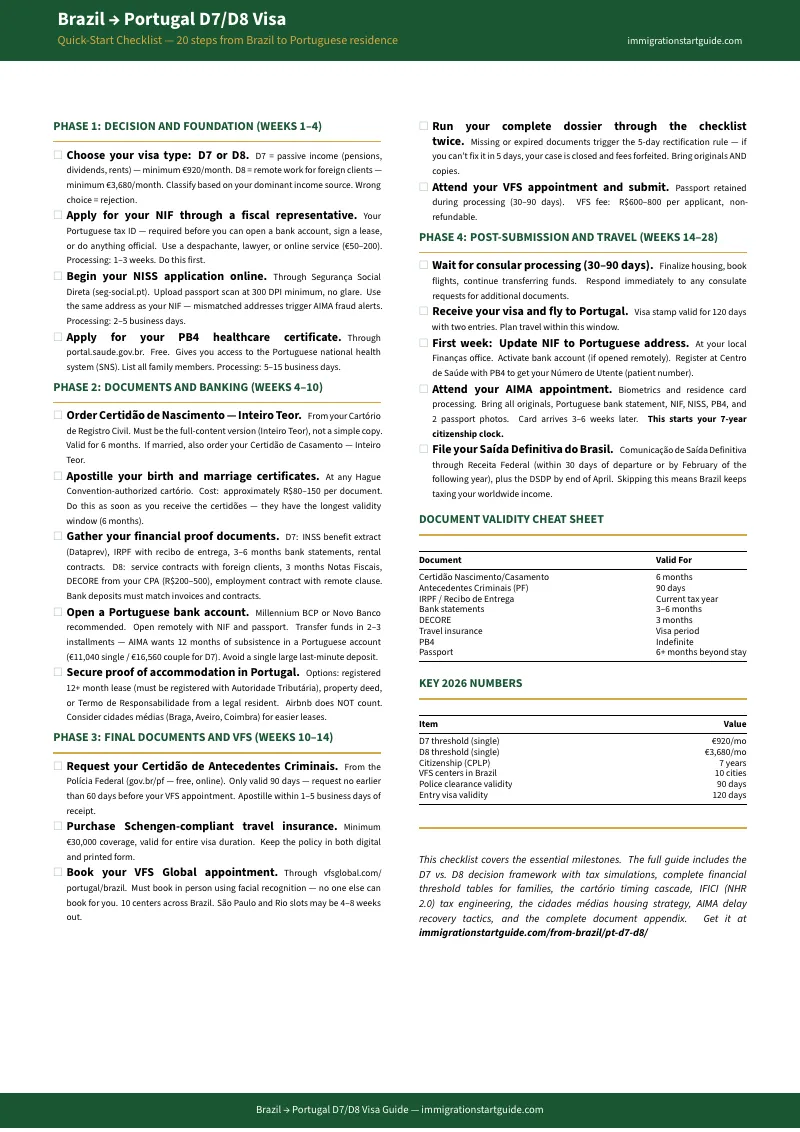
The complete 68-page guide, a quick-start checklist, and 9 standalone printable tools — 11 PDFs covering every step from visa selection through Portuguese citizenship:
The D7 vs D8 Decision Framework with 5-Year Fiscal Simulation
This is the single most consequential decision in the entire process — and for Brazilians with PJ income, no free resource answers it correctly. The D7 requires €920 per month in passive income. The D8 requires €3,680 per month in active remote work income. But if you earn through a PJ, your income is simultaneously "labor" and "profit distribution" — and which classification the consulate applies determines which visa you qualify for. The guide provides the decision matrix for CLT employees with remote addendums, PJ holders splitting pró-labore and dividends, MEI operators at the faturamento limit, retirees with INSS pensions supplemented by rental income, and mixed-income applicants who could technically qualify for either visa. The 5-year fiscal simulation compares total tax burden under D7 vs D8 for each income profile — because the visa that is easier to get may cost you tens of thousands of euros more over the 7-year citizenship timeline.
The Cartório-to-VFS Document Timing Chain
Every Brazilian document must be apostilled by a cartório before submission at VFS. But apostilled documents have validity windows — the Certidão de Antecedentes Criminais expires in 90 days, birth and marriage certificates must be issued in "inteiro teor" within six months, and university transcripts need separate MEC validation for regulated professions. If you apostille too early, your documents expire before your VFS appointment. If you apostille too late, you miss the appointment entirely. The guide maps the exact timing sequence: which documents to order first, when to visit the cartório, and how to synchronize the 90-day criminal clearance window with VFS appointment availability across all ten Brazilian centers. It includes the VFS facial recognition preparation checklist — the biometric scan requirements, the character-for-character name matching protocol for Brazilian compound surnames, and the rebooking strategy when a scan fails.
The PJ Income Evidence Architecture
Portuguese consulates are unfamiliar with the Brazilian PJ structure. They do not understand MEI or the relationship between faturamento and pró-labore. They will reject a D8 application backed by bank deposits alone — even if the deposits consistently exceed €3,680 per month. The guide covers the complete "Dossiê de Faturamento": the DECORE issued by your contador with electronic validation, the Contrato de Prestação de Serviços with explicit remote work and foreign-client clauses, three months of Notas Fiscais matching bank deposits in your corporate account, and the IRPF da empresa that proves the income's legitimacy. It also covers the critical distinction between pró-labore and profit distribution — because consulates in 2026 scrutinize whether your PJ income is genuinely "active labor" (D8) or "disguised passive income" (D7), and presenting it wrong triggers rejection.
The INSS Pension and Passive Income Strategy (D7)
For retirees, the D7 income threshold is €920 per month — roughly R$5,500 at current exchange rates. The documentation seems simple: an Extrato de Benefício from Dataprev plus bank statements. But consulates in 2026 require more. The guide covers the full D7 evidence package: the IRPF with rendimentos isentos and tributáveis codes mapped to Portuguese fiscal categories, rental income documentation with escritura and contratos de locação, dividend proof from corretoras, and the supplementary documentation for applicants whose INSS pension alone falls below the threshold. It includes the exchange rate buffer strategy — because the BRL/EUR rate fluctuates significantly, and a pension that qualifies in January may fall short by June.
The IFICI Tax Analysis and the Saída Definitiva Decision
The NHR regime that made Portugal a tax haven for Brazilian retirees closed to new applicants at the end of 2023. Its replacement — IFICI — retains the 20% flat rate but restricts it to five qualified sectors: IT, engineering, science, healthcare, and certified startups. For D8 digital nomads in qualifying sectors, IFICI is a significant advantage. For D7 retirees, foreign pensions are now taxed under progressive IRS rates up to 48%. The guide provides worked tax examples for both visa types at multiple income levels, the social security obligations for PJ holders (21.4% on 70% of income with a 12-month exemption), and the double taxation treaty (Decreto 4.012/2001) that prevents you from paying income tax in both countries. It covers the Saída Definitiva do Brasil — the formal exit declaration to the Receita Federal that stops Brazilian worldwide taxation but triggers a 25% withholding on Brazilian-source income. The timing matters: declare too early and you lose access to Brazilian financial products; declare too late and both tax authorities classify you as resident.
The PB4 Healthcare and Post-Arrival Settlement
Brazilians have a healthcare advantage no other non-EU nationality shares: the PB4 agreement. This bilateral accord gives you access to Portugal's Serviço Nacional de Saúde at the same symbolic moderating fees as Portuguese citizens. But the PB4 form must be obtained from the Brazilian Ministry of Health before departure, and the Centro de Saúde registration requires both the PB4 and a comprovativo de morada. The guide covers the complete post-arrival sequence: PB4 registration, Número de Utente setup, NISS (Social Security) registration, NIF address update, the AIMA biometrics appointment and what your legal status actually is during the 6-to-18-month backlog wait, and the Estatuto de Igualdade application that gives you civil rights equivalent to a Portuguese citizen.
The 7-Year CPLP Citizenship Pathway
The May 2026 Nationality Law changed the citizenship timeline for everyone — but Brazilians still have the best deal. Non-EU, non-CPLP nationals now need 10 years. Brazilians need 7. But the clock starts only when AIMA issues your physical residence card, not when you enter Portugal. Given AIMA's backlog, the realistic timeline is 8 to 9 years from arrival. The guide covers the full pathway: the residence card renewal cycle, the A2 Portuguese language requirement (which Brazilians typically satisfy by default), the new civic knowledge test, permanent residency at 5 years as the intermediate milestone, and why the CPLP advantage — even at 7 years — still makes Portugal the fastest EU citizenship route for Brazilians by a significant margin.
Quick-Start Checklist (free download)
The critical steps distilled into a single action sheet organized by phase: D7 vs D8 visa selection, pre-departure infrastructure (NIF, bank account, PB4), cartório document preparation, VFS appointment execution, post-arrival first 30 days, and the AIMA waiting period. Enough to confirm your visa type tonight and identify whether your PJ income maps to D7, D8, or the gray zone that requires strategic positioning.
9 Standalone Printable Tools
Every major decision point and planning stage extracted as its own printable worksheet or reference card — fill them in, pin them to your wall, bring them to your VFS appointment. The D7 vs D8 Decision Worksheet, Document Timing Chart, PJ Evidence Checklist, Financial Requirements Table, Tax Comparison Worksheet, Month-by-Month Planner, Complete Document Checklist, Post-Arrival First 90 Days Checklist, and Government Portals Reference Card.
Who This Guide Is For
This guide is for Brazilians applying for Portuguese D7 or D8 residency visas:
- Digital nomads and remote workers earning through PJ, MEI, or CLT with remote addendum — you meet the income threshold but need to know whether your specific PJ structure maps to D7 or D8, how to build the DECORE-and-Nota-Fiscal evidence package that Portuguese consulates actually accept, and how to navigate the VFS facial recognition appointment at your nearest center.
- Retirees and INSS pension holders planning to live in Portugal on passive income — you qualify for D7 but need the exchange rate buffer strategy, the IRPF documentation mapping, and the truth about what the end of NHR means for your pension taxes in 2026.
- Couples and families relocating together — you need the per-capita income calculations (€1,380 for D7 couples, €5,520 for D8 couples), the dependent application process, and the cartório timing for multiple applicants sharing one VFS appointment window.
- Brazilians currently in Portugal on tourist status or CPLP authorization who need to formalize their residency through D7 or D8 — the guide covers the transition pathway and the risks of overstaying the Schengen limit.
- PJ holders earning from both Brazilian and international clients who sit in the gray zone between D7 and D8 — the fiscal simulation tells you which visa type minimizes your total tax burden over the 7-year citizenship timeline, not just which one is easier to apply for today.
- Professionals weighing Portugal against Spain, Germany, or staying in Brazil — the guide provides the comparative context for why Portugal's CPLP advantage still makes it the strongest option for Brazilians despite the 2026 regulatory changes.
This guide is not for: EU/EEA/Swiss nationals (you have automatic free movement rights), applicants seeking Portuguese citizenship through ancestry or marriage (see the Portugal Citizenship Guide), or non-Brazilian applicants (see the Portugal Digital Nomad Visa (D8) Guide or the Portugal D7 Passive Income Visa Guide).
Why Not Free Resources?
Free information about Portuguese visas for Brazilians is everywhere. Here is what it actually delivers:
- The AIMA website and ePortugal list the requirements: income threshold, criminal record, health insurance, housing proof. They do not explain the PJ income classification trap, the cartório apostille timing chain, the VFS facial recognition preparation, or the five-day correction window. The government tells you what to submit. It does not tell you when to apostille, which VFS center to target, or how to present MEI income so the consulate classifies it correctly.
- Reddit and Brazilian Facebook groups give you real-time anecdotes. One person approved in six weeks at VFS São Paulo. Another rejected because their Certidão de Antecedentes expired three days before the appointment. A third who submitted Nubank screenshots instead of a formal bank letter with institutional signature. Each story is real. None tells you which scenario applies to your income type, your VFS center, or your specific PJ structure.
- YouTube and blog posts in Portuguese were mostly created before April 17, 2026 — before the VFS facial recognition system, before the postal submission option ended, before the citizenship timeline extended to 7 years. A video titled "Visto D8 Portugal — Passo a Passo" that references the old postal process or promises NHR tax benefits will steer your application into a rejection in 2026.
- Immigration lawyers in Brazil charge R$3,000 to R$18,000 for full D7 or D8 service. They handle the consulate filing. They do not teach you how to optimize the D7-vs-D8 decision for your PJ structure, survive the AIMA backlog, navigate the Saída Definitiva timing, or plan for the 7-year citizenship pathway. And they expect you to show up with your Brazilian documents already gathered, apostilled, and timed correctly — that entire cartório coordination is on you.
This guide fills the gap between "I know I need a D7 or D8 visa" and "I have my residence card, my tax filing is compliant, and I know exactly what to do for the next 7 years" — the space where qualified Brazilians still fail because they apostilled too early, presented PJ income under the wrong visa category, missed the VFS facial scan requirements, or discovered the Saída Definitiva implications after the Portuguese tax authority had already classified them as resident.
— Less Than One Hour of a Brazilian Immigration Lawyer's Time
An immigration lawyer in Brazil charges R$3,000 to R$18,000 for a standard D7 or D8 filing. A fiscal representative in Portugal charges €150 to €400 just for NIF setup. A single rejected VFS appointment costs you the non-refundable consulate fee (R$600 to R$800) plus the cartório apostille fees for documents that will expire before your next appointment. The wrong visa classification — filing D7 when your PJ income is active labor, or D8 when your income is genuinely passive — costs you months and the full application fee.
This guide costs less than one hour of a Brazilian immigration lawyer's billing rate and covers every step, every document, every cartório timing window, and every post-arrival survival strategy between your NIF application and your Portuguese citizenship. The D7 vs D8 fiscal simulation alone can save you tens of thousands of euros over the 7-year timeline — because the visa that is easier to qualify for today may be the one that costs you the most over the next decade.
You have the income. You have the language. You have the CPLP advantage that cuts three years off the citizenship timeline compared to every other non-EU nationality. What stands between you and a legal life in Europe is not qualification — it is execution. The VFS facial recognition system means there are no postal do-overs. The five-day correction window means there are no leisurely fixes. The AIMA backlog means every month of delay from a rejected first attempt adds to what is now an 8-to-9-year path to a European passport.
Money-back guarantee, no time limit. If the D7/D8 fiscal simulation, the cartório timing chain, the PJ evidence architecture, and the AIMA survival manual do not make your application stronger than anything you could assemble from Reddit threads and pre-April-2026 YouTube videos, you pay nothing.
Download the free Quick-Start Checklist to confirm your visa type, verify your income maps to D7 or D8, and identify the first cartório step you need to take. When you are ready for the complete D7/D8 Decision Engine — the full guide with the fiscal simulation, the VFS preparation protocol, the PJ evidence architecture, the INSS documentation strategy, the tax planning breakdown, and the 7-year citizenship roadmap — the full guide is here.
The visa exists. The CPLP advantage is yours. Now build the application that gets approved on the first VFS appointment — in a system that no longer lets you mail corrections.