
You Know the D8 Visa Requires €3,680 a Month in Foreign Income. What You Don't Know Is That the Wrong Income Type Gets Your Application Auto-Rejected, That AIMA's Zero-Tolerance Rule Means a Single Missing Document Closes Your Case With No Second Chance, That the NISS Registration Portal Rejects Foreign Employees by Default, That the NHR Flat Tax No Longer Exists for Most Remote Workers, That Your Residency Clock Only Starts When the Physical Card Arrives — Not When You Apply — and That the Path to a Portuguese Passport Just Doubled From 5 Years to 10.
You earn well above the threshold. Your employer already supports remote work. You have done enough research to know that Portugal's D8 Digital Nomad Visa is one of the most accessible routes into the European Union for location-independent professionals. You are ready to apply.
What you are not ready for is what actually happens after the consulate says yes.
The government websites tell you the requirements: income proof, criminal record, health insurance, housing contract, consulate appointment. They do not tell you that since April 2025, AIMA rejects incomplete applications on the spot — no grace period, no request for missing documents, no second chance. They do not explain that the online NISS portal systematically rejects foreign employees who lack a Portuguese employment contract, creating a registration loop that blocks thousands of applicants from completing their residency conversion. They do not mention that the Non-Habitual Resident tax regime closed at the end of 2023, and its replacement — IFICI — limits the 20% flat rate to five narrow professional sectors, leaving most remote workers facing standard progressive rates of 25% to 48%. And they certainly do not warn you that in May 2026, the path to Portuguese citizenship was doubled from 5 years to 10, with the residency clock now starting from the date your physical card is issued — not the date you applied.
Reddit gives you stories. One nomad approved in six weeks, another stuck in the AIMA backlog for eighteen months with no appointment in sight. Someone says you can travel through Spain while waiting for your card. Someone else was detained at Madrid airport and nearly received a five-year Schengen ban. A thread from 2023 tells you NHR gives you a flat 20% tax rate. That thread is wrong for anyone arriving in 2026. The free information is not wrong — it is fragmented, outdated, and contradictory in exactly the ways that cause rejections, fines, and months of preventable limbo.
This is the reality every D8 applicant discovers: the visa application is 30% of the challenge. The other 70% is what happens after you land — the NISS loop, the AIMA backlog, the tax filing obligations, the travel restrictions, and the bureaucratic survival skills that determine whether your first year in Portugal is a smooth transition or an expensive, anxiety-filled improvisation.
The Portugal Digital Nomad Visa (D8) Guide is an AIMA-Reality Survival Guide built for the specific challenge every remote worker faces in 2026: converting qualifying foreign income into an approved D8 visa, navigating the post-arrival bureaucratic maze that no government website describes accurately, and building a legal foundation that survives the new zero-tolerance environment. This is not a summary of the AIMA website. This is the integrated system covering the 2026 income thresholds with proof strategies for W-2 employees, freelancers, and business owners, the D7 vs D8 decision framework that prevents you from choosing the wrong visa, the complete document checklist with apostille requirements and validity windows calibrated to the zero-tolerance rule, the NISS registration workarounds, the consulate-by-consulate processing timeline, the AIMA biometrics backlog and what to do while you wait, the Direct Entry Rule for safe international travel, the IFICI tax regime analysis, the May 2026 citizenship law impact, and the city-by-city cost of living breakdown for Lisbon, Porto, the Algarve, and Madeira.
What's Inside the AIMA-Reality Survival Guide
A 64-page guide, a quick-start checklist, and 8 standalone printable reference cards — 10 PDFs covering every step from income verification through permanent residency:
The D7 vs D8 Decision Framework
The single most consequential decision you make — and most applicants make it based on incomplete information. The D7 visa has a lower income threshold (€920/month vs €3,680/month), which makes it tempting for remote workers who also have passive income. But consulates in 2026 enforce the income type distinction rigidly: if your primary income is from active remote work, you must apply D8. Submitting a D7 application while working remotely is a top cause of rejection. The guide provides the decision matrix for pure employment income, pure freelance income, mixed active-and-passive income, and the gray zone where your situation could go either way — with the specific evidence strategy for each scenario.
The Income Proof Strategies
The D8 requires €3,680 per month (€44,160 annually) from non-Portuguese sources. But "proof" means different things depending on how you earn. W-2 employees need an employment contract with explicit remote work language — a standard office-based contract is rejected even if your employer verbally approves remote work. Freelancers need 6 to 12 months of client contracts, invoices, and matching bank deposits. Business owners need incorporation documents and salary or dividend extraction records. The guide covers each pathway with the specific documents consulates accept, the evidence gaps that trigger rejections, and the income combination rules for applicants with multiple revenue streams. It includes the family multiplier calculations: €5,520 for couples, €6,624 with one child, €7,728 with two — and how to document a spouse's qualifying income separately.
The Pre-Application Infrastructure Sequence
Before you can even apply, you need three things that each take weeks to set up and depend on each other in a specific order. The NIF (Portuguese tax number) requires appointing a fiscal representative at €150 to €400. The Portuguese bank account requires a NIF. The registered lease requires a bank account for deposits and a NIF for the tax registration. Start this sequence in the wrong order and you lose months. The guide maps the dependencies, provides the timeline for each step, and covers remote NIF acquisition through ePortugal, which banks allow remote account opening via video call, and how to negotiate a lease registration with Portuguese landlords who may prefer to keep rentals off the tax books.
The Zero-Tolerance Document Checklist
Since April 2025, AIMA enforces a "complete application" policy: if any document is missing, expired, or improperly authenticated at the time of your appointment, the case is closed. No requests for additional documents. No grace period. The guide provides the complete checklist with validity windows reverse-engineered from typical processing times — so your criminal record certificate (90-day expiry) does not expire while your consulate takes 60 to 90 days to process. It covers apostille requirements for Hague Convention countries, the full legalization chain for non-Hague countries, certified translation standards, and the specific document format each consulate expects.
The NISS Registration Loop and Three Solutions
The Social Security number (NISS) has become a de facto requirement within 120 days of arrival. The problem: the online registration portal systematically rejects applications from foreign employees who do not have a Portuguese employment contract. If you work for a US, UK, or Canadian employer, the system does not know what to do with you. The guide covers the three proven workarounds: opening a self-employed activity ("Trabalhador Independente") at Finanças to trigger NISS eligibility while keeping your foreign employment, using an Employer of Record service (€300 to €600 per month) that creates a formal Portuguese employment relationship, or visiting a Segurança Social office in person with your D8 visa and employer documentation for manual registration — the option that costs nothing but requires knowing which offices process it and what to say.
The AIMA Backlog Survival Manual
You arrive in Portugal on your D8 visa. Your AIMA biometrics appointment could be next month or six months away. In the meantime, you need healthcare, banking, and the ability to travel. The guide covers what your legal status actually is during the wait (it is more protected than you think, but only within Portugal), how to register at your local Centro de Saúde for public healthcare access, which private insurance to maintain as a backup, and the Direct Entry Rule — the only safe way to travel internationally while your residence card is pending. The rule: fly directly between Portugal and non-Schengen countries only. Do not transit through Spain, France, Germany, or any other Schengen country. Border agents in those countries may not recognize your Portuguese AIMA extension documents, and the consequences — detention, deportation, a five-year Schengen ban — are real. The guide also covers the legal remedy of suing AIMA for administrative silence under Article 66 of the CPTA, which typically produces a court-ordered appointment within 8 to 10 weeks.
The Tax Reality After NHR
The Non-Habitual Resident regime — the flat 20% tax that made Portugal famous among digital nomads — closed to new applicants at the end of 2023. Its replacement, IFICI (sometimes called NHR 2.0), retains the 20% rate but restricts eligibility to five specific sectors: IT and software, engineering and science, healthcare, certified startups, and finance. If you are a marketing manager, a virtual assistant, a copywriter, a project manager, or anything outside those five sectors, you do not qualify. You will pay standard Portuguese progressive rates, which range from 14.5% on the first €7,703 to 48% on income above €81,199, plus a solidarity surcharge for high earners. For a D8 holder at the threshold income of €44,160, the effective rate falls between 25% and 30%. The guide provides worked examples at multiple income levels, covers the social security obligation for freelancers (21.4% rate on 70% of income, with a 12-month exemption for new registrations), and explains the quarterly declaration requirement that applies even during the exemption year.
The May 2026 Citizenship Law Impact
On May 3, 2026, the Portuguese president promulgated a revised nationality law that changed the long-term calculus for every D8 holder. The standard residency requirement for naturalization increased from 5 years to 10 years for non-EU, non-CPLP nationals. EU and CPLP citizens saw their requirement increase from 5 to 7 years. And the residency clock reversal means your time no longer counts from the date you applied for your residence permit — it counts from the date the physical card is issued. Given AIMA's processing times, this adds 6 to 18 months of "dead time" to the statutory 10-year requirement, making the realistic path to a Portuguese passport 12 to 13 years. The guide covers what this means for your planning, why permanent residency at 5 years remains unchanged and may be the more practical goal, and how the A2 language requirement and new civic knowledge test work.
Quick-Start Checklist (free download)
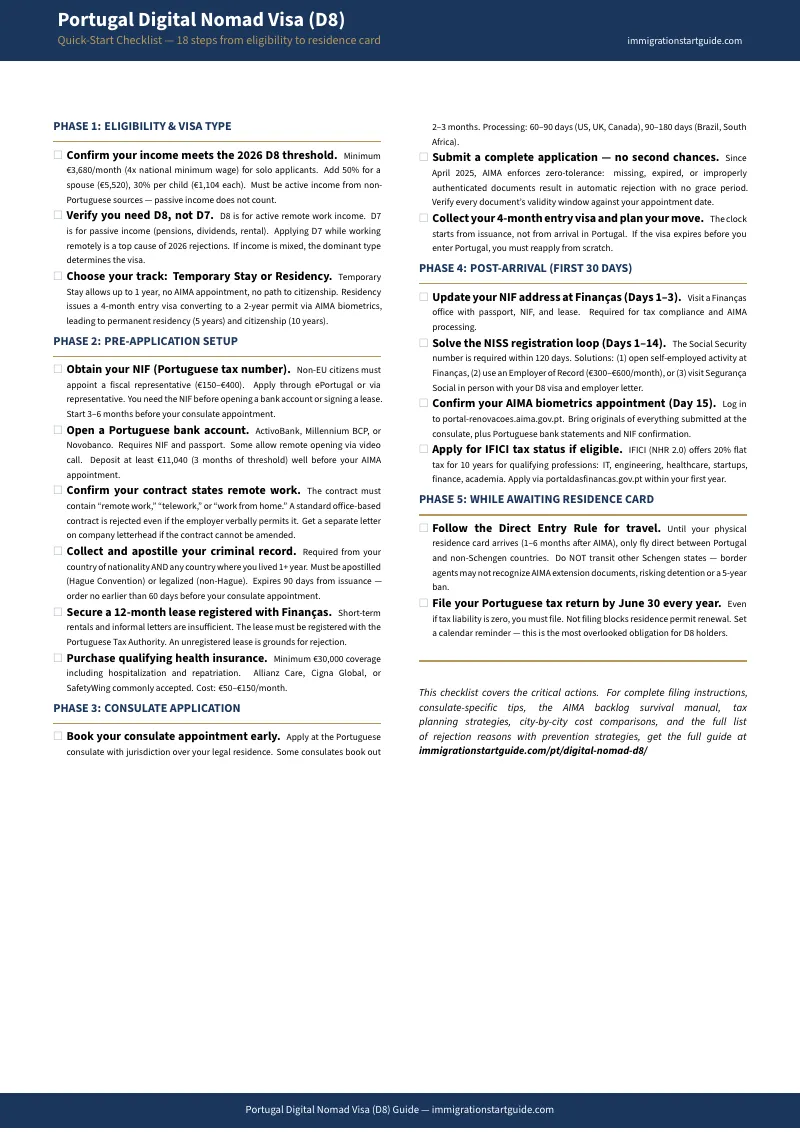
The 18 critical steps distilled into a single action sheet organized by phase: eligibility and visa type confirmation, pre-application infrastructure setup, consulate submission, post-arrival first 30 days, and the waiting period survival rules. Enough to audit your situation tonight and identify whether you are D8-eligible, D7-eligible, or somewhere in between.
Who This Guide Is For
This guide is for remote workers earning from foreign employers or clients who want to live legally in Portugal on the D8 Digital Nomad Visa:
- Software engineers, designers, data scientists, and other tech professionals working remotely for US, UK, Canadian, or other non-Portuguese companies — you meet the income threshold easily but need the exact documentation strategy that prevents your contract's missing "remote work" clause from sinking your application.
- Freelancers and independent contractors earning from multiple international clients — you need to know how to present 6 to 12 months of invoices, contracts, and bank statements as a coherent income proof package when no single client provides a traditional employment contract.
- Couples and young families relocating together — you need the family multiplier calculations (€5,520 for couples, €6,624 with one child), the dependent application process, and the specific evidence requirements when both partners earn qualifying income.
- Remote workers currently on tourist visas or visa runs who need to formalize their status before the 90-day Schengen limit runs out — the guide covers the timeline for transitioning from tourist to D8 without leaving Portugal at the wrong time.
- Applicants deciding between D8 and D7 — if you have both active work income and passive income from investments, the decision framework tells you which visa to apply for based on your dominant income type, not the internet's oversimplified "D7 is cheaper" advice.
- Professionals weighing Portugal against Spain's digital nomad visa, Germany's freelancer visa, or the Netherlands' DAFT — the guide provides the comparative context for why the D8 remains one of the strongest options despite the 2026 regulatory changes.
This guide is not for: EU/EEA/Swiss nationals (you have automatic free movement rights), retirees or investors with purely passive income (see the Portugal D7 Passive Income Visa Guide), or applicants seeking Portuguese citizenship through ancestry or marriage (see the Portugal Citizenship Guide).
Why Not Free Resources?
Free information on the D8 visa exists across government portals, law firm blogs, YouTube, and expat communities. Here is what it actually delivers:
- The AIMA website and ePortugal list the requirements: income threshold, criminal record, health insurance, housing proof. They do not explain the NISS registration loop, the Direct Entry Rule for travel during the backlog wait, the income type distinction that causes D7/D8 misfilings, or the zero-tolerance document policy that took effect in April 2025. The government tells you what to submit. It does not tell you how to survive the 6-to-18-month gap between submission and card issuance.
- Reddit and Facebook groups give you real-time anecdotes. One person approved in six weeks. Another waiting eighteen months with no AIMA appointment. A third who flew through Madrid and was nearly banned from Schengen. Each story is real. None tells you which scenario applies to your consulate, your income type, or your nationality. You read fifty threads and come away more anxious than when you started.
- YouTube and blog posts were mostly created in 2022 or 2023 — before the zero-tolerance rule, before IFICI replaced NHR, before the citizenship timeline doubled. A video titled "How to Get the Portugal Digital Nomad Visa" that references a €3,040 threshold (the 2024 number) or promises a flat 20% tax rate will get your application rejected in 2026.
- Immigration lawyers charge €1,500 to €5,000 for full D8 service. They handle the filing. They do not teach you how to navigate the NISS loop, survive the AIMA backlog, optimize your tax position, or plan for the 10-year citizenship timeline. Their fee covers the application. Your post-arrival survival is your problem.
This guide fills the gap between "I know I need a D8 visa" and "I have my residence card, my tax filing is compliant, and I know exactly what to do for the next 10 years" — the space where qualified applicants still fail because they used outdated thresholds, mixed up D7 and D8 income types, missed a document validity window, or discovered the AIMA backlog travel restrictions after booking a connecting flight through Frankfurt.
— Less Than One Hour of an Immigration Lawyer's Time
An immigration lawyer charges €1,500 to €5,000 for a standard D8 filing. A relocation agency charges €250 to €500 just to set up your NIF and fiscal representative. A single rejected application costs you the non-refundable consulate fee (€90 to €120) plus three to six months of delay while you gather corrected documents and reapply. A connecting flight through a Schengen country during the AIMA wait can cost you a five-year ban from the entire zone. An incorrect tax filing — or a missed filing — can block your residence permit renewal.
This guide costs less than one hour of a Portuguese immigration lawyer's billing rate and covers every step, every document, every deadline, and every post-arrival survival strategy between your first NIF application and your permanent residence card. The D7 vs D8 decision framework alone can save you from filing the wrong visa type — a mistake that costs months, not days.
You earn the income. You have the employer's support. Portugal has the visa. What stands between you and a legal life in Europe is not qualification — it is execution. The zero-tolerance rule means there are no practice runs. The AIMA backlog means you cannot afford to waste months on a rejected first attempt. The May 2026 citizenship law means every month of delay adds to what is now a 10-to-13-year path to a European passport.
Money-back guarantee, no time limit. If the income strategies, the document checklist, the NISS workarounds, and the AIMA survival manual do not make your application stronger than anything you could assemble from Reddit threads and 2023 blog posts, you pay nothing.
Download the free Quick-Start Checklist to confirm your D8 eligibility, verify your income meets the 2026 threshold, and identify the first infrastructure step you need to take. When you are ready for the complete AIMA-Reality Survival Guide — the 64-page guide, plus standalone printable reference cards including the D8 vs D7 Decision Matrix, the Zero-Tolerance Document Checklist, the Pre-Application Timeline, the AIMA Survival Card, the Tax Calculation Worksheet, and the Rejection Prevention Checklist — the full toolkit is here.
The visa exists. The income qualifies. Now build the application that gets approved on the first attempt — in a system that no longer gives you a second one.