
You Have 5 Years of Software Engineering Experience. ACS Deducts 2 Years. Your "10 Points for Employment" Drops to 5. Your NAATI CCL Urdu Score Fails Because You Used "Appointment" Instead of "Mulaqat Ka Waqt." Your HEC Attestation Stalls at "Task Assigned" for Three Weeks. And the AUD 4,640 Visa Fee — PKR 858,000 of Your Family's Savings — Is Non-Refundable if Anything Goes Wrong.
You have a BS Computer Science from FAST or COMSATS, an engineering degree from UET Lahore or NUST, a nursing qualification from Aga Khan, or an accounting designation from ICAP. You have the skills that Australian employers and state nomination programs are actively recruiting. You assumed the points-tested system was transparent and meritocratic — fill out the EOI, hit the points threshold, get the invitation.
Then the system started working differently than the YouTube tutorials and Reddit threads described.
Your HEC attestation was rejected because your degree parchment is laminated. The HEC security stamp must adhere directly to the paper. Your university laminated it by default when they issued it. You must either peel off the lamination — risking damage to the original — or request a duplicate from the controller of examinations, which takes four to eight weeks. Meanwhile, your ACS assessment cannot proceed without an HEC-attested, sealed envelope copy. The 18-24 month timeline has not started yet, and you have already lost two months.
You have 5 years of post-graduation IT experience. You assumed that meant 10 points for overseas employment. But the Australian Computer Society deducts 2 years from your total for a closely related BSCS — your "Skill Level Requirement Met Date" is 2 years after graduation. You have 3 years of skilled experience. That is 5 points, not 10. The 5 points you lost are the same 5 points you could have gained from the NAATI CCL Urdu test — except you failed that too, because you walked in relying on your native fluency and used "school" instead of "madrasah," "hospital" instead of "haspataal," "appointment" instead of "mulaqat ka waqt," and "insurance" instead of "beema." The NAATI scoring system penalizes unjustified English borrowings. You failed with 26 out of 45 on the second dialogue. Pass mark is 29. Three marks. AUD 814 — PKR 150,000 — gone. And you need to wait two months before retaking.
Then the financial reality. A single-applicant DIY migration costs approximately AUD 7,500 — over PKR 1,400,000 at current exchange rates. For a family of four, the total approaches PKR 3,000,000. A migration agent in Lahore or Islamabad charges AUD 3,000 to 5,000 on top of that — PKR 555,000 to 925,000 — for what is essentially form-filling and document submission. They do not tell you that your laminated degree will stall the entire process. They do not explain the ACS year deduction that turns your 10 points into 5. They do not prepare you for the NAATI CCL vocabulary that separates formal Urdu from the conversational Urdu you speak every day. And when your EOI sits at 75 points because you targeted NSW with a profile that would have been competitive in South Australia or Western Australia at 85 points with a 491 nomination, the agent's fee is already in their account regardless of whether you ever receive an invitation.
The Pakistan Points Playbook
This is the operational manual for Pakistani professionals navigating the Australian Subclass 189, 190, and 491 skilled visas from the specific position of holding Pakistani educational credentials, dealing with HEC and IBCC attestation, managing the ACS year deduction for IT professionals, choosing between the Washington Accord and CDR pathways for engineers, navigating ANMAC assessment for nurses, building a financial plan in PKR against a volatile AUD exchange rate, and maximizing every available point — including the 5-point NAATI CCL Urdu advantage that applicants from most other countries cannot access. Not a generic explanation of the Australian points system — the Department of Home Affairs website covers that. This is the Pakistan-specific playbook for the six problems no other resource addresses simultaneously: getting your HEC/IBCC/NADRA documents attested without falling into the lamination trap or name-mismatch rejection, understanding exactly how many points your experience is actually worth after ACS deduction, passing the NAATI CCL Urdu test with the formal vocabulary that "native fluency" alone will not provide, choosing the right state nomination strategy instead of fixating on Sydney or Melbourne, structuring your financial evidence so sudden deposits are documented rather than flagged, and building a 24-month roadmap where every parallel process — HEC, PTE, NAATI, skills assessment, EOI — hits its window without expiring.
Immigration consultants in Pakistan charge AUD 3,000 to 5,000 (PKR 555,000 to 925,000) for General Skilled Migration management. Australian-based migration agents charge AUD 5,000 to 8,000. Both handle compliance — lodging the skills assessment, preparing the EOI, submitting the visa application. Neither delivers the strategic layer: whether your PEC degree has Level II OBE accreditation or needs a CDR, how the ACS classifies your BSCS from FAST-NU versus a BBA with IT experience, why your 6 years of experience yields 5 points instead of 10, which formal Urdu vocabulary items the NAATI CCL tests in the medical and legal domains, why targeting NSW at 85 points wastes months when South Australia would nominate you for a 491 at the same score, or how to structure your bank statements so a PKR 1 million deposit from a property sale does not trigger a "financial non-genuineness" flag at the Department of Home Affairs.
What Is Inside
HEC, IBCC, and NADRA Document Strategy
The attestation chain — HEC for university degrees, IBCC for Matric and Intermediate certificates, NADRA for identity documents — is where most Pakistani applications lose their first two months. The guide maps the parallel processing workflow that runs HEC attestation, IBCC equivalence, and NADRA document updates simultaneously rather than sequentially. It covers the lamination trap (HEC rejects laminated parchments — and many Pakistani universities laminate degrees by default), the name-matching requirement between your CNIC, passport MRZ, and degree certificates (variations like "Muhammad" vs. "Mohammad" or a blank surname field on older passports halt the entire process), the "One and the Same Person" affidavit from a First Class Magistrate that bridges unavoidable discrepancies, the e-services portal workflow with the 1Link payment system, and the urgent walk-in appointment strategy at HEC regional centres in Islamabad, Lahore, and Karachi — because a delayed attestation pushes your entire 24-month roadmap backward.
ACS Skills Assessment and the Year Deduction
For Pakistani IT professionals, the ACS year deduction is the single most misunderstood element of the points system. A BSCS from an HEC-recognized university (FAST, COMSATS, NUST) that closely matches your nominated occupation loses 2 years. A degree that is not closely related loses 4 years. A non-ICT degree with IT work experience loses 6 years. The guide walks through the exact calculation — your "Skill Level Requirement Met Date" is the starting point, and only experience after that date counts for points. It covers how to draft employment reference letters that describe ANZSCO-aligned duties rather than your company's internal job title (ACS evaluates duties against the SFIA framework, not titles — and "managed team deliverables and client relationships" gets classified as management, not ICT), the sealed envelope requirement from HEC, and the AUD 1,450 assessment fee with realistic 8-12 week processing timelines.
Engineers Australia: Washington Accord vs. CDR
Pakistan joined the Washington Accord in 2017 through PEC — but the distinction between Level I and Level II accreditation determines whether your assessment takes 2 months or 12 months. Level II (Outcome-Based Education) graduates from institutions like NUST, UET Lahore, GIKI, and NED can use the streamlined "Accredited Qualifications" pathway — no Competency Demonstration Report required, AUD 1,500, 2-3 months. Level I graduates must submit three Career Episodes to Engineers Australia through the CDR pathway — substantially more work, higher rejection rates, and 4-6 months. The guide explains how to verify your specific graduation year and program's accreditation level through PEC, the CDR writing approach that avoids the plagiarism flags Engineers Australia applies to Pakistani applications at elevated rates due to the prevalence of "CDR writing services," and the reality that the Subclass 476 Skilled Recognised Graduate visa closed on July 1, 2024 — eliminating the 18-month work pathway that engineering graduates from NUST and UET previously relied on.
NAATI CCL Urdu: The 5-Point Vocabulary Test You Cannot Wing
The Credentialed Community Language test gives Pakistani applicants a 5-point advantage that professionals from most other countries cannot access. At AUD 814 (~PKR 150,590), it costs less than a single PTE resit cycle yet delivers points that would otherwise require years of additional skilled experience. But the 30-40% first-attempt failure rate among Urdu speakers proves that "native fluency" is not enough. The guide covers the test format (two dialogues, 300 words each, online from your home in Pakistan), the scoring system (minimum 29/45 in each dialogue — three marks below pass is a common failure margin), and the specific vocabulary that separates prepared candidates from unprepared ones: formal Urdu for medical terms (علامات for "symptoms," not "nishanian"), legal terms (کرایہ نامہ for "tenancy agreement," not "rental agreement"), and community terms (ابتدائی تعلیم for "primary education," not "chota school"). The guide includes the high-frequency vocabulary list across medical, legal, and education domains with Urdu script, transliteration, and the common colloquial forms to avoid.
Points System Mastery With Real Pakistani Profiles
The minimum 65 points is a statutory requirement, not a practical threshold. In 2025-26, competitive scores are 85-95 for the 189, 80-85 for the 190, and 75-85 for the 491. The guide breaks down every points factor with the specific arithmetic that matters for Pakistani professionals: the age sweet spot (25-32 = 30 points, but crossing 33 costs you 5 points — the same as the entire NAATI CCL test), the 10-point jump from Proficient to Superior English that is the single highest-impact improvement, and four fully worked example profiles — a 28-year-old software engineer from Lahore at 80 points, a 34-year-old civil engineer from Islamabad at 85 points, a 27-year-old registered nurse from Karachi at 90 points, and a 30-year-old accountant from Islamabad at 95 points — showing exactly how each professional reaches competitive scores and which visa pathway gives them the best chance of an invitation.
State Nomination Strategy for 2025-26
With total state nomination allocations at 20,350 places and NSW and Victoria heavily favouring onshore applicants, targeting "Sydney or Melbourne" from offshore is a mathematical dead end for most Pakistani professionals. The guide maps each state's allocation, occupation list, and effective points threshold for offshore applicants: Western Australia for engineers (mining and construction demand, transparent General Stream pathway), Queensland for construction and health professionals (Brisbane 2032 Olympics infrastructure boom), South Australia as the 491 hub (1,350 regional places, Adelaide counts as "regional," established Pakistani community), and Tasmania as the broadest-list, lowest-threshold option for borderline profiles. The critical insight: the 491 regional visa's +15 points bonus transforms a 70-75 point profile into an 85-90 point profile that is competitive everywhere. Three years in Perth, Adelaide, or the Gold Coast — all with established Pakistani communities — followed by permanent residency through the Subclass 191.
Financial Planning in PKR With Exchange Rate Volatility
A single-applicant DIY migration costs approximately AUD 7,500 (~PKR 1,400,000). A family of four approaches AUD 15,000-17,000 (~PKR 2,800,000-3,150,000). The guide breaks down every fee — HEC attestation, IBCC equivalence, NADRA documents, police clearance with MoFA attestation, PTE Academic (budget for 2-3 attempts), NAATI CCL Urdu, skills assessment, visa application charge, medical examination — across the 18-24 month timeline so you save progressively rather than scrambling for a lump sum. It covers PKR-to-AUD volatility management (progressive currency conversion through your bank's forex desk or a Roshan Digital Account), the "source of funds" documentation the Department of Home Affairs expects for large deposits (salary accumulation, FBR tax records, property sale Fard, investment redemption statements), and the settlement funds evidence that South Australia and Tasmania require for state nomination.
The 24-Month Roadmap
The guide structures the entire journey — from name consistency audit to visa grant — across three phases: Documentation Foundation (months 1-6, ~PKR 300,000-400,000), Assessment and Points Building (months 7-12, ~PKR 200,000-430,000), and Invitation and Visa (months 13-24, ~PKR 860,000-1,500,000). It maps which tasks are sequential (HEC must complete before skills assessment), which are parallel (PTE preparation and HEC attestation run simultaneously), and the critical dependencies that determine whether your police clearance certificates expire before your visa is lodged or your age bracket ticks over from 32 to 33 while you wait for an ACS result — costing you the same 5 points as the NAATI test you prepared for.
Printable Tools — 9 PDFs
- Full Guide — 11 chapters covering the complete Pakistan-to-Australia skilled migration process: documentation foundation (HEC, IBCC, NADRA, police clearance), skills assessment pathways (ACS, Engineers Australia, ANMAC, VETASSESS), points system mastery with four worked Pakistani profiles, PTE vs. IELTS strategy, NAATI CCL Urdu with vocabulary lists, state nomination strategy for 2025-26, EOI mechanics, financial planning in PKR, visa lodgement, medical examinations at IOM Pakistan, and the top 10 mistakes Pakistani applicants make
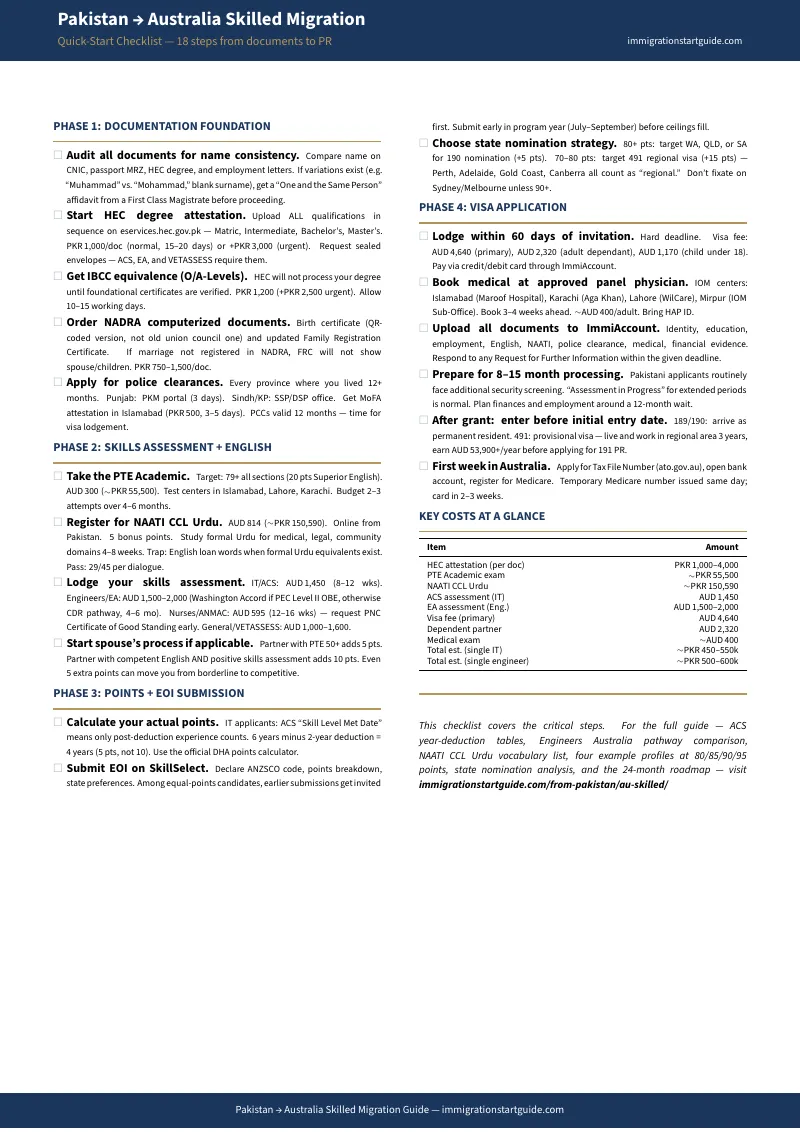
- Quick-Start Checklist — 18-item action sheet covering name consistency audit, HEC attestation, IBCC equivalence, NADRA documents, police clearance with MoFA attestation, PTE scheduling, NAATI CCL registration, skills assessment lodgement, points calculation, EOI submission, state nomination strategy, and visa application timeline
- Pakistani Document Checklist — Track all your HEC, IBCC, NADRA, and police clearance attestation streams in parallel with fees, timelines, and a progress tracker
- Points Calculator Worksheet — Fillable worksheet with the ACS year deduction table built in and all four worked profiles as reference — fill in your numbers and see exactly where you stand
- NAATI CCL Urdu Vocabulary Sheet — Formal Urdu vocabulary reference card across medical, legal, and community domains with transliterations and the colloquial forms to avoid
- State Nomination Reference Card — One-page comparison of all state and territory nomination options for 2025-26 with allocations, key occupations, and minimum points estimates
- Financial Planning Worksheet — Fillable cost tracker in AUD and PKR across the three phases with a monthly savings plan, PKR volatility stress-test, and source-of-funds documentation checklist
- Visa Document Checklist — Everything you need for ImmiAccount upload organized by category, with IOM Pakistan panel physician centers and the 60-day lodgement clock
- 24-Month Roadmap — Visual timeline showing parallel vs. sequential tasks, PKR cost targets per phase, critical dependencies, and document expiry warnings — print and pin to your wall
Who This Is For
- Pakistani IT professionals — software engineers, developers, systems analysts from FAST, COMSATS, NUST, or LUMS — who need to understand the ACS year deduction that turns 5 years of experience into 5 points instead of 10, draft reference letters that describe ANZSCO duties rather than company titles, and build a points profile that is competitive for state nomination
- Pakistani engineers — civil, mechanical, electrical, and software engineers with PEC-registered degrees — who need to determine whether their specific program and graduation year qualifies for the Washington Accord pathway or requires a CDR, and who lost the Subclass 476 graduate visa when it closed in July 2024
- Pakistani nurses — BSN graduates navigating ANMAC Full Skills Assessment — who need to coordinate the Pakistan Nursing Council Certificate of Good Standing (4-8 week bottleneck), document clinical placement hours that their Pakistani transcript may not explicitly break down, and plan the AHPRA registration pathway (NCLEX-RN and OSCE) for after arrival
- Pakistani accountants and general professionals — assessed by VETASSESS or CPA Australia — who need to build payment evidence in a market where cash salaries and informal salary certificates are common, using FBR tax records, bank statements, and EOBI records to satisfy assessing authorities that scrutinize Pakistani employment evidence at elevated levels
- Anyone maximizing NAATI CCL Urdu — who needs the formal vocabulary list for medical, legal, and community domains that separates a 29/45 pass from a 26/45 failure — and cannot afford to waste AUD 814 and two months on a retake
- Families — where the primary applicant and spouse are both building points, managing a combined financial plan in PKR, and coordinating parallel processes across HEC, skills assessments, English tests, and NAATI for two applicants simultaneously
Why Not YouTube, Reddit, or a Migration Agent?
YouTube and Reddit are the primary source of Australian PR advice for Pakistani professionals — and they are a patchwork of outdated information, agent marketing, and success stories from a lower-threshold era. The "65 points is enough" advice was true three years ago. The Subclass 476 graduate visa videos were filmed before it closed in July 2024. The experience points calculations assume ACS counts all your years when it deducts two. The state nomination posts recommend NSW and Victoria without mentioning that both states now heavily favour onshore applicants. And the NAATI CCL advice says "just speak Urdu naturally" — which produces a 30-40% first-attempt failure rate.
Migration agents in Lahore, Islamabad, and Karachi charge AUD 3,000 to 5,000 (PKR 555,000 to 925,000) for General Skilled Migration management. Their business model is compliance: they lodge the skills assessment, prepare the EOI, submit the visa application. They do not tell you that your laminated degree will stall HEC attestation for two months. They do not explain why ACS deducted 2 years from your experience and how that changes your entire points strategy. They do not prepare you for the NAATI CCL Urdu vocabulary test. They do not advise you to target South Australia's 491 instead of waiting indefinitely for an NSW 190 invitation. And when your EOI expires at 75 points because you did not know that moving from Proficient to Superior English is worth 10 points — more than any other single improvement you can make — their fee is already paid.
The Department of Home Affairs website publishes every rule. The points table is listed. The occupation lists are available. The visa fees are public. But the website does not tell you that your HEC attestation will be rejected because your university laminated the degree. It does not explain that 5 years of IT experience yields 5 points after ACS deduction, not 10. It does not warn you that "native Urdu fluency" fails the NAATI CCL test at a rate of one in three. It does not advise you that an 80-point profile targeting NSW will never receive an invitation while the same profile with a 491 nomination in South Australia would be invited within months. The system is designed to be followed, not to protect you from the Pakistan-specific failure points that turn an 18-month process into a 36-month one.
The Free Checklist vs. The Full Guide
The free Quick-Start Checklist gives you the 18 critical action items — name consistency audit, HEC attestation status, IBCC equivalence, NADRA document review, police clearance with MoFA attestation, PTE scheduling, NAATI CCL registration, skills assessment preparation, points calculation, EOI submission, state nomination strategy — in the order you should tackle them. It is enough to see the full scope of the 24-month process, identify the long-lead-time items that need to start immediately, and calculate whether your current points profile is competitive for the visa pathway you are targeting.
The full guide gives you how — plus 7 standalone printable tools you can use independently: the HEC parallel processing workflow with the lamination trap and name-matching fixes (with a separate Pakistani Document Checklist to track all attestation streams), the ACS year deduction calculator with your specific degree classification (with a fillable Points Calculator Worksheet), the Engineers Australia pathway decision between Washington Accord and CDR, the NAATI CCL Urdu vocabulary list with 50+ formal terms across medical, legal, and community domains (with a separate Vocabulary Reference Sheet for test-day prep), the state-by-state nomination analysis with realistic offshore thresholds (with a one-page State Nomination Reference Card), the financial planning across 24 months with progressive PKR-to-AUD conversion strategy (with a fillable Financial Planning Worksheet and monthly savings tracker), the four worked example profiles showing exactly how Pakistani professionals at 80, 85, 90, and 95 points build their scores, a Visa Document Checklist organized by ImmiAccount upload category, a 24-Month Roadmap showing parallel vs. sequential tasks, and the top 10 mistakes Pakistani applicants make.
— Refusal Insurance for a PKR 1.4 Million Investment
A single consultation with a MARA-registered migration agent costs AUD 160 to 300. Full-service General Skilled Migration management runs AUD 3,000 to 5,000 in Pakistan or AUD 5,000 to 8,000 with an Australian-based agent. Your total skilled migration costs will exceed PKR 1,400,000 as a single applicant. For a family of four, the government fees alone exceed PKR 3,000,000.
If the information in one chapter — the HEC lamination fix that prevents a two-month attestation delay, the ACS year deduction table that corrects your points calculation before you submit an EOI with inflated experience claims, the NAATI CCL vocabulary list that turns a 26/45 failure into a 32/45 pass, the state nomination analysis that redirects you from an impossible NSW target to a competitive South Australia 491, or the financial planning timeline that prevents you from obtaining police clearance certificates 14 months before visa lodgement only to watch them expire — prevents a single failed assessment, a single wasted NAATI attempt, a single year of waiting for an invitation that never comes, or a single AUD 4,640 visa refusal, the guide has paid for itself before you finish the first chapter.
100% satisfaction guaranteed. If the guide does not meet your expectations, email [email protected] for a full refund.