
You Have Lived in Ireland for Five Years, Paid Taxes, Built a Career, and Raised a Family. Now a Miscounted Absence Day, a Missing 150-Point Document, or a Form 8 Error You Cannot See Could Get Your Naturalisation Application Refused — Costing You €1,125 in Government Fees, 12 to 18 Months of Processing Time, and Another Full Year Before You Can Reapply for the EU Passport That Changes Everything.
You have five years of reckonable residence. You have a Stamp 4. You have been paying tax, building a career, and making Ireland your home. You are eligible — or you think you are. You open the ISD naturalisation portal. You download Form 8. And then you stop. Because Form 8 is 26 pages long. It asks for every address you have lived at in the last nine years — and in Dublin's rental market, that could be ten properties. It asks for your travel history — every trip home, every work conference, every family emergency — because the Department needs to verify you did not exceed 70 days absent in your final year or 150 days in any of the preceding four. It asks for proof of "good character" but does not define the threshold. You search online. Citizens Information tells you the rules but not how to calculate your days when your Stamp 1G overlapped with a gap between IRP cards. Reddit tells you someone was approved despite 73 days absent — and someone else was refused for 71. The official residency calculator cannot handle Stamp 1G entries properly and produces results you do not trust. You consider a solicitor. They quote €2,000 to €5,000 for a "straightforward" application.
Here is the problem no free resource solves: Irish naturalisation is not a form you fill in — it is a 150-point evidence audit, a reckonable-day calculation that spans nine years of your life, a "good character" assessment with no published standard, and a Ministerial discretion that can refuse you even when every box is ticked. The stakes are not administrative. An Irish passport is ranked top 5 globally. It gives you visa-free access to 190 countries. It gives you the right to live and work in all 27 EU member states and the United Kingdom through the Common Travel Area. It gives your children citizenship by descent. It frees you permanently from work permits, salary thresholds, and IRP renewals. One refused application delays all of this by two to three years — and costs you the €175 application fee and €950 certification fee you have already committed to paying.
The Ireland Citizenship (Naturalisation) Guide is a Naturalisation Filing System built for the specific problem every applicant faces at the five-year mark: converting years of compliant residence into the certificate of naturalisation that makes you an Irish and EU citizen — without a refusal, a request for further information, or a miscalculation that costs you years. This is not a summary of Section 15. This is the integrated system covering the reckonable residence calculation across every stamp type, the 150-point document scoring strategy, the Form 8 field-by-field walkthrough, the "good character" disclosure framework, the absence tracking methodology, the spousal shortcut for three-year applicants, and the ceremony-to-passport action plan that takes you from approval to your first Irish passport.
What's Inside the Naturalisation Filing System
The complete guide, a quick-start checklist, and standalone printable tools you can use immediately:
The Reckonable Residence Calculator
The Department requires 1,826 days of reckonable residence in the nine years preceding your application, including 365 continuous days immediately before you apply. The trap: not all residence is reckonable. Stamp 2 (student) time does not count. Stamp 1G counts but the official calculator mishandles it, requiring you to enter it as "Stamp 1" — a quirk that causes applicants to undercount their qualifying days or panic about gaps that do not exist. Time between IRP cards can be non-reckonable even if you were legally present and working. The guide provides a manual auditing worksheet that accounts for every stamp type, every gap, and every transition — so you know your exact day count before you commit to the €1,125 in government fees. It also includes the proactive absence tracker: a real-time logging tool for trips abroad so you never accidentally exceed the 70-day limit in your final year or the 150-day limit in any qualifying year.
The 150-Point Document Scoring Strategy
Since 2022, the Department requires documents totalling exactly 150 points for every single year of reckonable residence you claim. Type A documents (Revenue Employment Detail Summary, bank statements covering three months, social welfare statements) are worth 100 points each. Type B documents (utility bills, rent agreements, medical insurance letters) are worth 50 points each. You need 150 points per year — and the Department explicitly warns against submitting more than 150, because over-documentation creates administrative delays. The guide provides a year-by-year scoring worksheet: which document combinations are safest, how to download the correct Revenue EDS for each tax year, how to request compliant bank statements, and which documents to avoid because they trigger follow-up queries. For applicants with five to nine years of residence, this means building a document portfolio of 750 to 1,350 points — each one correct, current, and in the right format.
The Form 8 Field-by-Field Walkthrough
Form 8 is 26 pages of legal disclosure. It asks for your full address history, employment history, travel history, family details, and declarations about criminal convictions, pending proceedings, and good character. For a tech worker who has moved four times in Dublin, travelled home to India twice a year, and changed employers once, this form requires reconstructing nine years of life from memory and records. The guide walks through every section — what each field actually asks for (versus what it appears to ask for), how to format dates and addresses consistently, which supporting documents to attach to which section, and the specific disclosure language for the "good character" declaration that satisfies the Department without creating problems that do not exist. It covers the digital submission process on the ISD portal, including file format requirements, upload size limits, and how to verify your application was received.
The "Good Character" Disclosure Framework
The good character requirement is the most anxiety-inducing part of naturalisation. The Department conducts Garda vetting and checks your record — but "good character" is not defined in the legislation. Applicants agonise over a speeding fine from 2019, a spent conviction from their home country, a dispute with a former landlord, or a social welfare overpayment query. Case law (including AP v. Minister for Justice) establishes that candour matters more than the offence itself — but most applicants do not know this. The guide provides the self-vetting framework: how to request your own Garda record via a Subject Access Request before the Department does, how to assess whether a disclosure is required, and the specific language for declaring minor matters that satisfies the honesty threshold without escalating a non-issue. It separates what genuinely concerns the Minister from what applicants needlessly worry about.
The Spousal and Civil Partnership Shortcut
Spouses and civil partners of Irish citizens qualify after just three years (1,095 days) of reckonable residence — but the application requires additional evidence that standard applicants do not face. You need an original civil marriage certificate (religious certificates are insufficient), proof of cohabitation through joint utility bills or bank statements, and an affidavit of joint residence witnessed by a Commissioner for Oaths or Solicitor. The guide covers the complete spousal evidence package, the specific affidavit wording that satisfies the Department, and the common mistakes that trigger requests for further information — like submitting a marriage certificate that was issued more than six months before the application date.
The Absence Rules: 70 Days, 150 Days, and the Jones Ruling
In 2019, a High Court ruling in Jones v. Minister for Justice declared that "continuous residence" meant an applicant could not leave Ireland for a single day in the year before applying. This paralysed the naturalisation system for six months before the Court of Appeal overturned it as "absurd," endorsing the Minister's policy of allowing up to six weeks of absence for holidays and business travel. This legal saga is why applicants are terrified of their absence count. The guide provides the current, legally tested rules: the 70-day limit in the final year (with the specific exceptions that apply), the 150-day limit in each of the preceding four qualifying years, how to calculate absence days correctly (departure day counts, arrival day does not), and how to document "reasonable cause" for absences that exceed the threshold. You will know exactly where you stand — not based on a Reddit comment from 2023, but on the Court of Appeal's interpretation and the Department's current operational policy.
The Stamp-by-Stamp Reckonability Guide
Not all immigration stamps count toward naturalisation, and the transitions between stamps create the most dangerous calculation errors. Stamp 1 (employment permit) is reckonable. Stamp 1G (graduate scheme) is reckonable but mishandled by the official calculator. Stamp 2 and 2A (student) are not reckonable at all — meaning a Brazilian national who spent three years on a student visa before transitioning to a work permit may have been in Ireland for eight years but has only five years of qualifying residence. Stamp 3 (dependent) is reckonable. Stamp 4 is reckonable. Stamp 0 is reckonable. Gaps between stamps — even a one-week gap between an expired IRP and its renewal — may be non-reckonable. The guide maps every stamp type to its reckonability status, provides the calculation method for transitions, and flags the specific gap scenarios that cause applicants to apply too early and get refused.
Refusal Recovery and Reapplication
If your application is refused, you lose the €175 application fee (the €950 certification fee is only charged on approval). You receive a letter stating the grounds for refusal. You have the right to request a review and submit additional documentation. In some cases, you may seek judicial review — though this is expensive and rarely necessary for straightforward applicants. The guide covers the most common refusal grounds (residence miscalculation, insufficient documentation, undisclosed convictions), the review timeline, and the reapplication strategy that addresses the specific deficiency without starting from scratch. It is the safety net you build before you apply, not after you are refused.
From Approval to Passport: The Ceremony and Beyond
When your application is approved, you receive an invitation to a citizenship ceremony — typically held in Dublin, Killarney, or another designated venue. You make a declaration of fidelity to the Irish nation and loyalty to the State, receive your certificate of naturalisation, and become an Irish citizen on that day. But the process does not end at the ceremony. You need to apply for your first Irish passport (online via Passport Online or by post), notify Revenue of your changed status, update your Public Services Card, and understand your new rights — including the right to vote in all elections, the right to an Irish passport for your children, and the right to live and work across the EU without any further immigration permission. The guide provides the post-ceremony action plan so you convert the certificate into a functioning passport and full citizen status within weeks, not months.
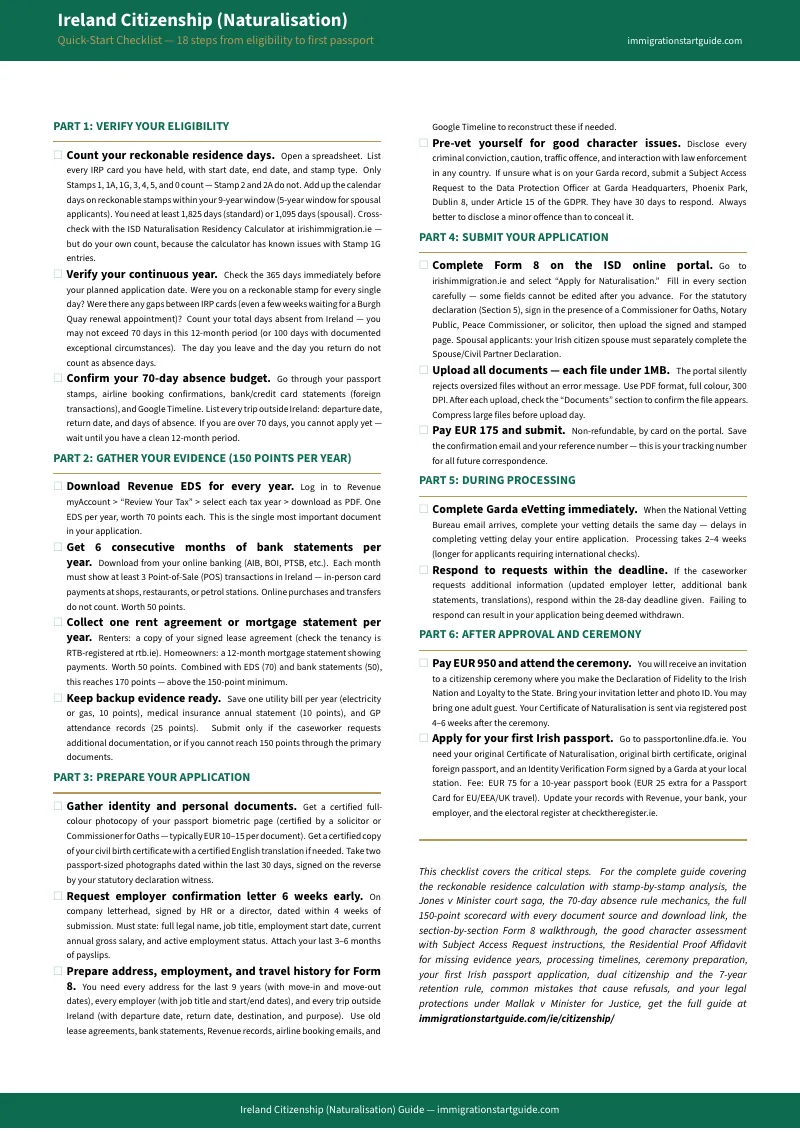
Quick-Start Checklist (free download)
A focused action plan covering the essentials: check your stamp history, count your reckonable days using the manual worksheet, verify you meet the 150-point threshold for at least one year, and identify your next concrete step. Enough to assess whether you are eligible — tonight.
Who This Guide Is For
This guide is for non-Irish nationals who have accumulated five or more years of reckonable residence and are preparing to apply for Irish citizenship through naturalisation:
- Indian software engineers and tech professionals on Stamp 4 who have the residence but are paralysed by the reckonable-day calculation — unsure whether their two-week trips to India each year, a three-day conference in London, and a one-week gap between IRP cards add up to a refusal
- Brazilian professionals who spent years on Stamp 2 (student) before transitioning to Stamp 1G and then Stamp 4, and need to know exactly which years count and which do not — because miscounting means applying too early and losing the €175 fee and 12 to 18 months of processing time
- Filipino and African healthcare workers who have built careers in the HSE and are anxious about the "good character" requirement — worried that a minor driving offence, a historical social welfare query, or a spent conviction from their home country could derail an application they have waited five years to submit
- Spouses and civil partners of Irish citizens who qualify after three years but face additional documentation requirements — affidavits of joint residence, proof of cohabitation, and marriage certificates that must meet specific format and recency standards
- Former students who transitioned through Stamp 2 to Stamp 1G to Stamp 4 over seven to nine years and need to untangle which portions of their residence are reckonable and which are not — the most complex calculation in the naturalisation system
- Anyone on Stamp 4 or Stamp 5 who has been putting off the application because they are overwhelmed by the 150-point document requirement, the 26-page Form 8, or the fear that something in their history will surface during Garda vetting
This guide is not for: Irish citizens by birth or descent seeking a first passport (that is a passport office matter, not naturalisation), applicants for citizenship through the Foreign Birth Registration (FBR) process (a separate pathway for those with Irish grandparents), or people who have not yet obtained Stamp 4 or equivalent long-term residency (see the Ireland Stamp 4 (Long-Term Residency) Guide for the transition from employment permit to Stamp 4).
Why Not Free Resources?
Free information on Irish naturalisation exists across government websites, solicitor blogs, and expat forums. Here is what it actually delivers:
- Citizens Information provides a reliable summary of the eligibility requirements and the application process. It does not explain how to calculate reckonable residence when you transitioned from Stamp 2 to Stamp 1G to Stamp 4 across nine years, how to build a 150-point evidence portfolio for a year when you changed addresses twice and your utility bills are in your landlord's name, or how to disclose a spent conviction without escalating it into a refusal ground. Citizens Information tells you what the rules are. It does not show you how to satisfy them.
- The ISD website and official calculator provide the residency calculator and Form 8 download. The calculator cannot handle Stamp 1G entries correctly — it requires you to enter them as "Stamp 1," a workaround that is undocumented and causes applicants to either undercount their days or believe they have a gap that does not exist. The portal accepts your submission and goes silent for months. You have no way to know whether a missing document will result in a refusal or a request for further information until the decision letter arrives 8 to 14 months later.
- Immigration solicitors charge between €2,000 and €5,000 for naturalisation applications. For the 90% of applicants whose case is straightforward — five years of Stamp 1/4 residence, no criminal record, stable employment — this is paying thousands for an administrative filing service. The solicitor fills in the same Form 8, uploads the same documents, and waits the same 8 to 14 months. The difference between a successful DIY application and a solicitor-assisted one is not legal expertise. It is knowing which documents score 150 points, how to count your days correctly, and how to format the form so it does not trigger unnecessary follow-up queries.
- Reddit and Facebook expat groups are where someone who was naturalised in 2022 tells you to submit "as many documents as possible" (the Department explicitly warns against exceeding 150 points per year), that Stamp 1G does not count (it does), that you need a P60 (replaced by the Revenue EDS), and that 73 days absent is fine because they were approved with 73 (they were lucky, not compliant). The advice is specific, confident, and based on rules that have changed since their application was processed.
This guide fills the gap between "I know the rules" and "I can file an application the Department approves" — the space where eligible applicants with five years of residence still get refused because they miscounted their reckonable days, submitted the wrong document combinations, or disclosed a minor matter in a way that raised questions instead of answering them. It delivers the same preparation that immigration solicitors charge thousands for, organised as a filing system you can execute yourself.
— A Fraction of What One Refusal Costs You
The government fees for naturalisation are €175 to apply and €950 upon approval — €1,125 total. A refusal means the €175 is gone, plus 12 to 18 months of waiting for the decision, plus another full year to reaccumulate the continuous residence requirement before you can reapply. For a professional, that is two to three years of delayed EU citizenship — two to three years without the passport that gives you visa-free access to 190 countries, the right to work across 27 EU member states, and freedom from work permits and salary thresholds forever.
Immigration solicitors charge €2,000 to €5,000 for the same application. For a Stamp 4 holder with five clean years of residence and no complications, that is paying professional fees for a process you can execute yourself — if you have the right system. The guide costs less than a single hour of solicitor time and covers every calculation, every document, and every form field that determines whether your application succeeds or fails.
You have already invested five years of your life in Ireland. You have paid thousands in permit fees, IRP registrations, rent, and taxes. You have built a career, raised a family, and made Ireland your home. The Irish passport is the return on that investment — permanent EU citizenship for you and your children, a top-5 passport, and the security of never being subject to immigration permission again. The guide costs a fraction of what you have already spent — and it protects the entire investment by ensuring the application you submit is the one that gets approved.
Money-back guarantee, no time limit. If the reckonable residence calculator, the 150-point document strategy, and the Form 8 walkthrough do not make your application stronger, you pay nothing.
Download the free Quick-Start Checklist to check your stamp history, count your reckonable days, and verify you meet the documentation threshold tonight. When you are ready for the complete Naturalisation Filing System — the full guide, the absence tracker, the document scoring worksheets, the Form 8 walkthrough, the good character framework, and the ceremony-to-passport action plan — the full guide is here.
You have earned the right to call Ireland home. Now secure the passport that makes it permanent — for you and for every generation that follows.