
You Got the Job Offer. Now a Single EPOS Upload Error, a Mismatched SOC Code, or a Degree That Maps to the Wrong NFQ Level Could Cost You the Permit, the €1,000 Fee, and a Refusal That Follows You to Every Country You Ever Apply To.
You've done the hard part. An Irish employer wants to hire you. The salary clears the threshold. Your skills are on the Critical Skills Occupation List. You log into EPOS to start the application and discover that "starting the application" means navigating a system that went live in April 2025 with undocumented file size limits, biometric photo dimensions that reject standard passport photos, and a "Pay Now" button that sometimes doesn't appear even when every field is complete. You search for help. Citizens Information gives you a summary written before the 2024 Act changed the salary thresholds. Reddit gives you advice from someone who applied in 2022 under rules that no longer exist. Your employer's HR department is focused on getting the permit issued to the company — they are not managing your D Visa, your spouse's Stamp 1G, or your 21-month path to Stamp 4.
Here is the structural problem no free resource solves: the Critical Skills Employment Permit is not a single application — it is three separate processes administered by three separate government departments, and a successful permit grant does not guarantee a visa, a visa does not guarantee an IRP appointment, and none of these departments coordinate with each other. DETE handles the permit. The Embassy handles the D Visa for visa-required nationals. Immigration Service Delivery handles IRP registration and the eventual Stamp 4. Every guide, every blog post, every Reddit thread treats these as isolated steps. The people who get refused, delayed, or trapped in RFI loops are the ones who prepared for one stage without understanding how it connects to the next.
The Ireland Critical Skills Employment Permit Guide is a Permit-to-Residency System built for the specific problem that every self-applying professional faces: converting a valid job offer into a permit, the permit into lawful entry, and lawful entry into permanent residency — as one continuous process, not three disconnected bureaucratic encounters. This is not a repackaging of Citizens Information. This is the integrated journey from EPOS submission through Stamp 4, covering the 2024 Act changes, the March 2026 salary thresholds, the EPOS 2.0 field-by-field walkthrough, NARIC qualification mapping for the countries that get caught (India, Brazil, Philippines, Nigeria), the 9-month employer change rules and the SOC code trap that makes them dangerous, and the Stamp 4 transition process that changed when DETE abolished the Support Letter — a change that no free resource has documented clearly.
What's Inside the Permit-to-Residency System
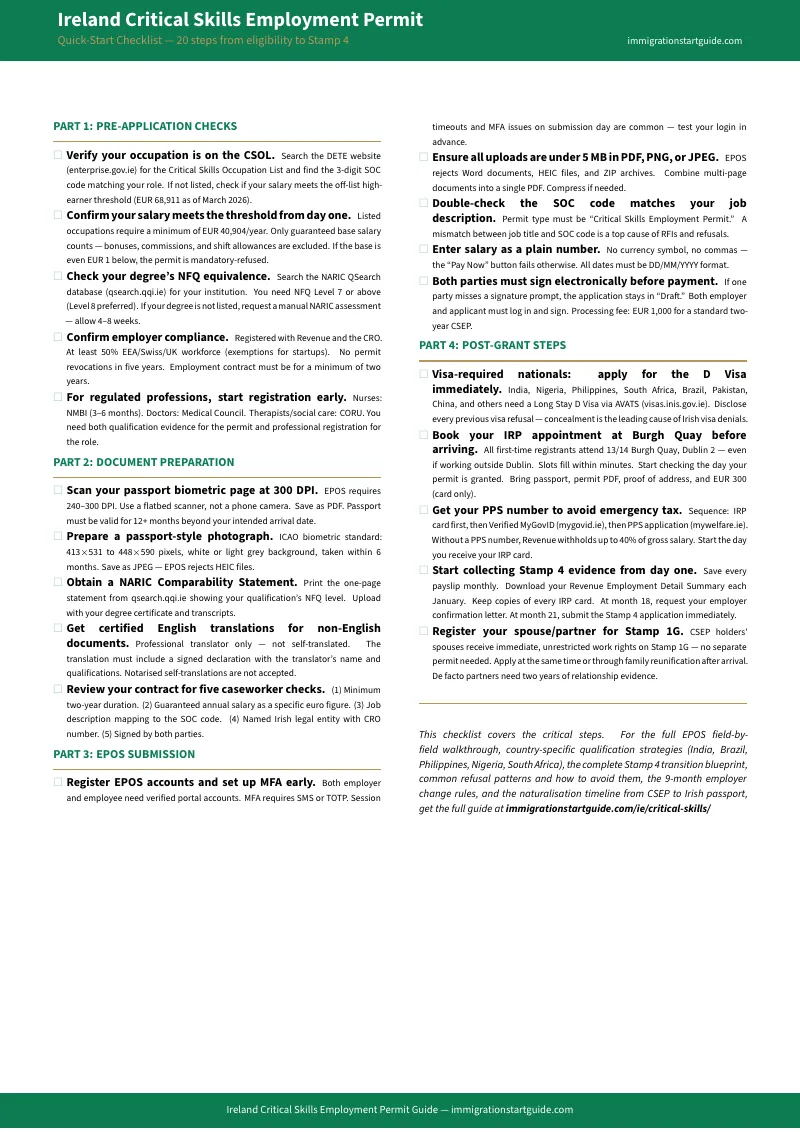
The complete guide (70 pages), a quick-start checklist, and 9 standalone printable tools you can use immediately:
The 2024 Act and 2026 Threshold Briefing
The Employment Permits Act 2024 replaced the 2003 and 2006 frameworks entirely. Salary thresholds jumped to €40,904 for listed occupations and €68,911 for the off-list high-earner route as of March 2026, with annual indexation starting 2027. An application submitted one day before a threshold change at the old salary will be refused. The guide maps every threshold change, the indexation formula, and the timing strategy that ensures your salary clears the bar on the day your application is assessed — not the day it was submitted.
The EPOS 2.0 Field-by-Field Walkthrough
EPOS 2.0 launched in April 2025 with MFA accounts for employer, employee, and agent — and immediately introduced technical friction that the official documentation does not address. Documents must be under 5MB. Photos must be 413x531px to 448x590px at 240-300 DPI. The system accepts PDF, PNG, and JPEG only — upload a HEIC from your iPhone and the submission fails silently. The "Pay Now" button disappears when mandatory fields are technically filled but logically inconsistent. The guide walks through every field, every upload requirement, and every known system behaviour that causes applications to stall before a caseworker ever sees them.
The NARIC Qualification Strategy
For listed occupations below €68,911, a degree at NFQ Level 7 or higher is mandatory. The trap: Indian three-year bachelor's degrees frequently map to NFQ Level 7 (Ordinary), not Level 8 (Honours) — and some roles on the Critical Skills list require Level 8. Brazilian degrees face similar recognition problems. The guide provides country-specific NARIC strategies so you know whether your qualification meets the threshold before you accept the job offer, not after DETE issues a refusal.
The SOC Code Mapping Guide
A "Project Manager" in a tech company could be SOC 2134 (IT Project Manager — on the Critical Skills list) or SOC 2424 (Business Project Manager — different eligibility and salary rules). A "Data Analyst" could be SOC 2136 (eligible) or SOC 3544 (not eligible). The mismatch between your contract's job title and the SOC code on your application is one of the most common causes of Requests for Further Information, which add four to eight weeks to your timeline. The guide teaches you how to read the occupation list, match your actual duties to the correct SOC-4 code, and ensure your employment contract's language supports the classification.
The D Visa Bridge (Visa-Required Nationals)
If you hold a passport from India, Nigeria, Pakistan, the Philippines, or any other visa-required country, your approved permit is not permission to enter Ireland. You must separately apply for a Long Stay D Visa through AVATS, submit your original passport to the nearest Embassy or VFS Global centre, and wait for processing that can add weeks to your timeline. The guide covers the AVATS application, the documentation package, the biometric appointment process, and the timing coordination between permit grant and visa submission so you don't lose your start date.
The 9-Month Rule and Employer Change Trap
The 2024 Act reduced the employer lock-in period from 12 months to 9 months. Free resources celebrate this as "you can change jobs after 9 months." What they leave out: you can only change to a role within the same SOC code as your original permit. Moving from Software Developer to Project Manager requires a completely new permit application, even after the 9-month window. The guide maps the mobility rules, the SOC code constraint, and the redundancy protections that give you 6 months to find a new qualifying role if your employer lets you go.
The Stamp 4 Transition Blueprint
The primary prize of the Critical Skills permit: Stamp 4 after 21 months of continuous employment, granting you the right to work for any employer without a permit, start your own business, and access broader social services. In late 2023, DETE abolished the Stamp 4 Support Letter that previously made this transition straightforward. The current process requires you to apply directly to the Department of Justice with proof of compliance — and no free resource clearly documents what that proof looks like. The guide provides the Month 21 Checklist: exactly what to submit, where to submit it, and how to prove continuous employment when your evidence trail is scattered across EPOS, Revenue, and your employer's HR records.
Spouse and Family Reunification Guide
CSEP holders get immediate family reunification — your spouse or partner can apply for a visa at the same time as you and receives a Stamp 1G permission on arrival, allowing them to work for any employer without a separate permit. This is one of Ireland's strongest advantages for dual-career households, and it is routinely neglected by employer HR departments whose scope ends at getting your permit issued. The guide covers the concurrent application strategy, Stamp 1G rights and limitations, and the documentation your spouse needs that your employer will not prepare for them.
Quick-Start Checklist (free download)
A focused action plan covering the essentials: verify your occupation against the current CSOL, check your salary against 2026 thresholds, confirm your degree maps to NFQ Level 7+, identify your EPOS registration steps, and plan your D Visa timeline if visa-required. Enough to assess your eligibility and identify your next concrete step tonight.
Who This Guide Is For
This guide is for non-EEA professionals who have a job offer from an Irish employer in a Critical Skills occupation and need to navigate the permit, visa, and residency process without hiring a solicitor:
- Software developers, data scientists, and cybersecurity professionals joining multinationals in Dublin's Silicon Docks who need the permit processed before their start date and the Stamp 4 transition planned from day one
- Healthcare professionals — nurses, doctors, radiographers — who face the dual burden of DETE permit requirements and professional registration with NMBI, the Medical Council, or CORU
- Engineers and biopharmaceutical scientists joining manufacturing or R&D operations in Cork, Limerick, and Galway where the "specific skills" context requirement means your role must be framed correctly or the CSEP is refused
- Indian professionals with three-year bachelor's degrees who need to confirm their NARIC qualification mapping before committing to a role that requires NFQ Level 8
- Visa-required nationals from India, Nigeria, Pakistan, and the Philippines who face a two-stage process — permit then D Visa — and need to coordinate timelines so neither approval expires before the other arrives
- Dual-career couples where the trailing spouse needs Stamp 1G guidance that the employer's HR department is not providing
- Professionals on General Employment Permits considering whether a job change could qualify them for the faster CSEP route to Stamp 4
This guide is not for: EEA/Swiss/UK nationals (you don't need a permit), applicants seeking roles on the Ineligible Occupations list, or professionals looking for the General Employment Permit route (see the Ireland General Employment Permit Guide).
Why Not Free Resources?
Free information on the Critical Skills permit exists in abundance. Here is what it actually delivers:
- Citizens Information provides a reliable plain-language summary of the permit requirements. It does not cover the EPOS 2.0 technical specifications, does not explain the NARIC qualification traps for specific countries, does not document the Stamp 4 transition process after the Support Letter was abolished, and treats the permit, visa, and IRP as three unrelated processes. You get the rules without the strategy.
- DETE's own guidance tells you that your occupation must be on the Critical Skills list and your salary must meet the threshold. It does not tell you how to handle a SOC code mismatch between your job title and your actual duties, how to time your application around a threshold change, or what to do when the EPOS upload silently rejects your documents. The department that processes your application does not teach you how to survive its own system.
- Immigration solicitors charge €1,500 to €2,500 for a single CSEP application and €225 to €500 for an initial consultation. Many corporate solicitors are hired by the employer, not the employee — their scope ends at getting the permit issued. Your D Visa application, your spouse's Stamp 1G, your IRP registration, and your Stamp 4 transition are your problem. You pay thousands for representation that covers one stage of a three-stage journey.
- Reddit and Boards.ie are where someone who moved to Ireland in 2021 tells you the employer lock-in is 12 months (it's now 9), that you need a DETE Support Letter for Stamp 4 (it was abolished), and that the salary threshold is €32,000 (it's now €40,904). The advice is specific and confident and often dangerously wrong because the 2024 Act changed the rules they learned under.
- Generic "Move to Ireland" ebooks on Amazon and Etsy cover packing lists and Dublin neighbourhood guides. They were published before the 2024 Act, before EPOS 2.0, and before the March 2026 salary thresholds. They do not address the Critical Skills permit at all.
This guide fills the integration gap — the space between "I know the requirements" and "I can navigate three government departments as one continuous process without an RFI, a refusal, or a missed deadline." It delivers the same strategic preparation that immigration solicitors charge thousands for, organised so you can execute it yourself.
— Less Than 5% of Your Application Fee at Risk
Your Critical Skills permit application costs €1,000 in government fees. If refused, you lose €100 immediately — DETE keeps 10% — and the refusal goes on your permanent immigration record. That refusal must be declared on every future visa application you make: UK, Canada, Australia, United States. The damage is not just the lost fee. It is the shadow that follows your file across every border for years.
Add the D Visa fee for visa-required nationals. Add the €300 IRP registration fee when you arrive. Add the months of salary you lose if an RFI delays your start date by four to eight weeks while your employer considers hiring someone else. The total cost of getting this wrong is measured in thousands of euros and months of career disruption.
Immigration solicitors charge €1,500 to €2,500 for the permit application alone. A one-hour consultation costs €225 to €500. And here is the part that matters: the solicitor your employer hired is protecting the company's compliance, not your personal immigration journey. They are not planning your Stamp 4 transition. They are not preparing your spouse's Stamp 1G documentation. They are not checking whether your Indian degree maps to NFQ Level 7 or Level 8. Your residency is your responsibility. This guide is the strategy layer that makes sure the €1,000 you're about to spend produces a permit, not a refusal.
Money-back guarantee, no time limit. If the EPOS walkthrough, the NARIC qualification strategy, and the Stamp 4 transition blueprint don't make your application stronger, you pay nothing.
Download the free Quick-Start Checklist to verify your eligibility against the 2026 thresholds and identify your next step tonight. When you're ready for the complete Permit-to-Residency System — the EPOS field-by-field guide, the NARIC strategy, the SOC code mapping, the D Visa bridge, and the Month 21 Stamp 4 blueprint — the full guide is here.
You've already secured the job offer. Now secure the permit that makes it real.