
Your Employer Got the Job Offer Approved. Now a 27-Day LMNT Ad, a Salary Listed as a Range Instead of an Exact Figure, or a Role That Quietly Sits on the Ineligible List Could Cost You the Permit, the €1,000 Fee, and the 57-Month Clock to Permanent Residency.
You have a job offer from an Irish employer. The salary clears the threshold. The role looks eligible. Your employer starts the Labour Market Needs Test and discovers that "advertising the role" means running identical listings on Jobs Ireland, EURES, and a third recruitment platform for exactly 28 consecutive days — not 27, not with a salary range, not with the employer's trading name instead of their registered legal name. They modify the ad on day 14 to fix a typo in the job description. The 28-day clock resets to zero. Nobody told them. You search for help. Citizens Information gives you a summary written before the 2024 Act changed the advertising rules. Reddit gives you advice from someone who applied in 2021 when you still needed newspaper ads. Your employer's HR person is handling their first permit application and is focused on getting a body in the door — they are not thinking about your renewal in two years, the 50/50 rule that could block it, or the 57-month path to Stamp 4 that starts the day you arrive.
Here is the structural problem no free resource solves: the General Employment Permit is not a single application — it is a multi-year compliance chain where the LMNT must be flawless before you apply, the EPOS submission must survive a forensic document review, the D Visa for visa-required nationals runs on a separate timeline that no one coordinates for you, and every renewal and employer change for the next five years must meet salary thresholds that increase annually. DETE handles the permit. The Department of Justice handles the D Visa and IRP registration. Revenue handles the tax compliance that proves you meet the 50/50 rule. Every guide, every blog post, every Reddit thread treats these as isolated steps. The people who get refused, delayed, or trapped in RFI loops are the ones who prepared for one stage without understanding how it connects to the next.
The Ireland General Employment Permit Guide is a Permit-to-Passport System built for the specific problem that every GEP applicant and their employer faces: converting a valid job offer into an LMNT-compliant application, the application into a granted permit, the permit into lawful entry, and lawful entry into permanent residency and eventually Irish citizenship — as one continuous 57-month process, not five disconnected bureaucratic encounters. This is not a repackaging of Citizens Information. This is the integrated journey from LMNT advertising through Stamp 4 and naturalisation, covering the 2024 Act changes, the March 2026 salary thresholds and MAR indexation roadmap, the EPOS 2.0 field-by-field walkthrough, sector-specific guidance for healthcare, construction, meat processing, and hospitality, the Ineligible List navigation strategy, the 50/50 rule compliance tools, the D Visa bridge for visa-required nationals, the 9-month employer change rules and the SOC code trap that makes them dangerous, and the worker rights protections that 71% of GEP holders wish they had known from day one.
What's Inside the Permit-to-Passport System
The complete guide, a quick-start checklist, and five standalone printable tools you can use immediately:
The LMNT Compliance Toolkit
The Labour Market Needs Test is the most common reason GEP applications are refused. The 28-day advertising window is enforced to the day. The salary on the ad must match the contract exactly — a range like "€34,000-€40,000" instead of a fixed figure triggers automatic refusal. The employer's full registered legal name must appear, not a trading name or recruitment agency. The ad must run simultaneously on Jobs Ireland, EURES, and a third platform whose primary purpose is job advertising — Facebook and company websites do not qualify. The guide provides LMNT advertisement templates, a submission readiness calculator that maps your 28-day window against the 90-day filing deadline, and a compliance checklist your employer can print and work through before a single ad goes live.
The EPOS 2.0 Field-by-Field Walkthrough
EPOS 2.0 launched in April 2025 with separate MFA-verified accounts for employer and employee — and immediately introduced technical friction that the official documentation does not address. Documents must be under 5MB. The system accepts PDF, PNG, and JPEG only. The employer's Company Profile must show a current Tax Clearance Certificate and CRO registration matching Revenue records exactly. The "joint application" model requires both parties to e-sign before the fee can be paid, and the €1,000 payment button disappears when mandatory fields are technically filled but logically inconsistent. The guide walks through every field, every upload requirement, and every known system behaviour that causes applications to stall before a caseworker ever sees them.
The Ineligible List Navigation Strategy
The GEP operates on a "negative list" — all occupations are eligible unless specifically excluded. The trap: the Ineligible List is organised by SOC-2010 codes, and the boundary between eligible and ineligible is often a single digit. A "General Labourer" in construction is ineligible; a "Specialist Steel Fixer" is not. A hotel receptionist is ineligible; a Head Chef with five years of experience is eligible. A "Retail Manager" is ineligible; a "Logistics Manager" may qualify. The guide maps the Ineligible List by sector, identifies the carve-outs and exceptions that DETE grants for specific roles, and teaches you how to classify your actual duties against the correct SOC-4 code so your application survives scrutiny.
Sector-Specific Guidance
A healthcare assistant earning €32,691 faces different rules than a construction site supervisor earning €36,605. HCAs must hold or obtain a QQI Level 5 qualification within two years — failure to prove educational progress blocks renewal. Meat processing and horticulture operatives work under quota systems that close when filled, sometimes mid-year. Construction trades must navigate the line between ineligible "general" roles and eligible specialist classifications. Hospitality managers need two or more years of documented experience to qualify. The guide segments every major GEP sector with its specific salary threshold, qualification requirements, quota status, and the documentation that proves eligibility for each.
The 50/50 Rule Compliance Tools
DETE will refuse a permit if more than 50% of the employer's workforce consists of non-EEA nationals at the time of application. This rule is checked at initial grant and again at every renewal. A company that was compliant when they hired you can fall below the threshold by the time your renewal is due — and your renewal gets refused because of their subsequent hiring decisions. The guide provides a 50/50 Rule Tracker template your employer can use to monitor workforce composition in real time, plus the exemption criteria for Enterprise Ireland and IDA Ireland startups.
The D Visa Bridge (Visa-Required Nationals)
If you hold a passport from India, Nigeria, Pakistan, the Philippines, South Africa, or any other visa-required country, your approved permit is not permission to enter Ireland. You must separately apply for a Long Stay D Visa, submit your original passport, and wait for processing that adds 4 to 12 weeks depending on the consular office. The Abuja office has a 35-45% refusal rate. The Delhi office processes in 4-8 weeks but scrutinises financial standing. The guide covers the AVATS application, VFS Global appointment process, country-specific documentation requirements, and the timeline coordination between permit grant and visa submission so you do not lose your start date.
The 9-Month Employer Change Rules and Worker Rights
The 2024 Act reduced the employer lock-in from 12 months to 9 months. Free resources celebrate this as "you can change jobs after 9 months." What they leave out: you can only change to a role within the same SOC code. A Welder (SOC 5215) cannot move to a Metal Working Machine Operative (SOC 8125) under the simplified process — that requires a completely new permit and a new LMNT. And here is what matters most: 71% of GEP holders report some form of workplace exploitation. The guide maps the mobility rules, the SOC code constraint, the redundancy protections, and your specific employment rights under Irish law — including the Workplace Relations Commission complaint process that many permit holders do not know exists.
The 57-Month Stamp 4 and Citizenship Blueprint
The real prize of the General Employment Permit is not the permit itself — it is Stamp 4 after 57 months of continuous employment, granting the right to work for any employer without a permit, start a business, and access broader social services. Then, at 60 months of reckonable residence, you become eligible for Irish citizenship and an EU passport. The guide provides the Year 1 through Year 5 Compliance Timeline: exactly what evidence to collect monthly, when to file renewals (the 16-week window opens, the 8-week deadline approaches), how to handle salary threshold increases at renewal, and the Stamp 4 application process now that DETE no longer issues Support Letters.
The Renewal Planning System
Your initial 2-year permit is just the beginning. Renewal requires a current salary that meets the MAR roadmap — a worker hired at €34,000 in 2024 must be earning at least €36,605 for a 2026 renewal, and that threshold increases again in 2027. No new LMNT is needed if you stay with the same employer, but the 50/50 rule is rechecked and your employer's Tax Clearance must be current. The guide's Renewal Alarm system maps every deadline and compliance check so you never miss the filing window or discover at Month 23 that your employer's workforce ratio has changed.
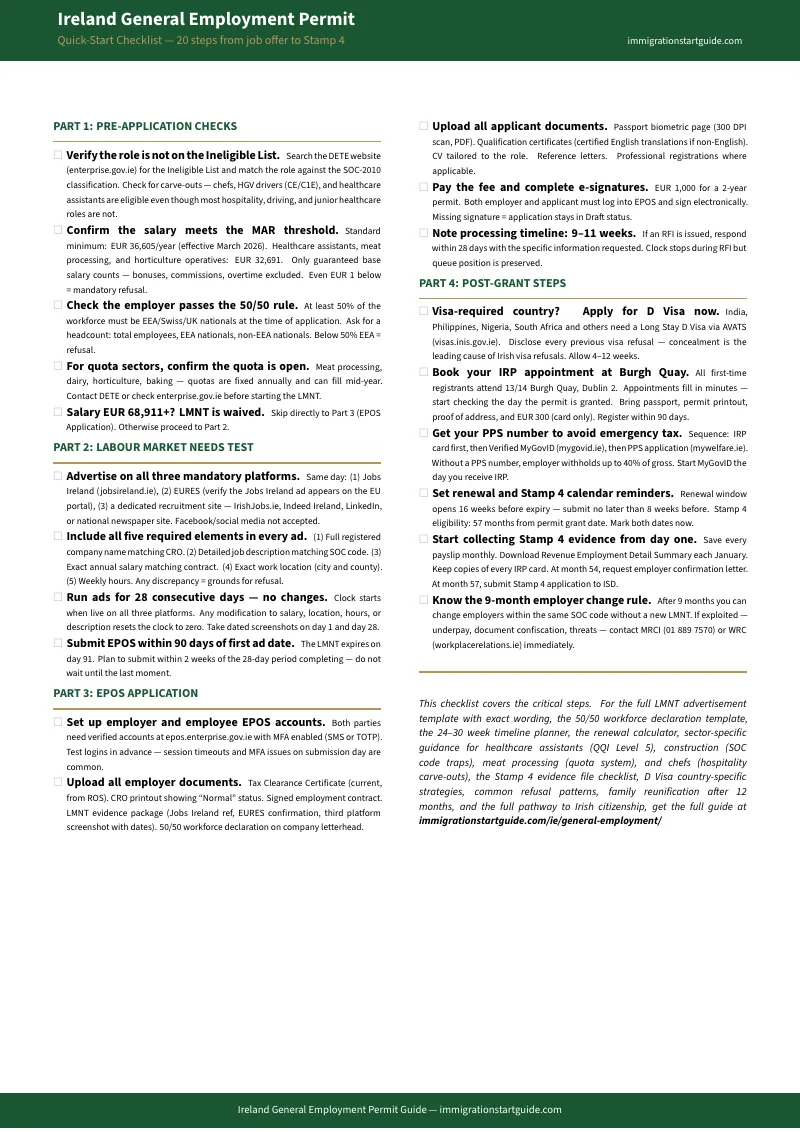
Quick-Start Checklist (free download)
A focused action plan covering the essentials: verify your role is not on the Ineligible List, check your salary against the 2026 thresholds, confirm your employer meets the 50/50 rule, identify your LMNT advertising requirements, and plan your D Visa timeline if visa-required. Enough to assess your eligibility and identify your next concrete step tonight.
Who This Guide Is For
This guide is for non-EEA workers with a job offer from an Irish employer for a role that requires a General Employment Permit, and the employers sponsoring them:
- Healthcare assistants and home carers recruited from India, the Philippines, and Nigeria who face the dual burden of the permit process and QQI Level 5 qualification requirements — with a lower salary threshold that still increases annually
- Construction trades — electricians, carpenters, steel fixers, site supervisors — who need to classify their role correctly to avoid the Ineligible List and whose employers are often handling their first permit application
- Meat processing operatives and horticulture workers applying under quota-limited permits where slots close mid-year and the advertising requirements include specific accommodation declarations
- Chefs and hospitality managers who qualify under the Ineligible List carve-outs but must document 2+ years of experience and navigate the distinction between "chef" (eligible) and "kitchen assistant" (not eligible)
- Small and medium employers sponsoring their first non-EEA hire who need to get the LMNT right the first time because their HR department is one person who has never used EPOS
- Visa-required nationals from India, Nigeria, Pakistan, the Philippines, and South Africa who face a two-stage process — permit then D Visa — and need to coordinate timelines so neither approval expires before the other arrives
- Workers already on a GEP who are approaching their 9-month mobility window, their 2-year renewal, or their 57-month Stamp 4 eligibility and need to understand the compliance requirements at each stage
This guide is not for: EEA/Swiss/UK nationals (you do not need a permit), applicants seeking roles on the Critical Skills Occupation List (see the Ireland Critical Skills Employment Permit Guide), or professionals whose salary exceeds €68,911 (you qualify for the LMNT-exempt high-earner GEP route, which is covered but is a simpler process).
Why Not Free Resources?
Free information on the General Employment Permit exists in abundance. Here is what it actually delivers:
- Citizens Information provides a reliable plain-language summary of the permit requirements. It does not cover the LMNT advertising templates, does not explain the difference between a valid and invalid third platform, does not document the 50/50 rule calculation at renewal, and treats the permit, visa, IRP, and Stamp 4 as four unrelated processes. You get the rules without the strategy.
- DETE's own guidance tells you that your occupation must not be on the Ineligible List and your salary must meet the threshold. It does not tell you how to handle a SOC code that falls on the boundary between eligible and ineligible, how to time your LMNT against a March salary threshold increase, or what to do when the EPOS upload silently rejects your employer's Tax Clearance Certificate because the CRO name does not match exactly. The department that processes your application does not teach you how to survive its own system.
- Immigration solicitors charge €2,000 to €5,000 for a GEP application. For a healthcare assistant earning €32,691, that is two months of take-home pay. Many solicitors are hired by the employer or recruitment agency, not the employee — their scope ends at getting the permit issued. Your D Visa, your IRP registration, your renewal strategy, your 57-month Stamp 4 clock, and your employment rights if your employer is one of the 71% who breach them — those are your problem.
- Recruitment agencies handle the permit as part of a placement fee paid by the employer. This is convenient until you realise the agency has no interest in your renewal, your salary keeping pace with the MAR roadmap, your employer maintaining the 50/50 ratio, or your path to Stamp 4. They filled the vacancy. Your five-year immigration journey is not their product.
- Reddit and Facebook groups are where someone who moved to Ireland in 2022 tells you the employer lock-in is 12 months (it is now 9), that you need newspaper ads for the LMNT (you do not since the 2024 Act), and that Healthcare Assistants need a salary of €30,000 (it is now €32,691). The advice is specific and confident and often dangerously wrong because the 2024 Act and the MAR roadmap changed the rules they learned under.
This guide fills the integration gap — the space between "I know the requirements" and "I can navigate three government departments, annual salary indexation, an employer compliance regime, and a 57-month residency clock as one continuous process without an RFI, a refusal, or a missed deadline." It delivers the same strategic preparation that immigration solicitors charge thousands for, organised so you and your employer can execute it yourselves.
— Less Than 5% of Your Application Fee at Risk
Your General Employment Permit application costs €1,000 in government fees. If refused, you lose €100 immediately — DETE keeps 10% — and you restart the entire LMNT advertising cycle from scratch: another 28 days of ads, another 90-day filing window, another 9-11 weeks of processing. That is not a two-week setback. That is a four-month delay while your employer considers whether to wait or hire someone else. The total cost of getting this wrong is measured in thousands of euros of lost salary and months of career disruption.
Add the D Visa fee for visa-required nationals. Add the €300 IRP registration fee when you arrive. Add the renewal fee of €1,500 at Year 2. Add the salary increases your employer must grant to meet the MAR roadmap at each renewal — increases they will not grant if they do not understand the obligation. The GEP is not a one-time application. It is a five-year financial and administrative commitment, and the cost of getting any stage wrong cascades into every stage that follows.
Immigration solicitors charge €2,000 to €5,000 for the permit application alone. Recruitment agencies take a placement fee from the employer and disappear. And here is the part that matters: neither of them is managing your five-year journey. The solicitor is not checking whether your employer's 50/50 ratio will hold at renewal. The agency is not tracking whether your salary meets the 2027 MAR threshold. Your residency, your citizenship, your family's future in Ireland — those are your responsibility. This guide is the strategy layer that makes sure the €1,000 you are about to spend produces a permit, not a refusal — and that every year that follows builds toward Stamp 4 and an EU passport.
Money-back guarantee, no time limit. If the LMNT templates, the EPOS walkthrough, and the 57-month Stamp 4 blueprint do not make your application stronger, you pay nothing.
Download the free Quick-Start Checklist to verify your eligibility, check the Ineligible List, and confirm your salary meets the 2026 thresholds tonight. When you are ready for the complete Permit-to-Passport System — the LMNT compliance toolkit, the EPOS field-by-field guide, the sector-specific strategies, the 50/50 rule tracker, the D Visa bridge, and the Year 1-to-Year 5 Stamp 4 blueprint — the full guide is here.
You have the job offer. Now secure the permit — and the five-year path to an EU passport — that makes it real.