
You Survived 21 Months on a Tied Permit. Now a Missing Payslip, an Absence You Thought Was Fine, or an "Inactive" Status on the ISD Portal Could Cost You the Stamp 4 That Frees You From Your Employer, Your Right to Stay in Ireland, and the Citizenship Clock That Starts the Day It's Granted.
You have been in Ireland for nearly two years. You have a Critical Skills Employment Permit. You are approaching the 21-month mark — the threshold where you become eligible to apply for Stamp 4, the immigration permission that lets you work for any employer, start a business, and live in Ireland without being legally tethered to the company that brought you here. Your employer's HR department handled the employment permit. They do not handle Stamp 4. Stamp 4 is a personal residency permission — your employer has no legal standing to apply for it, and in some cases they have a quiet incentive not to help you get it, because a Stamp 4 holder can walk away. You search for guidance. Citizens Information tells you that you need "proof of employment" but does not explain how to get that proof when your HR manager takes three weeks to reply or your company was acquired six months ago and the legal entity name changed. Reddit tells you someone got approved without a Revenue EDS, so maybe you do not need one — until you encounter a stricter adjudicator who refuses your application for exactly that reason. The ISD portal accepts your upload, shows "Inactive" for eleven weeks, and you have no idea whether that means it is being processed, it failed silently, or your file exceeded the 1MB limit and was never received.
Here is the problem that no free resource solves: Stamp 4 is not a single application — it is a pathway-specific transition that depends on which permit you hold, how long you have held it, whether your employer cooperates, what documents Revenue has on file for you, and how the ISD portal behaves on the day you submit. The CSEP route requires 21 months. The GEP route requires 57 months. The spouse route has no waiting period but needs proof of a genuine relationship. The Zambrano route for parents of Irish children has different evidence requirements entirely. Every pathway has its own document list, its own timing rules, its own refusal patterns — and every free resource covers only one of them, usually with information that was accurate two years ago.
The Ireland Stamp 4 (Long-Term Residency) Guide is a Tied-Permit-to-Independence System built for the specific problem every permit holder faces at the transition point: converting months of compliant residence into the stamp that gives you labour market freedom, removes the employer tie, and starts the citizenship clock — without a refusal, a request for further information, or a gap in permission that costs you reckonable residence days. This is not a summary of the rules. This is the integrated system covering every pathway to Stamp 4, the 2026 ISD portal walkthrough, the Revenue EDS that replaced the P60, the employer non-cooperation strategy, the absence rules that confuse Stamp 4 with citizenship, the expired IRP recovery procedure, and the post-grant plan that turns your Stamp 4 into an Irish passport.
What's Inside the Tied-Permit-to-Independence System
The complete guide, a quick-start checklist, and three standalone printable tools you can use immediately:
The CSEP Pathway: 21-Month Fast Track
Critical Skills Employment Permit holders become eligible for Stamp 4 after 21 months of continuous employment. The trap: applying even one week before the 21-month mark triggers an automatic refusal. Applying too late risks a gap in permission that could affect your citizenship timeline years from now. The guide provides the exact eligibility date calculator, the complete document list for the 2026 ISD standards — passport, IRP (front and back), employment permit, employer letter (with the specific phrases adjudicators look for), three months of payslips, and the Revenue Employment Detail Summary that replaced the P60 in 2024. It maps the application window so you file at the right moment: not early enough to be refused, not late enough to create a permission gap.
The GEP Pathway: 57-Month Standard Route
General Employment Permit holders face a longer road — approximately five years of continuous legal residence before Stamp 4 eligibility. The complexity multiplies because GEP holders must navigate permit renewals, salary threshold increases under the MAR roadmap, and the 50/50 workforce ratio rule at every stage. A GEP holder who was compliant at initial grant can be blocked at renewal because their employer hired additional non-EEA workers. The guide covers the 57-month calculation, the renewal compliance checkpoints, and the specific documentation differences between the GEP and CSEP pathways so nothing falls through the gap between Year 2 and Year 5.
Family Pathways: Spouse, De Facto Partner, and Zambrano
Spouses and civil partners of Irish citizens can register for Stamp 4 immediately — no waiting period. But "immediately" does not mean "simply." You need an original civil marriage certificate (religious certificates are insufficient), your Irish spouse's passport, proof of joint address through utility bills or bank statements in both names, and private health insurance with full hospital cover for first registration. De facto partners face additional scrutiny — proving a genuine relationship of two or more years. Zambrano applicants (parents of Irish citizen children) navigate an entirely separate evidence framework based on the constitutional rights of the child. The guide provides the document masterclass for each family pathway, with the specific evidence that distinguishes an approval from a request for further information.
The Document Masterclass
ISD adjudicators in 2026 operate on a volume-based model. If a document is missing, blurry, in the wrong format, or lacks the right phrasing, the application is refused or returned without a request for more information. The guide covers every document across every pathway: how to request a Revenue EDS (the Employment Detail Summary from Revenue.ie that is now the gold standard for proving tax compliance), how to get an employer letter that contains the exact phrases adjudicators verify (job title, salary, commencement date, confirmation of active employment — dated within three months), the file format and size requirements for the ISD portal (PDF only, under 1MB per upload), and the specific documents that trip up each nationality — Indian applicants who need apostilled degrees, Filipino nurses whose NMBI registration must be current, Brazilian professionals whose qualifications need credential evaluation.
The ISD Portal Walkthrough
The Immigration Service Delivery portal is the primary bottleneck in 2026. The system accepts your upload and then goes silent. An "Inactive" status can mean your application is in queue, or it can mean your file exceeded the size limit and was never received. The "Renewal/Upgrade" pathway selection is confusing — choosing the wrong sub-category can route your application to the wrong team. The guide provides a screenshot-annotated walkthrough of the entire portal process: account creation, document upload with compression instructions for oversized files, the correct sub-category for your specific pathway, how to interpret each portal status, when to send a follow-up email (and to which address), and how to use your OREG number to verify that your submission actually reached a caseworker.
The Absence Rules: Stamp 4 vs. Citizenship
This is where the internet gets it dangerously wrong. Applicants panic because they spent three weeks visiting family abroad and believe it disqualifies them from Stamp 4. It does not. The "continuous residence" standard for Stamp 4 means Ireland is your primary centre of life — brief trips for holidays and family visits are permitted, and there is no hard cap of 42 or 70 days for Stamp 4 eligibility. The 70-day cap is for citizenship — specifically the final year before your naturalisation application. The guide separates these two standards clearly, provides the absence calculation method for both, and includes a residence-day tracker so you know exactly where you stand for Stamp 4 now and for citizenship later.
The Employer Non-Cooperation Strategy
Your employer's HR department handled your work permit because the company was the applicant. Stamp 4 is different — you are the applicant, and your employer's only role is providing a confirmation letter. Some employers are slow. Some are reluctant. Some have a quiet conflict of interest: a Stamp 4 holder can resign and work anywhere, which removes the employer's leverage over a worker who might otherwise tolerate below-market pay or poor conditions. The guide provides the alternative evidence strategy for when your employer refuses or delays the letter — how to compile contracts, payslips, Revenue EDS records, and a statutory declaration that together satisfy the adjudicator's requirements without employer cooperation. It also covers the specific scenario of company acquisition, name change, or closure during your qualifying period.
Expired IRP Recovery
IRP processing delays in 2026 routinely reach 12 to 16 weeks. Your current IRP card expires. Your new one has not arrived. You cannot travel. Your bank asks questions. Your landlord sees an expired card and worries. The guide covers how to document your pending renewal status, what evidence to carry, the letter you can request from ISD confirming your application is in process, and how to handle the practical consequences of being in immigration limbo while your application is processed.
Refusal and Appeal Procedures
If your Stamp 4 application is refused, you are not deported. You have the right to request a review, submit additional documentation, and in some cases make formal representations. The guide covers the most common refusal reasons (insufficient evidence of continuous residence, missing documents, timing errors), the review process and timelines, and the specific evidence that overturns each type of refusal. It is the safety net you hope you never need but must understand before you apply.
Beyond Stamp 4: Renewal and Citizenship
Stamp 4 is not permanent. It is typically granted for two years and must be renewed. The guide covers the renewal process, the documents required, and the timeline for filing so your permission never lapses. More importantly, it maps the path from Stamp 4 to Irish citizenship: the five-year reckonable residence requirement, the 70-day absence rule in the final year, the naturalisation application process, and the calculation method for determining your exact eligibility date. You did not come this far to stop at Stamp 4. The guide takes you to the passport.
Post-Grant Action Plan
The day your Stamp 4 is granted, your to-do list changes. You need to notify Revenue of your new immigration status. Your bank may need an updated IRP. If you plan to change employers, you can now do so without a permit — but there are practical steps to take first. If you plan to start a business, Stamp 4 gives you the right but not the roadmap. The guide provides the post-grant checklist: every notification, every update, every practical step to take in the first 30 days after approval so you immediately benefit from the freedom you worked years to earn.
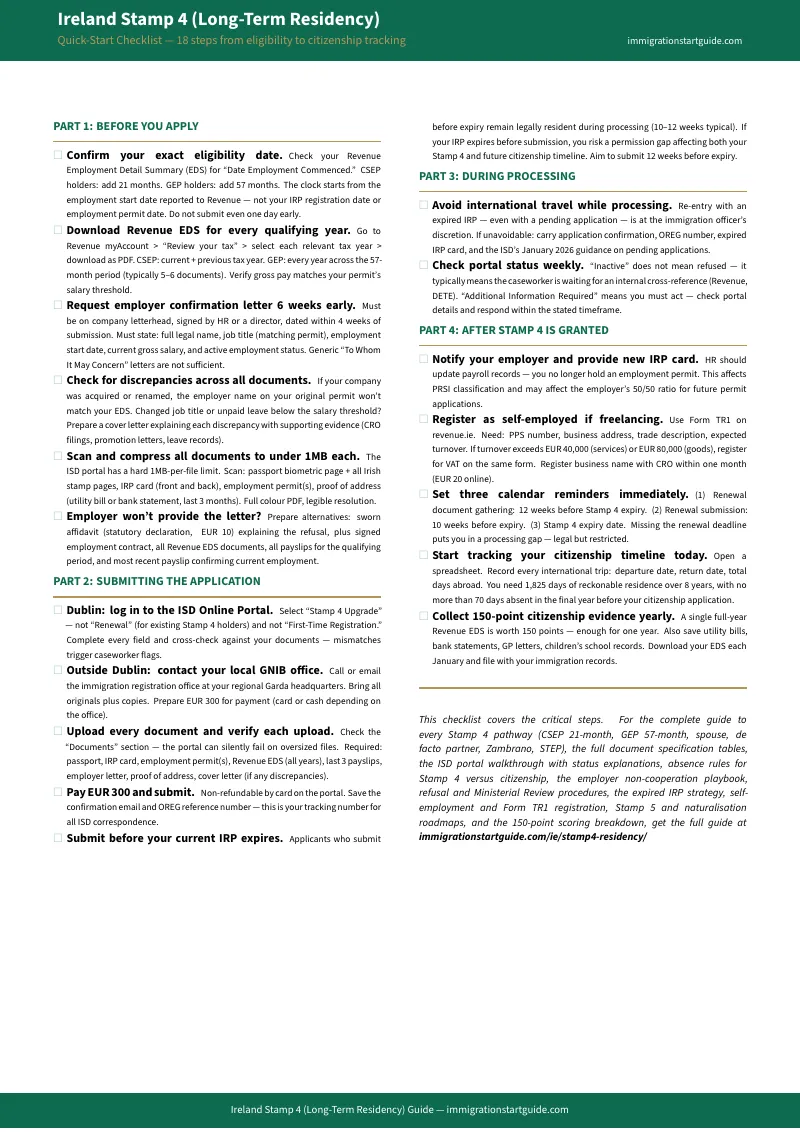
Quick-Start Checklist (free download)
A focused action plan covering the essentials: confirm your pathway and eligibility date, verify you have the core documents (IRP, permit, EDS), check the ISD portal requirements, and identify your next concrete step. Enough to assess where you stand and what to do first — tonight.
Who This Guide Is For
This guide is for non-EEA nationals who are approaching or have reached Stamp 4 eligibility and need to navigate the transition from a tied permit to independent residency:
- Indian software engineers and IT professionals on Critical Skills Employment Permits approaching the 21-month mark — earning well above the threshold but paralysed by the ISD portal and unsure whether their three-week trip to India last December counts against them
- Filipino nurses and healthcare workers on GEPs who have spent nearly five years building a career in Ireland and cannot afford a refusal at the 57-month mark that would reset the clock on everything they have worked toward
- Brazilian, South African, and Pakistani professionals on either CSEP or GEP who need to coordinate the Stamp 4 transition with IRP renewal timelines and cannot get a straight answer from their employer's HR department
- Spouses and partners of Irish citizens who are entitled to Stamp 4 immediately but face a document-intensive registration process that requires proof of a genuine relationship, joint address evidence, and private health insurance
- Parents of Irish citizen children applying under the Zambrano route — a pathway with its own distinct evidence requirements that most general guides do not cover at all
- Workers whose employer has been acquired, restructured, or is uncooperative — and who need to prove their qualifying period without the standard employer confirmation letter
- Anyone on Stamp 4 approaching renewal or planning for Irish citizenship and naturalisation who needs to understand the reckonable residence calculation and the 70-day absence rule
This guide is not for: EEA/Swiss/UK nationals (you do not need immigration permission), applicants who have not yet obtained an employment permit (see the Ireland Critical Skills Employment Permit Guide or the Ireland General Employment Permit Guide), or people seeking Stamp 5 (long-term residency without conditions), which has separate requirements.
Why Not Free Resources?
Free information on Stamp 4 exists across government websites, immigration forums, and expat communities. Here is what it actually delivers:
- Citizens Information provides a reliable summary of what Stamp 4 is and who is eligible. It does not explain how to get a Revenue EDS when your employer used a payroll bureau and the records do not match, how to navigate the ISD portal when your upload silently fails at 1.2MB, or what to do when your employer takes six weeks to produce a confirmation letter and your IRP expires in the meantime. You get the rules without the execution strategy.
- The ISD website lists the required documents and provides the portal link. It does not explain why applications sit at "Inactive" for months, which sub-category to select for your specific pathway, or how to handle the gap between your expired IRP and your pending Stamp 4 decision. The department that processes your application does not teach you how to survive its own system.
- Immigration solicitors charge between €1,500 and €3,000 for Stamp 4 applications. For a standard CSEP-to-Stamp-4 transition — which is what 95% of applicants are doing — this is paying professional fees for administrative data entry. A solicitor does not make your application stronger if your documents are complete and correctly formatted. They make it more expensive.
- Reddit and Facebook expat groups are where someone who got Stamp 4 in 2023 tells you the P60 is a required document (it has been replaced by the Revenue EDS), that you need to be absent fewer than 42 days (that is the citizenship rule, not the Stamp 4 rule), and that the ISD portal works fine (it has been redesigned twice since their application). The advice is specific, confident, and based on a process that no longer exists.
This guide fills the gap between "I know the rules" and "I can execute the transition" — the space where applicants with complete eligibility still get refused because the employer letter was missing a phrase, the EDS was for the wrong tax year, or the portal upload failed silently and no one checked. It delivers the same preparation that immigration solicitors charge thousands for, organised so you can do it yourself.
— Less Than the Cost of Your IRP Registration Fee
Your IRP registration costs €300 every time you renew. A Stamp 4 refusal means reapplying — another €300 registration, another 12 to 16 weeks of processing, another period in immigration limbo where you cannot travel and your employer questions your status. If the refusal was caused by a timing error, you may need to remain on your current permit for additional months before you are eligible to reapply. That is not a minor setback. That is months of continued employer dependency, restricted job mobility, and the citizenship clock standing still.
Immigration solicitors charge €1,500 to €3,000 for the same transition. For a CSEP holder who has been in Ireland for 21 months without incident, that is paying for legal expertise you do not need. The solicitor fills in the same forms, uploads the same documents, and clicks the same buttons on the ISD portal. The difference between a successful DIY application and a solicitor-assisted one is not legal skill — it is knowing exactly which documents to prepare, in what format, with what phrasing, submitted through which portal pathway. That is what this guide provides.
You have already invested years of your life in Ireland. You have paid thousands in permit fees, IRP registrations, rent, and taxes. You have built a career, made a home, and established the residence that qualifies you for Stamp 4. The guide costs a fraction of what you have already spent — and it protects the entire investment by ensuring that the application you submit is the one that gets approved.
Money-back guarantee, no time limit. If the pathway-specific document lists, the ISD portal walkthrough, and the absence calculation tools do not make your application stronger, you pay nothing.
Download the free Quick-Start Checklist to confirm your pathway, check your eligibility date, and verify you have the core documents tonight. When you are ready for the complete Tied-Permit-to-Independence System — the multi-pathway guide, the document masterclass, the ISD portal walkthrough, the employer non-cooperation strategy, and the citizenship roadmap — the full guide is here.
You have earned the right to stay in Ireland. Now secure the stamp that makes it official — and start the clock toward an EU passport.