
KRW 100 Million on the Line. One Missing Document and Immigration Rejects Your Entire Application. This Guide Gets You From Capital Transfer to Residence Card.
You have the capital. You have the business idea. But Korean immigration does not care about your entrepreneurial vision. They care whether your KRW 100 million was transferred through the correct escrow sequence, whether your source of funds documentation traces every won back to a legitimate origin, whether your Articles of Incorporation were filed at the district court before or after your Business Registration Certificate was issued, and whether the physical office on your lease agreement qualifies as a "legitimate business premise" or gets flagged as a virtual address. Get any of these wrong and your investment sits frozen in a Korean bank account while your application is returned without prejudice. Not denied on merit. Returned because the sequence was wrong.
Law firms charge KRW 5 million to KRW 20 million to manage this process. They handle the filing --- but they rarely explain why the escrow must come before incorporation, why a serviced office with a hot desk will be rejected while a private lockable room at the same address will be approved, or why your business plan needs to address Korean job creation and not just your revenue projections. KOTRA's Invest Korea gives you forms and a consultation slot, but their advice is "siloed" --- one person helps with the Foreign Investment Notification, another with court registration, and nobody maps the immigration implications of each business decision. Reddit and expat forums are worse: someone's 2022 experience contradicts the 2026 NPS rate increase and the new education gap audit rules that took effect this year. You piece together fragments from five different sources and hope you assembled them in the right order.
The South Korea D-8 Investment Visa Guide is The Investment-to-Residency System --- the complete operational map that takes you from initial capital remittance through Korean company incorporation, D-8 visa approval, first-year renewal, and forward to F-5 permanent residency. Not a filing service that charges millions of won without transferring knowledge. Not a forum thread where contradictory advice from different years leaves you guessing which steps still apply. This is a structured system covering all four D-8 sub-categories (D-8-1 corporate investment, D-8-2 venture, D-8-3 joint venture, D-8-4 OASIS tech startup), the source of funds playbook with evidence templates for every wealth origin, the sequential incorporation lifecycle with the exact order that immigration requires, the office lease rules that determine approval or rejection, the business plan structure that passes immigration scrutiny, the Four Major Insurances and 2026 NPS rate changes, the renewal audit benchmarks, and the F-2-7 and F-5 permanent residency pathways available to D-8 holders.
What's Inside The Investment-to-Residency System
The complete guide plus a quick-start checklist --- everything from capital transfer to permanent residency:
Source of Funds Playbook
The number-one rejection reason for D-8 applications is failing the source of funds audit. Immigration does not just verify that KRW 100 million landed in the escrow account --- they trace it backward. Employment income requires salary certificates and 12 months of personal bank statements. Business profits require audited financials of the foreign parent company. Asset liquidation requires property sales contracts with proof of ownership history. Gifts and inheritance require notarized deeds and proof of the donor's source of funds. The guide provides evidence templates for each wealth origin and explains why applicants from high-violation countries face heightened scrutiny regardless of their actual financial position.
The Sequential Incorporation Lifecycle
Korean company formation is a strict sequence where each step is a legal prerequisite for the next. Foreign Investment Notification must precede the capital transfer. The capital transfer must complete before court registration. Court registration must precede Business Registration at the National Tax Service. And the Foreign-Invested Enterprise certificate must be issued before the visa application is filed. Miss one step or execute them out of order and the entire process invalidates. The guide maps every step with the responsible authority, the critical document produced at each stage, and realistic timelines --- not the "5 business days" that assumes no bank holidays or backlog.
D-8 Sub-Category Selection
The D-8 visa has four distinct sub-categories, each with different capital requirements, eligibility criteria, and target audiences. D-8-1 requires KRW 100 million and at least 10% voting shares. D-8-2 requires Venture Business Certification but no minimum capital. D-8-3 requires KRW 100 million invested in a Korean-managed company with joint representative registration. D-8-4 (OASIS) uses a points-based system that lets tech founders qualify without liquid capital if they have intellectual property or government startup support. The guide explains who qualifies for each, the strategic advantages and risks of each category, and how to choose the path that matches your capital position and business model.
The OASIS D-8-4 Route for Tech Founders
If you have a patent, a Master's degree, or participation in a government startup program --- but not KRW 100 million in liquid capital --- the D-8-4 OASIS visa is your entry point. The guide breaks down the 360-point matrix, the mandatory prerequisite items (you must satisfy at least one), the most efficient point combinations for reaching the 80-point threshold, and the 2026 expansion of Global Startup Immigration Centers to Busan and Chungbuk. It also covers the D-10-2 Startup Preparation visa as a bridge status while you accumulate OASIS points.
Business Plan Structure That Passes Immigration Scrutiny
Immigration officers do not evaluate your business plan like a venture capital investor. They look for specific signals: how many Korean nationals you will hire, how the investment contributes to GDP, what your revenue timeline looks like, and whether the business model is plausible for the Korean market. A plan that impresses Silicon Valley VCs but ignores Korean job creation will be rejected. The guide provides the structure, the mandatory elements, and the language that signals "legitimate economic contribution" rather than "paper company designed to secure residency."
Physical Office Requirements and the Lease Trap
Virtual offices are rejected for D-8 applications. Home offices are rejected in almost all cases. Shared desks and hot desks are rejected. A serviced office with a private, lockable room in your company's name is generally approved. Immigration may conduct site visits to verify that the office has a proper sign, is equipped for business, and is not shared with unrelated entities. The guide explains exactly which office arrangements qualify, how to handle the "chicken and egg" problem of needing a registered address before incorporation, and which government-backed startup incubators provide qualifying addresses.
The Four Major Insurances and 2026 NPS Changes
Foreign directors must enroll in National Pension, Health Insurance, Employment Insurance, and Workers' Injury Compensation. The NPS rate increased to 9.5% in January 2026 (targeting 13% by 2033). Health Insurance is mandatory for all foreign residents after six months regardless of nationality. These contributions are not optional --- they are scrutinised during visa renewal as proof of "active business." The guide covers current rates, employer-vs-employee splits, reciprocity treaty exemptions for National Pension, and how to budget for these costs from day one.
Renewal Audit Benchmarks
The initial D-8 visa is granted for one year. Renewal is a comprehensive audit: immigration checks revenue generation (zero-revenue companies face extreme difficulty), tax compliance (any unpaid tax means automatic rejection), job creation (hiring Korean nationals is the single best renewal signal), capital integrity (the KRW 100 million must remain in the company's capital account), and physical presence (absent more than six months and the extension is refused). The guide provides the specific benchmarks and documentation required to pass each renewal criterion.
The Path to Permanent Residency (F-5)
Most D-8 holders treat the visa as a stepping stone to permanent residency. The guide maps three routes: F-5-1 general (5 years residence + 2x GNI income), F-5-5 investor (USD 500,000 + 5 Korean employees --- waives KIIP and criminal record requirements), and the F-2-7 intermediate step (points-based, available after 1 year, grants freedom from single-employer restriction). It explains how to structure your business from day one to meet the thresholds that unlock permanent residency --- income targets, staffing benchmarks, and the KIIP/TOPIK requirements.
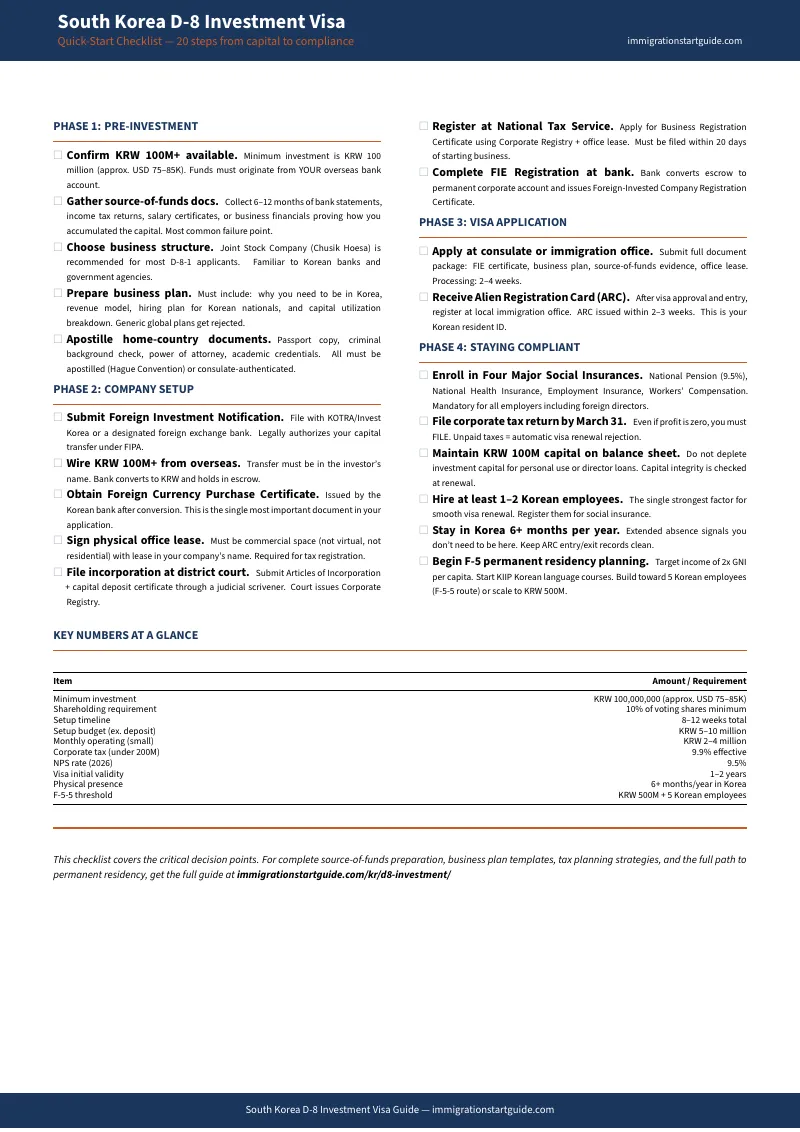
Quick-Start Checklist (free download)
A 20-item action list covering the essentials: confirm your D-8 sub-category, verify your source of funds documentation, understand the escrow sequence, check physical office requirements, and identify your capital remittance timeline. Enough to identify your first concrete step tonight.
Standalone Printable Tools (included with the guide)
- Source of Funds Evidence Guide --- bring this to your bank meeting: evidence templates for every wealth origin, common mistakes, and red flags to avoid
- Incorporation Timeline --- desk reference card mapping all 8 phases from document preparation to ARC with responsible authorities and timelines
- OASIS Points Worksheet --- fillable tracker for D-8-4 applicants to calculate their score against the 80-point threshold
- Business Plan Template --- the 10-section structure immigration officers evaluate, with guidance on what to include in each
- Compliance Calendar --- annual tax, insurance, and immigration deadlines for your office wall
- Renewal Audit Checklist --- the 5 criteria immigration evaluates and the 8 documents to prepare before filing extension
Who This Guide Is For
This guide is for foreign investors and entrepreneurs establishing businesses in South Korea who need to navigate the D-8 visa from capital transfer to permanent residency:
- Entrepreneurs with KRW 100 million or more in verifiable capital who want to incorporate a Korean company and secure D-8-1 residency without paying KRW 5-20 million in law firm fees for a process they do not understand
- Tech founders with intellectual property or advanced degrees who qualify for the D-8-4 OASIS route but need a clear map of the points system, the prerequisite items, and how to combine OASIS modules with a patent application to reach the 80-point threshold
- Foreign investors entering joint ventures with Korean partners who need to understand the D-8-3 joint representative structure and how to protect their position when co-managing with a Korean national
- Existing D-8 holders approaching their first renewal who need to know exactly what immigration audits --- revenue, taxes, headcount, capital integrity, physical presence --- and how to document compliance before the extension application is filed
- Anyone on a D-8 who wants to plan their F-5 permanent residency strategy from day one --- the income thresholds, the staffing targets, the KIIP requirement, and the high-investment shortcut that waives integration requirements
- Entrepreneurs currently on a C-3-4 business visa or D-10-2 startup preparation visa who need to understand the status change process to D-8 without leaving Korea
This guide is not for: professionals seeking employer-sponsored work visas (see the South Korea E-7 Work Visa Guide), or current visa holders focused solely on the F-2-7 points-based residency transition (see the South Korea F-2 Points-Based Residency Guide).
Why Not KOTRA or Free Resources?
- KOTRA / Invest Korea provides the Foreign Investment Notification form and a consultation slot. They help with incorporation paperwork. But they do not map the immigration consequences of each business decision, do not explain why your source of funds needs to be documented months before you transfer capital, and do not advise on the office lease requirements that determine whether your visa application is approved or returned. Their service is siloed --- business setup in one department, immigration in another, and nobody connects them.
- Law firms charge KRW 5 million to KRW 20 million for the first year. They file documents. But most investors walk away without understanding why the escrow must precede incorporation, what the renewal audit actually evaluates, or how their first-year decisions affect their F-5 eligibility five years later. You get a filing service without the strategic layer.
- Reddit and expat forums (r/Living_in_Korea, r/korea) contain advice from people who went through the process in different years, under different rules. The 2026 NPS rate increase, the heightened source-of-funds scrutiny, and the education gap audit rules are not reflected in posts from 2023 or 2024. You get contradictory fragments with no way to verify which still apply.
- Beomusa (judicial scriveners) handle court registration filings. They are essential for that step but do not advise on the immigration strategy, the source of funds documentation, or the business plan structure that determines whether your visa is approved.
This guide fills the gap --- the space between "KOTRA gave me a form" and "I understand every sequential step, every documentation requirement, and every decision point from capital transfer through permanent residency." It provides the investor-aligned strategy that no single government agency or law firm offers as a complete picture.
--- A Fraction of One Law Firm Consultation
A source of funds rejection does not just delay your application --- it freezes your KRW 100 million in a Korean escrow account while you scramble to produce documentation you should have prepared months earlier. A wrong office lease means a site visit that flags your company as a "paper entity." An out-of-sequence incorporation means your Foreign-Invested Enterprise certificate is invalid and you restart the process from the notification stage. Each of these failures costs months and often additional legal fees to correct.
Law firms charge KRW 5 million to KRW 20 million. A single Beomusa engagement for court registration runs KRW 1-3 million. The guide costs a fraction of one consultation and covers the strategic layer that filing services never transfer to the investor.
Money-back guarantee, no time limit. If the source of funds playbook, the sequential incorporation map, the D-8 sub-category analysis, the office lease rules, the business plan structure, the renewal audit benchmarks, and the F-5 residency pathway do not make you materially better prepared for your D-8 application, you pay nothing.
Download the free Quick-Start Checklist to run the 20-item readiness assessment tonight. Confirm your D-8 sub-category. Check your source of funds documentation. Understand the escrow sequence. When you are ready for the full system --- the complete source of funds playbook, the sequential incorporation lifecycle, the OASIS D-8-4 route, the business plan structure, the office rules, the renewal benchmarks, and the permanent residency pathway --- the complete guide is here.
Your law firm files the paperwork. This guide makes sure you understand every step, every sequence, and every decision point that determines whether your KRW 100 million investment actually becomes a Korean residence card.