
You Are 2 Points Short of Residency. Your 40th Birthday Is in 11 Months. This Guide Shows You Exactly Where to Find Those Points.
You have been in Korea for three years. You have a stable job, a lease, a life. But you are still on an E-7. Your employer knows you cannot leave without losing your legal status. Your salary negotiation last year went nowhere because they know the power dynamic --- if you quit, you have 14 days to find a new sponsor or leave the country. The F-2-7 residency visa is the fix: independent status that survives any employer relationship. Freedom to change jobs, start a side business, or simply negotiate from a position of strength. But between you and that visa is an 80-point scoring system that nobody has explained to you properly in English.
You have read the Reddit threads. One person says TOPIK 5 is enough. Another says you need KIIP Stage 5 or you are leaving 10 points on the table. Someone calculated that a ₩45 million salary gives you 40 income points, but nobody mentioned that freelancers reporting through the 3.3% withholding system often have their income artificially deflated by standard deduction ratios --- meaning the tax office shows ₩32 million on your Income Amount Certificate even though ₩48 million hit your bank account. And the person who said "just get TOPIK 6" did not mention that the certificate expires in two years, so if your renewal falls in an off-cycle testing month, you are reapplying for residency with zero language points.
Then there is the GNI problem. Every April, the Bank of Korea publishes a new Gross National Income figure --- ₩49,955,000 for the 2025 cycle --- and every income threshold in the scoring system shifts. The salary that gave you 50 points last year might only give you 40 this year. Nobody told you this was a moving target. Nobody told you the 8-point cliff at age 40, where your age score drops from 20 to 12 overnight. And nobody told you that if you work for a KOSPI-listed company, you can bypass the 3-year residency requirement entirely and apply on day one.
The South Korea F-2 Points-Based Residency Guide is the 80-Point Strategy System --- a complete tactical blueprint for accumulating, optimising, and defending your points score from today through approval and beyond. Not an agency that charges ₩1.5 to ₩3 million to fill out forms without explaining the strategy behind them. Not a Reddit thread from 2022 referencing a GNI figure that no longer applies. This is an English-language residency system covering the 2025 GNI-adjusted scoring tables, the KIIP vs. TOPIK strategic decision (and why one gives you 10 points the other cannot), the income optimisation framework for both employees and freelancers, the Listed Company fast-track that most professionals do not know exists, the country-specific apostille and document authentication chains, the complete application walkthrough from HiKorea portal to immigration office interview, and the F-5 permanent residency positioning strategy for after your F-2-7 is approved.
What's Inside the 80-Point Strategy System
The complete guide plus a quick-start checklist --- everything from point calculation to the permanent residency pathway:
The 2025 GNI-Adjusted Scoring Calculator
Income points are not static. They shift every April when the Bank of Korea publishes a new GNI per capita figure. For the 2025 cycle, ₩49,955,000 is the baseline --- and your income score is calculated relative to that number. The guide provides the complete 2025 scoring table with exact thresholds (₩30M = 30 points, ₩40M = 40 points, ₩60M = 50 points, ₩80M = 56 points, ₩100M+ = 60 points), explains how income is verified through the Income Amount Certificate (소득금액증명서), and walks you through the mismatch between actual earnings and reported income that costs freelancers points every year.
The KIIP vs. TOPIK Strategic Decision
Both paths give you up to 20 base points for Korean language proficiency. But KIIP Stage 5 completion adds 10 bonus points that TOPIK cannot provide --- and it never expires, while TOPIK certificates become invalid after two years. The guide maps out the 12-month KIIP timeline (70 hours of coursework through socinet.go.kr), the placement test strategy that can skip you directly to Stage 4, when TOPIK is the faster choice for professionals who already have intermediate Korean, and the specific scenario where holding both creates the maximum point buffer for renewals.
The Listed Company Fast-Track
If your employer is listed on KOSPI or KOSDAQ, the standard 3-year residency requirement is waived. You can apply for the F-2-7 on the first day of your contract --- provided your education, language, and income points clear 80. Most professionals at Samsung, SK Hynix, Kakao, Naver, and listed tech startups do not know this exemption exists. The guide identifies the eligibility criteria, shows you how to verify your company's listing status, and maps the fastest path from job offer at a listed company to F-2-7 approval.
The Freelancer Income Defence Strategy
Freelancers taxed at the 3.3% withholding rate face a structural problem: the tax office applies standard deduction ratios that can deflate your reported income by 30-60%. A freelancer depositing ₩50 million will often show ₩32-35 million on the Income Amount Certificate that immigration uses for point calculation. The guide explains the deduction ratio mechanics, the specific tax reporting strategy that preserves your income points without overpaying (and the annual cost --- typically ₩2-6 million in additional tax), and the calculation framework that lets you decide exactly how much "visa tax" your residency is worth.
The Age Clock and Timing Strategy
Age points decline on a fixed schedule, and the cliff at 40 is brutal: 20 points at age 39, 12 points at age 40. That is an 8-point drop that cannot be recovered through any other category. For a professional currently at 78-82 points, turning 40 can push them permanently below the threshold. The guide maps every age bracket, identifies the "critical windows" where application timing matters more than any other factor, and provides the acceleration strategy for professionals in their mid-to-late 30s who need to secure approval before the age penalty hits.
The Document Authentication Protocol
Korean immigration requires apostilled or embassy-verified originals for every foreign document --- degrees, criminal background checks, and marriage certificates. The process is different for every country, and documents authenticated through the wrong chain are rejected at the window with no warning. The guide provides country-specific apostille workflows for the US (Secretary of State for state-issued documents, Department of State for federal), India (State GAD attestation, then MEA apostille, then Korean translation), and the UK, plus the six-month validity window you must plan around and the "private letter workaround" for proving employment history from companies that no longer exist.
The Complete HiKorea Application Walkthrough
The HiKorea portal controls your entire immigration process and still requires Internet Explorer compatibility mode and ActiveX plugins. Mac users need specific workarounds. Pop-up blockers break the payment and certificate windows. Seoul immigration offices book out four to six weeks. The guide covers the technical setup, the Non-Member reservation system, the document upload process, what happens at the immigration office interview, and the timeline strategy of booking your appointment before all documents are ready.
The F-5 Permanent Residency Positioning
The F-2-7 is not the end --- it is the bridge to F-5 Permanent Residency after three years. But the F-5-16 pathway carries a much higher income requirement: approximately double the GNI, or ₩99.9 million for the 2025 cycle. The guide covers how to position yourself during the F-2-7 holding period, the income acceleration strategies that bring ₩100M within reach, and the alternative F-5 pathways (investment-based, social integration-based) for professionals whose salary trajectory will not reach the ₩100M mark.
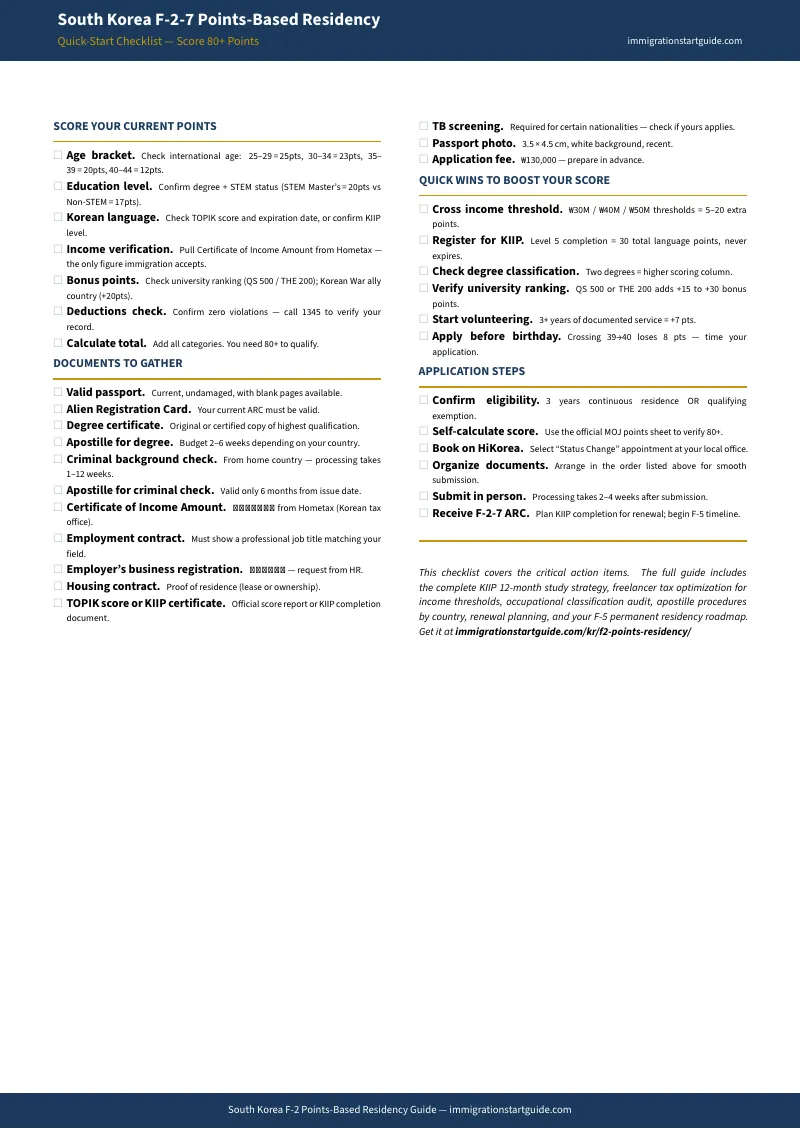
Quick-Start Checklist (free download)
A one-page scoring worksheet and action plan: calculate your current points across all five categories (Age, Education, Korean Proficiency, Income, Bonus), identify your gap to 80, and determine the single highest-leverage action you can take this month. Enough to know exactly where you stand tonight.
4 Standalone Printable Tools
In addition to the complete guide, you get 4 standalone PDFs designed to be printed and used at the exact moment you need them:
- Points Scoring Worksheet --- Every scoring category with 2025 thresholds on one page. Fill in your numbers, calculate your total, and identify the gap. Updated to the ₩49,955,000 GNI baseline.
- Document Checklist --- Every document required for the F-2-7 application with validity periods, authentication requirements, and the order you should gather them in.
- KIIP Enrollment Action Plan --- Timeline from registration through Stage 5 completion, placement test strategy, class schedules, and the specific milestones that earn you the 10-point bonus.
- Income Optimisation Reference --- The 2025 GNI-adjusted income brackets, the freelancer deduction ratio table, the "visa tax" calculation framework, and the employee vs. freelancer reporting comparison on one page.
Who This Guide Is For
This guide is for English-speaking professionals in Korea who need to reach, prove, and defend 80 points on the F-2-7 scoring system:
- E-7 visa holders who have completed one to three years of residence and need a clear strategy for transitioning to independent residency status before their next contract renewal
- Professionals at KOSPI or KOSDAQ-listed companies who qualify for the fast-track exemption but did not know the 3-year residency requirement could be waived
- Workers in their mid-to-late 30s facing the age cliff at 40 who need to secure approval before losing 8 points they cannot recover
- Freelancers and contractors on 3.3% withholding who are losing income points to standard deduction ratios and need the tax reporting strategy that preserves their score
- Professionals earning ₩40-60 million who fall in the "point shortfall" zone and need to know whether KIIP, TOPIK, volunteering, or income growth is the fastest path to 80
- E-7 holders with families who want to transition their spouse from the restricted F-3 visa to the F-2-71 dependent status that permits unrestricted employment
- D-2 or D-10 visa holders with Korean Master's or PhD degrees who qualify for the "Domestic Study Talent" fast-track and need the application mapped out
- Anyone planning for F-5 Permanent Residency who needs to use the F-2-7 as a strategic stepping stone while building toward the ₩100M income threshold
This guide is not for: professionals who have not yet secured a Korean work visa (see the South Korea E-7 Work Visa Guide), or entrepreneurs seeking self-sponsored business residency (see the South Korea D-8 Investment Visa Guide).
Why Not an Agency or Free Resources?
- Haengjeongsa (administrative agencies) charge ₩1.5 to ₩3 million. They assemble your documents and file the application. What they do not do: explain the KIIP vs. TOPIK trade-off, tell you about the Listed Company exemption, optimise your freelancer tax reporting for maximum income points, or map a 12-month acceleration plan that gets you from 72 points to 80 before your age score drops. You are paying for document assembly, not strategy.
- Reddit threads (r/Living_in_Korea, r/korea) contain real experiences from real applicants --- referencing GNI figures from 2022 and 2023. The 2025 baseline is ₩49,955,000. Every income threshold in the system shifted. Advice based on last year's numbers will miscalculate your points. And the conflicting KIIP-vs-TOPIK debate on Reddit never resolves because nobody explains the 10-point bonus mechanic clearly.
- HiKorea and official MOJ documents list the raw scoring table in Korean bureaucratic language. They do not explain point optimisation strategy, the freelancer income trap, the age cliff timing, or the Listed Company fast-track. They assume you already know how the system works and just need to confirm a number.
- Law firm blogs publish technically accurate summaries written for other immigration professionals. They do not tell you that booking your KIIP placement test in January instead of March saves you an entire KIIP cycle, or that your company's KOSDAQ listing status changes your timeline from "3 years minimum" to "apply immediately."
This guide fills the strategic gap --- the space between "I know the F-2-7 requires 80 points" and "I have a month-by-month plan to reach 80 points optimised for my specific situation." It is the tactical layer that neither agencies nor free resources provide.
--- Less Than One Percent of Agency Fees
Haengjeongsa charge ₩1.5 to ₩3 million for a filing service. Missing the age cliff at 40 costs you 8 points you cannot recover --- potentially disqualifying you permanently unless you invest years in KIIP completion or secure a major salary increase. Freelancers who do not understand the income reporting mechanics lose ₩2 to ₩6 million every year in unnecessary "visa tax" because they are defending points they did not know were at risk. A single miscalculated application that gets rejected wastes three to six months of timeline --- and for professionals approaching the age cliff, that delay is not recoverable.
The guide costs a fraction of one agency consultation and provides the strategic framework that filing services never touch.
Money-back guarantee, no time limit. If the GNI-adjusted scoring calculator, the KIIP acceleration timeline, the freelancer income defence strategy, the Listed Company fast-track chapter, and the complete application walkthrough do not make you materially more prepared for your F-2-7 application, you pay nothing.
Download the free Quick-Start Checklist to calculate your current points score tonight. Find out exactly where you stand across all five categories. Identify your gap. Determine whether KIIP, income growth, or timing is your fastest lever. When you are ready for the full system --- the complete point optimisation guide, the 12-month KIIP timeline, the freelancer tax strategy, the Listed Company fast-track, and the F-5 positioning roadmap --- the complete guide is here.
An agency files your forms. This guide makes sure the numbers on those forms add up to 80 before you spend a single won on their fees.