
91 Occupation Codes. One Wrong Match and Immigration Says No. This Guide Gets You the Right One.
You have a job offer from a Korean company. Your LinkedIn says "Full-Stack Developer." But Korean immigration does not care what LinkedIn says. They care whether your contract maps to Computer System Designer (2221), Application Software Developer (2222), or Web Developer (2223) --- and the wrong code on your application means a flat rejection with no request for clarification. Not a delay. A denial. You start the entire process over, and the reservation you waited six weeks to get at the Sejongno immigration office is gone.
Your employer's HR says they will "handle the visa." They have never sponsored a foreign worker before. They do not know they need at least five Korean employees for every one foreign hire, or that any amount of unpaid tax --- even a minor local levy --- automatically disqualifies the company from sponsoring you. They do not know the Recruitment Reason Statement needs to make a specific case for why a Korean national cannot do your job, not just say "we need an English speaker." Meanwhile, you are trying to get your degree apostilled, and the process is different depending on whether you graduated in California, Maharashtra, or Ho Chi Minh City. Your Indian colleague says the MEA apostille takes two weeks. Yours took six because the state-level GAD attestation in your state was backlogged. And the person on Reddit who told you "just bring your diploma to the immigration office" left out the part where Korean immigration rejects any document that was not apostilled through the correct chain for your specific country.
Then there is HiKorea. The government portal that controls your entire visa process still requires ActiveX plugins and Internet Explorer. In 2025. If you use a Mac, you cannot complete the e-Application. If you do not turn off pop-up blockers, the payment window will not open. And the reservation system for Seoul offices books out four to six weeks, so if you wait until your documents are ready to book an appointment, your visa timeline slips by over a month.
The South Korea E-7 Work Visa Guide is a Professional Visa Playbook --- the complete system that takes you from job offer to Residence Card and then maps your path forward to F-2-7 residency. Not a Haejungsa who charges ₩500,000 to ₩2,000,000 to file forms without explaining what is on them. Not a Reddit thread where someone's experience from 2022 contradicts the unified salary standards that took effect in April 2025. This is a 16-chapter guide covering the triadic assessment (you, your employer, and your contract must all pass), the 91 occupation codes decoded into plain English with real job-title matching, country-specific apostille chains for India, the US, Vietnam, and the Philippines, the HiKorea portal step-by-step with the technical workarounds for Mac users and non-IE browsers, employer compliance requirements you can hand directly to your company's HR, the Letter of Release and how to change jobs without losing your residency, the F-2-7 points-based residency system with scoring strategies, and the pathway from E-7 through F-2-7 to permanent residency.
What's Inside the Professional Visa Playbook
The complete guide plus a quick-start checklist --- everything from occupation code matching to the residency pathway:
The 91 Occupation Codes Decoded (Chapter 3)
Korean immigration does not match job titles. They match job duties to the Korean Standard Classification of Occupations. A "React Developer" could be a Computer System Designer, an Application Software Developer, or a Web Developer --- and which code you choose determines whether your application is approved or rejected. The guide decodes the 91 E-7 occupation codes into plain English, maps common international job titles to their correct KSCO codes, and explains the matching principle that immigration actually uses. It also flags the five roles under heightened scrutiny --- Mechanical Engineers, Draftspersons, Travel Product Developers, Overseas Salespersons, and Interpreters --- where the 5:1 ratio is enforced with extra rigour.
The Triadic Assessment --- Why Three Parties Must Pass (Chapter 2)
Most applicants think the E-7 is about their own qualifications. It is not. Immigration evaluates three entities simultaneously: you, your employer, and the contractual relationship between you. If any one of the three fails, the visa is denied. The guide breaks down the qualification matrix (PhD, Master's, Bachelor's, no degree, Korean university graduate, Top 500 university, Fortune 500 employment), the employer compliance requirements (the 5:1 ratio, zero tax delinquency, the Recruitment Reason Statement), and the contract conditions (salary thresholds, duty-to-code alignment) --- so you know exactly what will be scrutinised and can verify every element before you submit.
Country-Specific Apostille Chains (Chapter 4)
The apostille process is different for every country, and Korean immigration rejects documents that went through the wrong chain. Indian applicants need State GAD attestation, then MEA apostille, then translation --- a process that can take four to eight weeks depending on which state issued the degree. US applicants need Secretary of State apostilles for degrees and Department of State apostilles for FBI background checks --- and the apostille must come from the state where the document was issued, not the state where you live. Both have a six-month validity window. And if you need to prove work experience from a private employer, the guide explains the "private letter workaround" --- getting a former manager's signature notarised so the government can apostille the notary's seal, turning a private letter into a government-recognised document.
2025 Salary Thresholds and the Unified Standard (Chapter 3)
In April 2025, the Ministry of Justice replaced the old floating GNI-based salary requirement with a unified flat-rate standard. E-7-1 professionals now need a minimum of ₩28,670,000 per year. E-7-2 and E-7-3 categories require ₩25,150,000. The Top-Tier and E-7-S pathways require at least twice the GNI per capita --- approximately ₩99,910,000 for 2025. The guide explains every threshold, the additional requirement that your salary must meet the Korean industry average for the same role, and what these numbers mean for your negotiating position with the employer.
The HiKorea Portal --- Step by Step (Chapter 5)
HiKorea is the central system for Korean immigration --- and it still relies on ActiveX plugins and Internet Explorer compatibility. Mac users are locked out of certain e-Application functions. Pop-up blockers break the payment and certificate windows. And Seoul immigration offices book out four to six weeks. The guide provides the complete technical setup (Windows requirement, IE Mode in Edge, security software downloads, pop-up configuration), step-by-step appointment booking through the Non-Member reservation system, and the critical strategy of booking your appointment before your documents are ready so you lock in a date instead of waiting in a queue that pushes your timeline past your contract start date.
Employer Compliance --- What to Hand Your HR Department (Chapter 6)
Many visa denials happen because of the employer, not the applicant. The company needs a valid Business Registration Certificate, clean tax records at both national and local levels, financial statements proving operational health, an employee roster showing the 5:1 Korean-to-foreign ratio, and a Recruitment Reason Statement that makes a specific case for why a Korean national cannot fill the role. A startup with three Korean employees cannot sponsor you regardless of your qualifications. The guide covers every employer requirement and the red flags that will sink your application --- written so you can hand the relevant sections directly to your company's HR department.
Changing Jobs --- The Letter of Release (Chapter 8)
The E-7 visa ties you to a specific employer. If you want to change jobs before your contract ends, you need a Letter of Release from your current employer. If they refuse, your options narrow to waiting out the contract, leaving the country, or transitioning to a D-10 job-seeker visa. The guide covers the Letter of Release process, negotiation strategies for securing one, the D-10 safety valve (six months to find a new employer, but with financial and employment restrictions), and how to protect your residency status through a job transition. This is the chapter you hope you never need --- and the one that saves your career in Korea if you do.
The F-2-7 Points-Based Residency Pathway (Chapter 9)
For most E-7 holders, the long-term goal is the F-2-7 Resident Visa --- freedom from being tied to one employer, the ability to change jobs or freelance, and the pathway to permanent residency. The F-2-7 requires at least 80 points out of 170 after one year of residence. The guide breaks down every scoring category (Age up to 25 points, Education up to 25, Korean proficiency up to 20, Income up to 60, Bonus up to 40), the Income Buffer problem (points use the previous year's tax certificate, so most professionals cannot apply until Year 2), the TOPIK shortcut (Korean language proficiency is worth 20 points and entirely within your control), the KIIP program (free government-funded Korean classes that earn you 10 bonus points), and the KOSDAQ/KOSPI strategy --- the little-known provision where employees of publicly listed companies get an easier path to residency.
Special Visa Categories --- Top-Tier, K-Core, E-7-S (Chapter 11)
Korea's 2030 immigration strategy introduced new pathways for high-value professionals. The Top-Tier Visa streamlines entry for global elites in AI, semiconductors, and robotics. The K-Core Visa (E-7-M) creates a smooth transition for international students graduating from Korean universities. The E-7-S category recognises high-salary professionals earning at least twice the GNI per capita, potentially exempting them from degree requirements entirely. The guide explains who qualifies for each, how they differ from the standard E-7 path, and how to position yourself for the pathway that matches your profile.
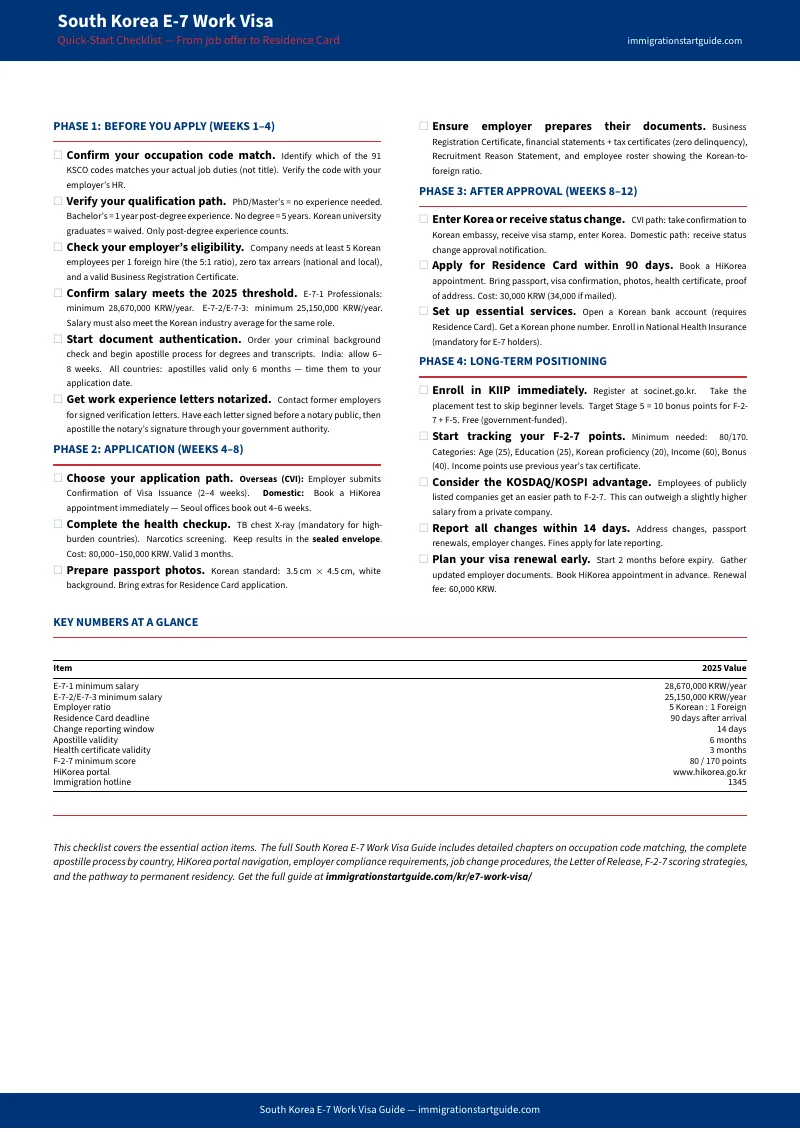
Quick-Start Checklist (free download)
An 18-step action plan covering the essentials: confirm your occupation code match, verify your qualification path, check your employer's eligibility, start your apostille process, and book your HiKorea appointment. Enough to identify your first concrete step tonight.
5 Standalone Printable Tools
In addition to the complete guide, you get 5 standalone PDFs designed to be printed individually and used at the exact moment you need them:
- Document Checklist --- Every document required from both you and your employer on one page, with notes on validity periods and common mistakes. Print it and check items off as you gather them.
- Occupation Code Reference Card --- Common international job titles mapped to their correct KSCO codes across IT, engineering, business, and language sectors. Hand it to your employer's HR when they ask "what code should we use?"
- F-2-7 Points Scoring Worksheet --- The complete points table (Age, Education, Korean Proficiency, Income, Bonus) with a fillable score column. Calculate your current score and identify exactly which categories to target for the 80-point threshold.
- Apostille Reference Card --- Country-specific authentication chains for India (State GAD, MEA, translation) and the US (Secretary of State vs Department of State) on one page. Includes the "private letter" workaround for employment verification.
- Key Numbers Quick Reference --- 2025 salary thresholds, employer ratios, registration deadlines, government fees, and key contacts on one card. Keep it on your desk during the application process.
Who This Guide Is For
This guide is for professionals and skilled workers with a Korean job offer or employer sponsorship who need to navigate the E-7 visa from application to residency:
- Software developers, data scientists, engineers, and IT professionals who have a Korean job offer and need to map their real-world job title to the correct KSCO occupation code before their application is filed
- Indian applicants who need the complete three-layer apostille chain (State GAD, MEA, translation) mapped out with realistic timelines --- not the "two weeks" estimate that assumes no backlog at the state level
- US applicants transitioning from E-2 teaching visas to professional E-7 roles who need the federal-vs-state apostille distinction explained and timed against the six-month validity window
- Professionals whose Korean employer has never sponsored a foreign worker and does not know about the 5:1 ratio, the tax compliance requirement, or what the Recruitment Reason Statement needs to say
- D-2 student visa holders graduating from Korean universities who need to time their status change to avoid a gap in legal status between graduation and employment
- Current E-7 holders in toxic work environments who need to understand the Letter of Release, the D-10 safety valve, and how to change employers without losing their residency
- Anyone on an E-7 who wants to plan their F-2-7 residency strategy from day one --- TOPIK scoring, KIIP enrollment, the KOSDAQ/KOSPI advantage, and the Income Buffer timing
This guide is not for: investors and entrepreneurs seeking self-sponsored business visas (see the South Korea D-8 Investment Visa Guide), or professionals who already hold F-2-7 residency and need guidance on the F-5 permanent residency transition (see the South Korea F-2 Points-Based Residency Guide).
Why Not a Haejungsa or Free Resources?
- Haejungsa (administrative attorneys) charge ₩500,000 to ₩2,000,000. They are typically hired by the employer, not the employee. They file your documents --- but they do not explain what your occupation code means, why the salary threshold matters for your F-2-7 timeline, or how the Recruitment Reason Statement should be written to maximise approval. You get a filing service without the strategic understanding.
- Reddit (r/Living_in_Korea, r/korea) has war stories from people who went through different processes, in different years, under different salary rules. The unified salary standard took effect in April 2025. Advice from 2023 references the old GNI-based formula that no longer applies. You get fragments of contradictory anecdotes with no way to verify which ones match your situation.
- Law firm blogs publish accurate legal summaries --- but they are written for other lawyers, not for a professional trying to figure out whether their Computer Science degree qualifies them for a Marketing role (it probably does not) or how to get an employment letter from a former private employer apostilled (the "private letter workaround").
- The HiKorea portal lists requirements in Korean-bureaucratic English. It does not explain the matching principle for occupation codes, does not warn you about the six-month apostille validity window, and does not mention that booking your appointment before your documents are ready is the only way to avoid a six-week delay.
This guide fills the gap --- the space between "my employer's Haejungsa is handling it" and "I understand every requirement, every timeline, and every decision point in my own visa process." It provides the applicant-aligned strategy that no employer-paid service will ever offer.
--- Less Than a Single Haejungsa Consultation
A mismatched occupation code does not just delay your application --- it resets it. You lose the immigration office reservation you waited six weeks to get. You lose the time you spent preparing documents, some of which have a six-month validity window that may expire before you can refile. And if your employer's HR wrote a weak Recruitment Reason Statement because nobody told them what immigration actually looks for, that failure compounds: a second attempt with the same employer raises flags.
Haejungsa charge ₩500,000 to ₩2,000,000 for a filing service. A single HiKorea reservation slot in Seoul costs nothing but takes four to six weeks to get --- and missing it because you did not book early enough pushes your entire timeline past your contract start date. The guide costs a fraction of one Haejungsa consultation and covers the strategic layer that filing services do not touch.
Money-back guarantee, no time limit. If the occupation code matching, the country-specific apostille chains, the HiKorea walkthrough, the employer compliance framework, the Letter of Release chapter, and the F-2-7 residency strategy do not make you materially better prepared for your E-7 application, you pay nothing.
Download the free Quick-Start Checklist to run the 18-step readiness assessment tonight. Identify your KSCO occupation code. Check your employer's headcount ratio. Start your apostille timeline. When you are ready for the full guide --- the complete occupation code decoder, the country-specific document chains, the HiKorea technical walkthrough, the employer compliance framework, the job change playbook, and the F-2-7 residency strategy --- the complete guide is here.
Your Haejungsa files the paperwork. This guide makes sure you understand every code, every threshold, and every decision point that determines whether it gets approved.