
You Found the Treaty. You Read the Requirements. You Know It's €4,500 and a KvK Registration. What You Don't Know Is the Exact Order of Operations for Your First 30 Days — the Sequence That Breaks the BSN-Address-Bank Deadlock, Gets an American Past FATCA-Wary Dutch Banks, Keeps Your Equity Above the Floor That the IND Will Audit at Renewal, and Files Your Taxes Correctly in Two Countries So You Don't Pay Double.
You are a US citizen. You have a treaty that most of the world does not: the Dutch-American Friendship Treaty, signed in 1956, still in force in 2026, granting you the right to live and work in the Netherlands as a self-employed person with a €4,500 business deposit. No employer sponsor. No points system. No government evaluation of your business plan's "added value." Just your passport, your capital, and a KvK registration. The barrier to entry is remarkably low. The barrier to actually getting set up — a functioning bank account, a registered address, a BSN that unlocks the entire Dutch system, and a tax position that doesn't result in paying social security in two countries — is where Americans fail.
You land at Schiphol. You need a BSN to open a bank account. You need a registered address to get a BSN. You need a rental contract to register an address — but most landlords require a BSN and a bank account to sign a lease. You try to open a bank account at ING. They want a BSN and a KvK extract. You try ABN AMRO. They flag you under FATCA and ask for documentation your US bank has never heard of. You search Reddit for "DAFT banking 2026" and find a thread from 2023 that says Bunq works, a thread from 2024 that says Bunq froze someone's account, and a thread from this year that contradicts both. You spend three hours reading and come away less certain than when you started. Meanwhile, your temporary housing is burning €100 per night, and every day without a BSN is a day your business cannot legally operate, your IND dossier sits incomplete, and your €4,500 equity is still in a US account where the IND cannot see it.
This is what every DAFT applicant discovers after they decide to move: the visa is 20% of the problem. The first 30 days — the administrative sequencing, the banking reality for Americans, the housing-registration deadlock, the dual-country tax obligations, and the equity-floor trap at renewal — are the other 80%. Free resources give you the requirements. Reddit gives you anecdotes from people who moved in 2022 under rules that have since changed. Immigration lawyers charge €950 to €2,000 to file the paperwork and do not help you set up your life. Nobody gives you the sequence.
The Netherlands DAFT (Self-Employment) Visa Guide is an Arrival Sequence System built for the specific problem every American DAFT applicant faces: converting a €4,500 deposit and a treaty right into a fully operational business and life in the Netherlands — BSN obtained, bank account open and FATCA-compliant, equity protected for renewal, taxes filed correctly in both countries, and every administrative dependency resolved in the right order on the right day. This is not a summary of the IND website. This is the integrated system covering the 2026 eligibility requirements, the ZZP vs BV decision and the pre-departure timing requirement for the 30% ruling, the day-by-day arrival sequence that breaks the BSN-address-bank deadlock, the housing-crisis workarounds that actually work, the FATCA-specific banking guide for Americans, the dual US-NL tax framework including the Totalization Agreement that eliminates double social security tax, the equity-floor protection strategy, and the "trail of enterprise" requirements for the two-year renewal.
What's Inside the Arrival Sequence System
The complete guide (62 pages), a quick-start checklist, and 7 standalone printable reference cards and worksheets — 9 files total — to get your Dutch business running from Day 1:
The ZZP vs BV Decision Framework
The choice between a sole proprietorship (ZZP/Eenmanszaak) and a private limited company (BV) determines your tax position, your liability, and whether you qualify for the 30% ruling. The ZZP costs €85 to register and is right for most freelancers earning under €69,000 per year. The BV costs €1,200 to €2,000 to incorporate, provides liability protection, and unlocks the 30% ruling — but only if the BV is established and an employment contract signed before you relocate. Miss this timing and you cannot apply retroactively. The guide covers the profit threshold where a BV becomes advantageous, the freelance tax incentives available only to ZZP holders (zelfstandigenaftrek, startersaftrek, MKB-winstvrijstelling), the liability difference, and the exact pre-arrival sequence if a BV is the right choice. If you make this decision wrong, you either leave tens of thousands in tax savings on the table or spend €2,000 incorporating a BV you did not need.
The Day-by-Day Arrival Sequence
This is the core of the guide. The IND, the gemeente, the KvK, and the Dutch banks do not coordinate with each other. Each requires outputs from the others. Get the order wrong and you wait weeks while your temporary housing burns through your savings. The guide provides the exact sequence: when to file with the IND to get your residence sticker, when to book the gemeente appointment for your BSN, when to register at the KvK, when to open the bank account, and when to engage the BECON accountant for your opening balance sheet — with the specific timing that avoids the deadlocks. It covers what to do when Amsterdam's BRP appointments are booked out for six to eight weeks (the smaller-gemeente workaround), how to get a Dutch IBAN on Day 1 before your BSN arrives, and the exact documents each authority requires at each step. Every day without a BSN is a day your business cannot deposit the €4,500, file with the IND, or register for VAT. This chapter turns a six-week paralysis into a structured first month.
The Housing-Registration Deadlock Breaker
The Netherlands is in a severe housing crisis. Most landlords require a BSN to sign a lease. You cannot get a BSN without a registered address. The guide provides the two proven workarounds: the briefadres (correspondence address) at a friend's residential address for up to three months while you continue your housing search, and the serviced apartment providers — City Retreat, Corporate Housing Factory, The Social Hub — that explicitly allow BRP registration with their contracts. It covers the cost of each option, the municipality approval requirements for a briefadres, and the secondary cities beyond Amsterdam where registration is faster and rent is substantially lower.
The 2026 Banking Reality for Americans
FATCA makes banking in Europe uniquely difficult for US citizens. Most Dutch banks would rather decline your application than deal with the IRS reporting requirements. The guide provides the current banking landscape — which banks accept Americans, which specific digital platforms work for the DAFT equity deposit, which branches have staff trained in US-citizen onboarding, and the exact phrasing to use so you are not flagged and turned away. It covers Bunq as the primary option, ABN AMRO's 120-day BSN grace period, ING's strict KYC requirements that typically disqualify Americans, and Wise and Revolut as supplementary accounts for lower FX fees. Reddit is contradictory on banking because the situation changes every few months. This section reflects the 2026 reality.
The Dual US-NL Tax Framework
Americans are taxed on worldwide income regardless of where they live. Move to the Netherlands and you file in two countries. The guide explains the Dutch three-box tax system (Box 1 for business income, Box 2 for substantial company holdings, Box 3 for savings and investments), the freelance deductions that reduce Box 1 liability, the Foreign Tax Credit vs the Foreign Earned Income Exclusion, and the Totalization Agreement between the US and the Netherlands that prevents double social security taxation. The Totalization Agreement alone can save you the 15.3% US self-employment tax — but only if you request a Certificate of Coverage (Form NL/USA 101) from the SVB and attach it to your US return every year. The guide covers FBAR reporting thresholds ($10,000 aggregate), FATCA Form 8938 thresholds ($200,000 for single filers abroad), and the penalties for non-compliance — which start at $10,000 per violation. Most DAFT guides stop at "you got the visa." This one continues through the tax obligations that follow you for as long as you hold a US passport.
The Equity-Floor Protection Strategy
The €4,500 is not a one-time fee. It is a permanent equity floor. Your business assets minus liabilities must never drop below €4,500 for a single day during your two-year permit. Spend €1,000 on business expenses without replacing it, and your equity falls to €3,500 — a violation that can result in a renewal denial after two years of successful living. The guide provides the "dusty account" strategy: a separate sub-account holding €5,000 or more that you never touch for operations, while running day-to-day expenses through a second account. It explains what equity means in accounting terms, how invoices and liabilities affect it, and what the BECON accountant actually checks at renewal.
The Two-Year Renewal Roadmap
In 2026, the IND does not simply check your bank balance at renewal. They require a "trail of enterprise" — proof that your business is genuinely active with multiple clients, consistent invoicing, and a personal income that approaches the Dutch social assistance level (approximately €1,735 per month from month seven onwards). The guide covers the equity audit, the active trading evidence, the multiple-client requirement, the pseudo self-employment risk for freelancers with a single US-based client, and how to structure your contracts and invoices to demonstrate genuine entrepreneurship. It also covers what happens after renewal: the five-year path to permanent residence, the civic integration exam with its B1 Dutch language requirement, and the citizenship renunciation dilemma for Americans — because the Netherlands generally requires you to give up your US passport to naturalize.
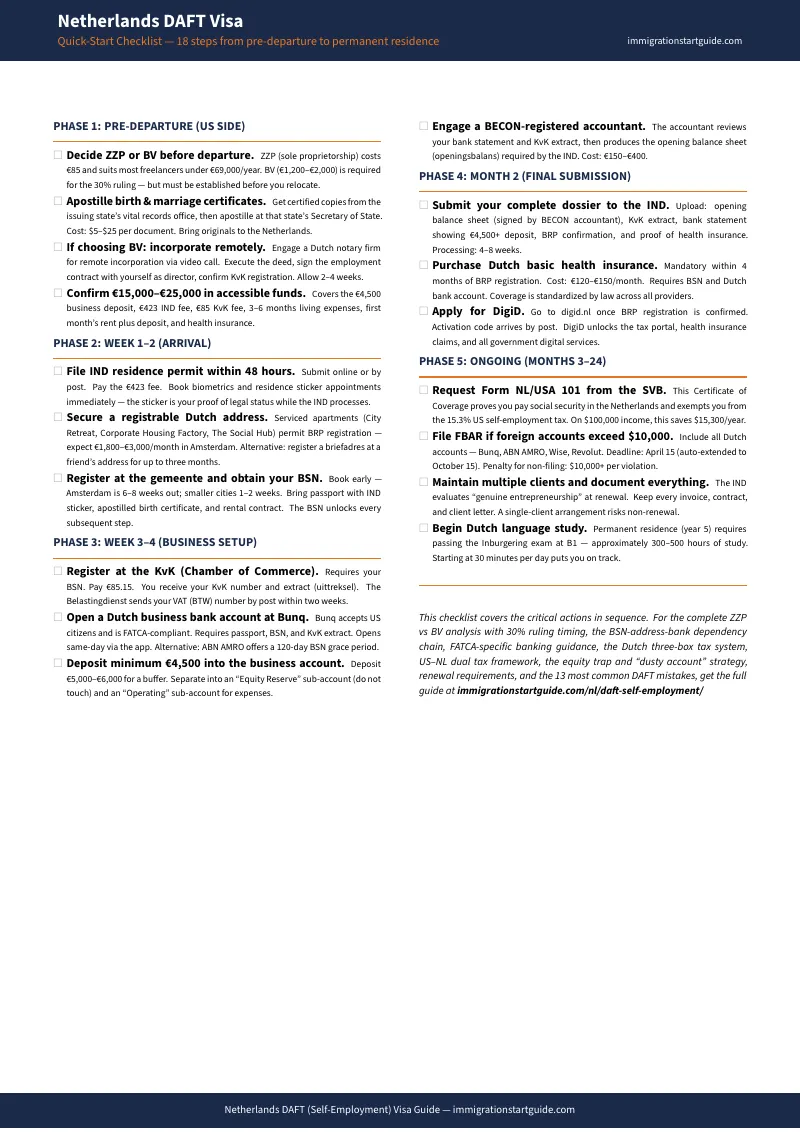
Quick-Start Checklist (free download)
A focused action plan covering the essentials: decide ZZP vs BV, confirm your total relocation budget, identify your municipality registration strategy, and understand the first three post-arrival actions. Enough to audit your situation tonight.
Who This Guide Is For
This guide is for US citizens using the Dutch-American Friendship Treaty to start a business and build a life in the Netherlands:
- Digital nomads who have been bouncing between tourist visas and need a permanent European base — a real tax residence, a real bank account, and legal status that does not expire in 90 days. The DAFT gives you an EU home while you continue serving clients worldwide.
- Remote freelancers and consultants with US-based clients who have realized their income buys a radically different quality of life in the Netherlands — healthcare that does not bankrupt you, 25 vacation days as a cultural norm, and a society that does not treat "self-employed" as "uninsured." The DAFT lets you relocate without finding a Dutch employer.
- Entrepreneurs who want to enter the European market through one of its strongest logistics and financial hubs. You have a product or service and you want a Dutch entity as your launchpad. The DAFT gets you in the door without venture capital, a certified facilitator, or a government evaluation of your business plan.
- Families relocating for schools, safety, healthcare, or political climate who need the most accessible visa route — one that does not require a Dutch employer willing to sponsor you. You sponsor yourself with €4,500 and your American passport.
This guide is not for: non-US citizens seeking Dutch self-employment (you need the regular self-employment permit with the RVO points system), employees joining a Dutch company (see the Netherlands Highly Skilled Migrant Visa Guide), or family members joining a Dutch or EU citizen through family reunification (see the Netherlands Partner/Family Visa Guide).
Why Not Free Resources?
Free information on the DAFT exists across government websites, law firm blogs, and expat communities. Here is what it actually delivers:
- IND.nl provides the legal requirements in bureaucratic Dutch-English. It states that a "business plan" may be requested but does not tell you that for DAFT applicants, this is rarely scrutinized — leading to weeks of unnecessary preparation. It lists the €4,500 requirement but does not explain the equity-floor concept that catches freelancers at renewal. It describes the steps but not the order — and the order is everything when each step depends on outputs from the previous one.
- Reddit and Facebook groups are where someone who moved in 2022 tells you ABN AMRO "works fine for Americans" (their branch now declines most US applications under updated FATCA procedures), that the BSN "takes about two weeks" (Amsterdam is six to eight weeks in 2026), and that you "don't really need an accountant" (the IND requires a BECON-certified opening balance sheet). The advice is specific, confident, and based on rules or conditions that changed after their application was processed. One Reddit user put it directly: "I honestly felt like I did know a lot before moving here but bad advice... made for a very rude awakening."
- Immigration lawyers charge €950 to €2,000 to file the paperwork. They handle the IND application. They do not help you open a bank account as an American, find housing that allows BRP registration, protect your equity floor, or file your US taxes correctly. Their fee covers your legal filing. Your life setup is your problem.
- Relocation agencies charge €5,000 or more for concierge services: apartment tours, furniture, utilities. They do not explain the equity trap, the Totalization Agreement, the FBAR reporting obligation, or the pseudo self-employment risk. They handle logistics. They do not handle the financial and administrative decisions that determine whether your permit survives its first renewal.
- The $64 PDF on Gumroad is 15 pages and a Discord community. User reviews confirm that the community is the valuable part — the PDF itself covers the basics. For context, this guide includes a 13-chapter system covering eligibility, entity structure, the complete arrival sequence, housing workarounds, banking, Dutch taxation, US tax compliance, the equity trap, renewal, permanent residence, and common mistakes — plus standalone printable tools for each phase of your relocation.
This guide fills the gap between "I know the DAFT exists" and "I have a functioning business and life in the Netherlands" — the space where Americans with a valid treaty right still fail because they got the sequence wrong, trusted outdated banking advice, spent their equity, or discovered their US tax obligations after the first FBAR deadline passed. It delivers the same preparation that lawyers and agencies charge thousands for, organized as a single arrival system you can execute yourself.
— Less Than One Month of That Temporary Airbnb
A sequence error that delays your municipality registration by two weeks costs you €1,400 to €2,100 in extended temporary housing alone. A banking mistake that sends you to ING instead of Bunq costs you weeks of back-and-forth with a compliance department that does not want American clients. Missing the Totalization Agreement costs you 15.3% of your self-employment income in unnecessary US social security tax — every year. Letting your equity drop below €4,500 for a single day costs you a renewal denial after two years of building a life in the Netherlands.
An immigration lawyer charges €950 to €2,000 for the filing alone. A relocation agency charges €5,000 or more. The Buncharted guide charges $64 for 15 pages. This guide costs less than two nights in an Amsterdam Airbnb and covers every step, every dependency, every banking workaround, every tax obligation, and every renewal requirement between your departure gate and your two-year extension.
You have something most people in the world do not: a 1956 treaty that gives you the right to build a business and a life in one of Europe's strongest economies for €4,500. The treaty provides the legal right. This guide provides the operational system that turns that right into a functioning reality — BSN obtained, bank account open, equity protected, taxes compliant, and business registered in the correct order on the correct day.
Money-back guarantee, no time limit. If the arrival sequence, the banking guide, and the equity protection strategy do not make your move stronger, you pay nothing.
Download the free Quick-Start Checklist to audit your ZZP vs BV decision, confirm your total relocation budget, and identify your first three post-arrival actions tonight. When you are ready for the complete Arrival Sequence System — the full guide, the day-by-day schedule, the banking walkthrough, the dual-tax framework, the equity-floor strategy, and the renewal roadmap — the full guide is here.
The treaty is yours. The right is yours. Now execute the move that makes it real — administratively, financially, and for everyone who is coming with you.