
You Accepted a Job Offer from a Dutch Employer. Your HR Team Says They'll Handle Everything. They Won't Handle the 30% Ruling Optimisation That's Worth EUR 15,000 to EUR 30,000 Per Year, the Zero-Gap Rule That Kills the Ruling if You Change Jobs, the 13th-Month Trap That Disqualifies Your Salary from the IND Threshold, or the BSN-Dependency Chain That Leaves You Without a Bank Account, Health Insurance, or DigiD for Your First Six Weeks.
You signed the contract. The salary clears the threshold. Your employer is a recognised sponsor and the IND application is already filed. Two weeks from now you will have a residence permit. You are, by every official measure, on track. And then you land in the Netherlands. You try to open a bank account. ING requires a BSN. ABN AMRO requires a BSN. You do not have a BSN because the Amsterdam gemeente has a six-to-eight-week wait for BRP registration appointments. You cannot receive your first salary because your employer has no Dutch bank account to pay into. You cannot register for health insurance because that requires a BSN and a bank account. You cannot apply for a DigiD because that requires BRP registration. Everything depends on everything else, and nothing moves until the municipality does. Meanwhile, you discover that the 30% ruling you were counting on requires a separate application to the Belastingdienst within four months of your start date, that the "full 30%" may actually be a partial 20% ruling because your salary falls between the HSM threshold and the tax-free minimum, that the 2027 reduction to 27% means your five-year net salary projection is wrong, and that your partner's visa application will be rejected if you wait two months to file it because only ten months will remain on your one-year contract. Your employer's immigration team handles none of this. They handle the employer's risk. You are on your own for the employee's side.
Here is what no free resource assembles into a single system: the Dutch Highly Skilled Migrant pathway is not a visa application — it is a salary-threshold compliance puzzle, a tax-optimisation decision worth six figures over five years, a post-arrival dependency chain with zero margin for delay, and a partner-visa timing trap that catches most first-time applicants. The IND processes your permit in two weeks. The 30% ruling, the BSN chain, the partner sustainability requirement, the Box 3 wealth tax, and the job-change zero-gap rule are where professionals lose tens of thousands of euros or strand their families — and none of those are covered by your employer's legal team.
The Netherlands Highly Skilled Migrant Visa Guide is a Kennismigrant Settlement System built for the specific problem every incoming knowledge worker faces: converting a signed employment contract into a fully operational life in the Netherlands — salary threshold verified, 30% ruling optimised, BSN-dependency chain solved, partner visa filed on time, and tax position mapped across all three Dutch income boxes. This is not a summary of the IND website. This is the integrated system covering the 2026 salary thresholds and what counts toward them, the 13th-month installment requirement, the 30% ruling with partial-ruling calculations, the 2027 reduction timeline, the abolished partial non-resident status and its Box 3 consequences, the BSN workaround that gets you a bank account on Day 1, the partner visa sustainability trap and simultaneous-filing strategy, the zero-gap rule for changing jobs without losing your ruling, and the complete first-30-days action plan that breaks the dependency chain before it breaks you.
What's Inside the Kennismigrant Settlement System
The complete guide, a quick-start checklist, and 8 standalone printable tools you need to protect the financial value of your move from Day 1:
The Salary Threshold Deep Dive
The IND requires EUR 5,942 per month for workers aged 30 and older, EUR 4,357 for workers under 30, and EUR 3,122 for recent graduates — all excluding the mandatory 8% holiday allowance. These numbers look simple until your offer includes a 13th-month bonus paid as a December lump sum (which does not count), stock options (which do not count), a company car (which does not count), or a variable performance bonus (which does not count). The guide provides the exact IND salary calculation — what is included, what is excluded, and how to restructure a 13th month into monthly installments so it qualifies. It covers the age threshold transition (what happens when you turn 30 mid-contract), the reduced graduate criterion, and the 2026 threshold increase that catches anyone applying under last year's numbers. If your offer is within EUR 500 of the threshold, this section is worth the entire guide — because a rejected IND application means your start date slips by months.
The 30% Ruling Optimisation
The 30% ruling allows your employer to pay up to 30% of your gross salary tax-free for five years. For a professional earning EUR 80,000, that is approximately EUR 12,000 per year in tax savings — EUR 60,000 over the full term. But the ruling is not binary. If applying the full 30% deduction would bring your taxable salary below EUR 48,013, the deduction is capped at whatever percentage keeps you at the threshold. A professional earning EUR 60,000 does not receive a 30% ruling — they receive approximately 20%, and the difference is over EUR 5,000 per year in net income that most applicants do not know they are missing until the first payslip arrives. The guide provides the complete partial-ruling calculation, the 150km residency rule, the application process and four-month deadline, the 2027 reduction from 30% to 27% for post-2024 arrivals, the Balkenende salary cap, and the transitional arrangements that protect pre-2024 applicants. If you understand nothing else about your move to the Netherlands, understand this section — it determines your net income for the next five years.
The Zero-Gap Rule for Job Changes
If you change employers while on the 30% ruling, the ruling transfers to your new employer — but only if there is zero gap in employment. Not a one-week gap. Not a weekend gap. Zero days. If your last day at Company A is a Friday and your first day at Company B is the following Monday, you are fine. If there is a single calendar day of unemployment, the Belastingdienst may disqualify you from the ruling for your second job entirely, on the grounds that you are no longer "recruited from abroad." For a professional with three years remaining on the ruling at EUR 80,000, that is approximately EUR 36,000 lost to a technicality. The guide covers the exact gap rule, the negotiation strategy with current and future employers, what happens during redundancy, and the three-month search period that protects your residence permit but does not protect your tax ruling.
The BSN-Dependency Chain Walkthrough
Your BSN is the master key to the Netherlands. Without it: no bank account, no health insurance, no DigiD, no tax portal, no childcare benefit. And you cannot get a BSN until you register at the municipality — which in Amsterdam takes six to eight weeks, in Rotterdam three to four weeks, and in Arnhem has taken some applicants over 13 weeks. The guide provides the day-by-day action plan that breaks this chain: the Bunq banking workaround that gets you a Dutch IBAN on Day 1 with only a passport and address, the municipality appointment booking strategy (including the smaller-gemeente workaround), the health insurance registration process that backdates coverage to your arrival, and the DigiD application sequence. Every day without a BSN is a day you cannot receive salary into a standard account, cannot see a specialist, and cannot access any government portal. This section turns a six-week paralysis into a structured first week.
The Partner Visa Sustainability Trap
To sponsor a partner, your income must be "sustainable" for at least 12 months from the date of the partner's application. You arrive in the Netherlands on a one-year contract. You spend two months settling in. You file your partner's visa in March. The IND checks your contract: it expires in December — only ten months remain. Application rejected. The guide covers the three strategies that prevent this: simultaneous filing (the safest), indefinite contract negotiation, and contract-term planning. It also covers the partner's "arbeid vrij toegestaan" work right — the unrestricted access to the Dutch labour market that most Dutch employers do not understand, causing them to reject your partner's job applications on the assumption that sponsorship is required. The guide includes the exact CV language and residence permit documentation that eliminates this barrier.
The Abolished Partial Non-Resident Status and Box 3 Wealth Tax
Before 2025, 30% ruling holders could elect to be treated as non-residents for investment income — exempting their global stocks, savings, and foreign property from Dutch tax. That election is gone. If you arrive in 2025 or later, the Netherlands taxes your worldwide assets under Box 3 using a notional return of approximately 6.17% on investments, taxed at 36%. A professional arriving with EUR 200,000 in a global stock portfolio faces an annual Dutch tax bill of approximately EUR 4,442 — on investments that may have actually lost value. The guide explains the new regime, the tax-free allowance (EUR 57,000 per person), the practical impact for professionals from the US, India, and other countries where significant pre-move wealth is common, and the Box 2 implications for anyone holding 5% or more of a company.
HSM vs. EU Blue Card Comparison
The HSM permit and the EU Blue Card have the same salary threshold but different advantages. The HSM is faster (two weeks vs. eight to twelve weeks), does not require a degree, and works only with recognised sponsors. The Blue Card does not require a recognised sponsor, is transferable to other EU member states after 12 months, and offers a potentially faster path to EU long-term residence. The guide provides the decision matrix: when the HSM is clearly better (you are staying in the Netherlands long-term), when the Blue Card wins (you may relocate within the EU), and when the choice depends on your employer's sponsor status and your degree qualifications.
The First 30 Days Action Plan
A day-by-day sequence from landing through the completion of your post-arrival setup: municipality registration, BSN issuance, bank account, health insurance, DigiD, TB test (if required), biometrics appointment, and the 30% ruling application. Each step includes the documents required, the expected wait times, the workarounds for bottlenecks, and the specific deadlines that trigger penalties if missed. This is the operational playbook your employer does not provide — because your employer's obligation ends at getting the permit approved.
Quick-Start Checklist (free download)
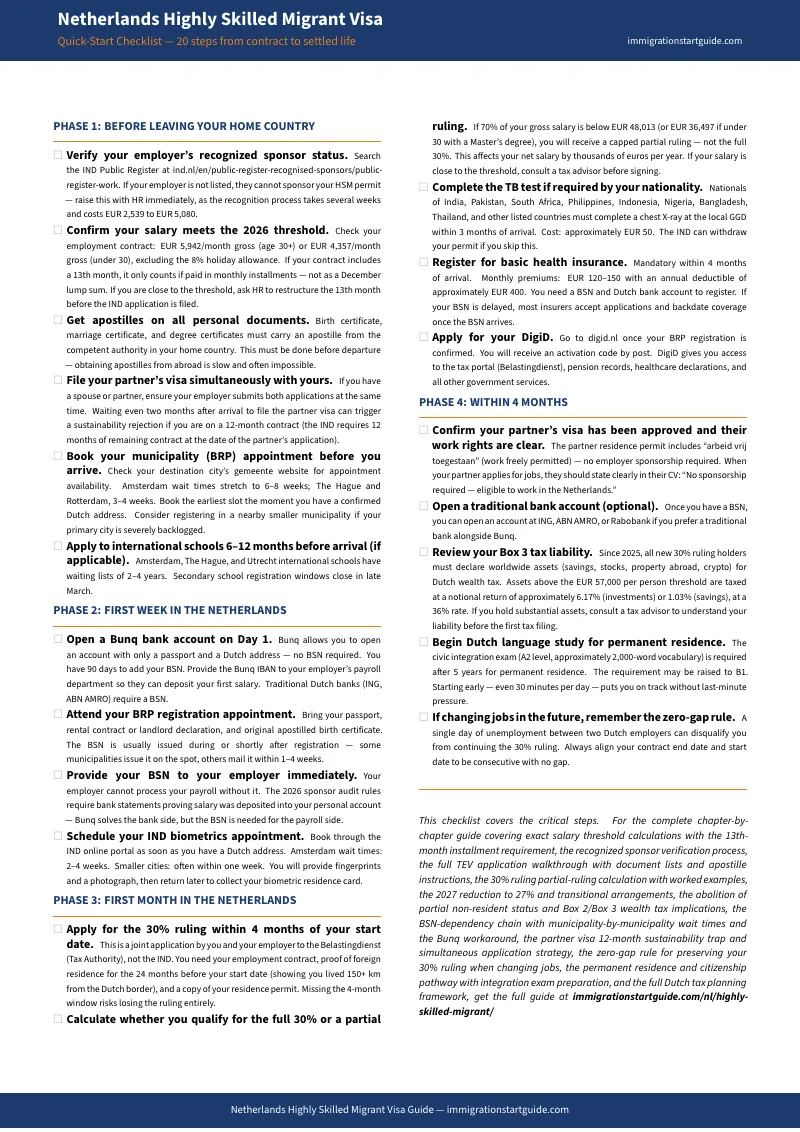
A focused action plan covering the essentials: verify your employer is on the recognised sponsor register, check whether your salary clears the threshold after excluding non-qualifying components, assess your 30% ruling eligibility, and identify your first three post-arrival actions. Enough to audit your situation tonight.
Who This Guide Is For
This guide is for non-EU/EEA professionals who have accepted or are considering a role with a Dutch employer and will enter the Netherlands on the Highly Skilled Migrant (Kennismigrant) permit:
- Software engineers, data scientists, and tech professionals joining ASML, Booking.com, Adyen, Philips, or the Amsterdam and Eindhoven startup ecosystems — who need to know whether their 13th month counts toward the threshold, what their actual 30% ruling percentage will be, and how to survive six weeks without a BSN in a city where everything requires one
- Indian professionals relocating from Bangalore, Hyderabad, or Mumbai who hold significant property or investments at home and need to understand the Box 3 wealth tax that now applies to worldwide assets — because the abolished partial non-resident status means the Netherlands taxes your Indian portfolio from Day 1
- Turkish and South African knowledge workers whose salary offers are close to the threshold and need the exact IND calculation to confirm qualification — including what happens when the 8% holiday allowance, the 13th month, and the variable bonus are stripped out
- Professionals relocating with a partner who need to file the partner visa simultaneously with the HSM application to avoid the sustainability trap — and who need their partner to understand the "arbeid vrij toegestaan" work right that Dutch employers routinely fail to recognise
- Professionals already in the Netherlands on an HSM permit who are changing jobs and need to navigate the zero-gap rule to preserve their 30% ruling — because a single day of unemployment between employers can cost EUR 10,000 to EUR 30,000 per year for the remainder of the five-year term
- Dutch university graduates on the zoekjaar (orientation year) visa who have found employment and need to transition to the HSM permit under the reduced graduate threshold of EUR 3,122 — within the three-year window before the reduced criterion expires
This guide is not for: EU/EEA citizens who have the right to work in the Netherlands without a permit, self-employed professionals or freelancers who need the DAFT visa or self-employment permit (see the Netherlands DAFT (Self-Employment) Visa Guide), or family members joining a Dutch or EU citizen through the family reunification pathway (see the Netherlands Partner/Family Visa Guide).
Why Not Free Resources?
Free information on the Dutch HSM permit exists across government websites, law firm blogs, and expat forums. Here is what it actually delivers:
- IND.nl provides the legal requirements in bureaucratic language. It tells you the salary threshold but not that your 13th month must be paid in monthly installments to count. It explains the recognised sponsor system but does not mention that Amsterdam BRP appointments are booked out for two months. It describes the 30% ruling eligibility but does not calculate the partial ruling that applies when your salary falls between the threshold and the full-benefit minimum. The IND tells you what the regulations are. It does not tell you how to comply with them efficiently — or what goes wrong when you follow the official process without the workarounds that every experienced expat eventually discovers.
- Reddit and IamExpat forums are where someone who arrived in 2022 tells you the 30% ruling is "simple" (the step-down was reversed, the partial non-resident status was abolished, and the 2027 reduction was introduced since they arrived), that Bunq "works fine without a BSN" (it does, for 90 days — then they freeze the account), and that the partner visa "just happens automatically" (it does not — the sustainability requirement actively rejects partners of professionals on one-year contracts who wait too long to file). The advice is specific, confident, and based on rules that changed after their application was processed.
- Immigration lawyers charge EUR 700 to EUR 3,000 for employer-side filing that your company's legal team already handles. For the employee's side — 30% ruling optimisation, BSN workarounds, partner visa timing, Box 3 planning — most lawyers either do not cover it or charge EUR 200 to EUR 500 per hour for tax consultations. A single tax advisory session costs more than this entire guide and covers one topic.
- Relocation agencies charge EUR 3,000 to EUR 10,000 for concierge services: apartment tours, school visits, furniture rentals. They do not optimise your 30% ruling, calculate your partial-ruling percentage, or warn you about the zero-gap rule before you change jobs. They handle logistics. They do not handle the financial decisions that determine your net income for the next five years.
This guide fills the gap between "I have a visa" and "I have a functioning, financially optimised life in the Netherlands" — the space where professionals with approved permits still lose thousands of euros to partial-ruling miscalculations, BSN delays, partner-visa timing errors, and wealth-tax surprises that no one warned them about. It delivers the same preparation that tax advisors and relocation agencies charge thousands for, organised as a single settlement system you can execute yourself.
— Less Than One Hour of an Expat Tax Advisor
The 30% ruling alone is worth EUR 10,000 to EUR 30,000 per year depending on your salary — EUR 50,000 to EUR 150,000 over the five-year term. A single partial-ruling miscalculation, a missed four-month application deadline, or a one-day employment gap costs you that entire benefit. The Box 3 wealth tax on a EUR 200,000 investment portfolio is approximately EUR 4,442 per year — a liability that did not exist before 2025 and that most incoming professionals do not discover until their first Dutch tax return. A partner visa rejection delays your family's reunion by months and requires a fresh application with a new fee.
An expat tax advisor charges EUR 200 to EUR 500 per hour. A relocation agency charges EUR 3,000 to EUR 10,000. An immigration lawyer charges EUR 700 to EUR 3,000 for the employer-side filing your company already covers. This guide costs less than a single advisory session and covers every calculation, every deadline, every workaround, and every trap between your signed employment contract and your first year of settled, financially optimised life in the Netherlands.
You are about to earn a salary that puts you in the top decile of the global workforce. The difference between a well-planned move and a chaotic one is not the visa — your employer handles that. It is the 30% ruling you optimise or lose, the BSN chain you solve in a week or suffer through for two months, the partner visa you file on time or reapply for, and the wealth tax you plan for or discover on your first tax return. Those decisions are worth six figures over five years. This guide ensures you make every one of them correctly.
Money-back guarantee, no time limit. If the salary threshold calculator, the 30% ruling optimisation, and the first-30-days action plan do not make your move stronger, you pay nothing.
Download the free Quick-Start Checklist to verify your employer's sponsor status, check your salary against the 2026 threshold, and assess your 30% ruling eligibility tonight. When you are ready for the complete Kennismigrant Settlement System — the full guide, the partial-ruling calculation, the BSN-dependency workarounds, the partner visa strategy, the Box 3 planning, and the day-by-day action plan — the full guide is here.
You earned the role. You cleared the threshold. Now build the life in the Netherlands that makes the move worth it — financially, personally, and for everyone who is coming with you.