
You Know You Need an MVV. You Know the IND Has Income Requirements. What You Don't Know Is How to Prove Your Long-Distance Relationship Meets the "Durable and Exclusive" Standard, How to Calculate Whether Your Sponsor's Income Actually Qualifies Under the Three-Year Averaging Rule, How to Pass the Civic Integration Exam Abroad on a 12-Week Self-Study Timeline, and How to Navigate the Three-Year Post-Arrival Integration Deadline That Most Couples Don't Discover Until the Fines Start.
You are in love with someone in the Netherlands. You want to build a life together. The IND website tells you the path: pass a Dutch language exam, meet the income threshold, prove your relationship, submit the TEV application. What the IND website does not tell you is that the income must be "independent, sustainable, and sufficient" — and those three words carry a technical meaning that catches sponsors on temporary contracts, freelancers who maximize tax deductions, and single-income households who are €50 per month below the threshold. It does not explain that "durable and exclusive" for unmarried partners means a specific type of evidence portfolio — not a 300-page WhatsApp dump, but a curated chronological narrative with photos, travel records, and third-party validation letters. It does not warn you that the Civic Integration Exam's speaking test is where self-study applicants fail most often, or that the 90-day IND decision clock pauses every time they request additional documents — turning "three months" into six.
Reddit gives you stories. One couple approved in two weeks. Another refused after three months of waiting and six months of preparation. A third told their relationship evidence was "insufficient" without being told what was missing. Immigration lawyers charge €1,000 to €3,000 for a standard partner filing — they handle the paperwork, but they don't help you build the relationship evidence portfolio, pass the integration exam, or prepare for the post-arrival B1 language requirement that starts a three-year countdown the day you land. And your Dutch partner, the person who should understand this system because it's their country? They are often the most shocked by its complexity. Dutch citizens assume their nationality is enough. It is not.
This is what every international couple discovers: the partner visa is 20% paperwork and 80% strategy. Getting the income calculation right, building the evidence portfolio the IND expects, passing the exam efficiently, and managing the post-arrival integration requirements — that is the work that determines whether your application becomes an approval in six weeks or a refusal that costs you three to six more months apart.
The Netherlands Partner/Family Visa Guide is a Reunification Roadmap built for the specific challenge every international couple faces: converting a genuine relationship and a qualifying income into an approved TEV application, a successful arrival, and a clear path to permanent residence. This is not a summary of the IND website. This is the integrated system covering the 2026 eligibility requirements, the €2,294.40 income threshold with calculation methods for employed sponsors, freelancers, and savings-only applicants, the 12-week Basisexamen study plan with module-by-module strategies, the relationship evidence portfolio structure that IND case officers can approve in minutes, the document legalization requirements for both Apostille and non-Convention countries, the step-by-step TEV process from submission to MVV collection, the first-30-days arrival sequence, the Wet Inburgering 2021 post-arrival integration roadmap, and the path from dependent permit to Dutch citizenship — including the dual nationality exception that means partners of Dutch nationals do not have to renounce.
What's Inside the Reunification Roadmap
The complete guide, a quick-start checklist, and standalone printable worksheets — covering every step from income verification through citizenship:
The Income Proof Strategies
The IND requires your sponsor to earn at least €2,294.40 gross per month excluding holiday allowance, or €2,477.95 including the mandatory 8% holiday pay. But "sustainable" income means different things depending on how your sponsor earns. For employees on a permanent contract, it is straightforward — payslips and the contract. For employees on a fixed-term contract, the contract must have at least 12 months remaining at the time of the IND decision, not at the time of application. For sponsors on short or temporary contracts, the three-year averaging rule allows qualification based on average income over the preceding 36 months — but only if you calculate it correctly. For freelancers and self-employed sponsors (ZZP), the IND requires 18 months of net profit meeting the threshold, supported by an accountant's declaration and KvK registration. For sponsors who cannot meet the income standard at all, savings of approximately €29,735 held in a personal account for at least one year can substitute. The guide includes the exact financial self-check formula: sum of last 3 months' gross salary, multiplied by 4, plus 8% holiday allowance, compared against €29,735.40 annually. Run this before you pay the non-refundable €254 application fee.
The Basisexamen Inburgering Study Plan
Most non-EU applicants must pass the Civic Integration Exam Abroad before the TEV application can proceed. It tests A1-level Dutch across three modules: Speaking (€60), Reading (€50), and Knowledge of Dutch Society (€40) — €150 total. The speaking test is where self-study applicants fail most often. It requires answering personal questions and completing Dutch sentences in real time through a headset. The guide provides a 12-week preparation timeline using the free "Naar Nederland" study materials, with week-by-week targets for vocabulary, reading practice, and KNS scenario memorization. It covers the specific strategies for the speaking module — the 1,000 most common Dutch words, basic SVO sentence structure, and the repetition-based practice method that builds real-time response speed. It covers which nationalities are exempt (US, Canada, Australia, New Zealand, Japan, South Korea), which diploma holders skip the exam, and what happens if you fail a single module (you retake only that module, not all three).
The Relationship Evidence Portfolio
Unmarried partners must prove a "durable and exclusive" relationship. The IND does not set a minimum duration, but expects a dossier demonstrating genuine, sustained connection. The guide provides the portfolio structure that works: 10 to 15 chronological photos spanning the entire relationship (including photos with each other's families and friends), flight tickets and hotel bookings proving mutual visits, curated communication logs (representative snippets showing daily contact over time, not the entire WhatsApp history), and 2 to 3 support letters from friends or family who have witnessed the relationship firsthand. It covers the Relationship Questionnaire (form 7625) — the mandatory form where both partners must provide consistent answers about when they met, when they became exclusive, and their future plans. Inconsistencies in this form trigger a sham marriage investigation. The guide explains what the IND considers "strong" versus "weak" evidence, why chronological narrative beats volume, and the specific mistakes that lead to "insufficient relationship evidence" refusals.
The Document Legalization Guide
A missing Apostille or an improperly legalized document causes immediate administrative rejection — not a refusal on the merits, but a rejection on form that wastes months. The guide covers the full legalization requirements: for Hague Convention countries (US, UK, most of Europe, Latin America), a single Apostille from the relevant government authority is sufficient. For non-Convention countries (most of the Middle East, parts of Africa and Asia), the full legalization chain applies — local authority certification, Ministry of Foreign Affairs attestation, then authentication at the Dutch Embassy. It covers which four languages the IND accepts without translation (Dutch, English, French, German), the sworn translator (beëdigd vertaler) requirement for all other languages, and whether a translation performed outside the Netherlands needs its own legalization.
The TEV Application Process — Step by Step
The sponsor submits the TEV application to the IND. Application fee: €254 for an adult partner. The IND has a 90-day statutory decision period — but the clock pauses every time they request additional documentation. In practice, straightforward applications are decided in 6 to 12 weeks. Complex cases or incomplete dossiers can stretch to six months. The guide walks through each step: online submission via ind.nl, required supporting documents, what happens when the IND sends a request for additional information, how to respond without resetting the clock, the positive decision notification, MVV sticker collection at the Dutch embassy, and the 90-day entry window after collection. It covers what to do if the application is refused — including the objection (bezwaar) procedure and its six-week deadline.
The First 30 Days After Arrival
You land in the Netherlands with your MVV sticker. Now the real-life setup begins. The guide provides the arrival sequence in the correct order: BRP registration at the municipality within five days (book the appointment from abroad — popular cities have multi-week waiting lists), BSN acquisition (the number that unlocks everything — bank accounts, health insurance, employment, tax registration), bank account opening (ING, ABN AMRO, Rabobank, or Bunq — each has different BSN and documentation requirements), mandatory health insurance within four months of registration (€125 to €150 per month, with a €385 annual deductible), TB screening at the GGD if required, and residence permit card collection at the IND desk. Each step depends on the previous one. Get the order wrong and you wait weeks with no bank account, no insurance, and no way to start working.
The Wet Inburgering 2021 Integration Roadmap
Many partners believe the process ends when the visa is granted. It does not. The Civic Integration Act 2021 starts a three-year countdown upon arrival. After a Broad Intake interview, the municipality assigns you to one of three learning routes: B1 (the standard path — most family migrants), Education (for those under 28 pursuing Dutch education), or Self-Reliance/Z (for those with learning barriers). You must complete the mandatory Participation Declaration Process (PVT) and the Labour Market and Participation Module (MAP — 64 hours of assignments and a portfolio). DUO provides loans for course costs. Missing the three-year deadline triggers fines from €340 to €1,000, repeated every two years. The guide covers how to choose the right route, how the DUO loan works, and the realistic study timeline for reaching B1 — approximately 300 to 500 hours of structured learning.
The Relationship Breakdown Safety Net
Your residence permit is tied to the relationship for the first five years. If the relationship ends, the IND can withdraw your permit. But exceptions exist that most applicants never learn about until it is too late. Victims of domestic violence can obtain a humanitarian residence permit through Veilig Thuis (Safe Home) — regardless of how long they have been in the Netherlands. Parents of Dutch children are protected by the Chavez-Vilchez ruling, which prevents the deportation of a primary caregiver whose child would be forced to leave the EU. Couples who were together for at least three years may qualify for "continued residence" under certain conditions. After five continuous years, you can apply for an independent permit that is no longer dependent on the relationship at all. The guide covers every transition pathway — because knowing your rights before a crisis is the definition of peace of mind.
The Path to Citizenship
Partners of Dutch nationals can apply for naturalization after just three years of marriage or registered partnership and three years of cohabitation. The standard path requires five years. And here is the exception most people do not know about: the Netherlands generally requires renunciation of your original nationality for citizenship — but partners of Dutch nationals are exempt. You keep your passport. The guide covers the full path from dependent permit to independent residence to permanent residence to Dutch citizenship — including the civic integration exam requirements, the naturalization fee (€1,139 single, €1,454 couple), and the timeline for each stage.
Quick-Start Checklist (free download)
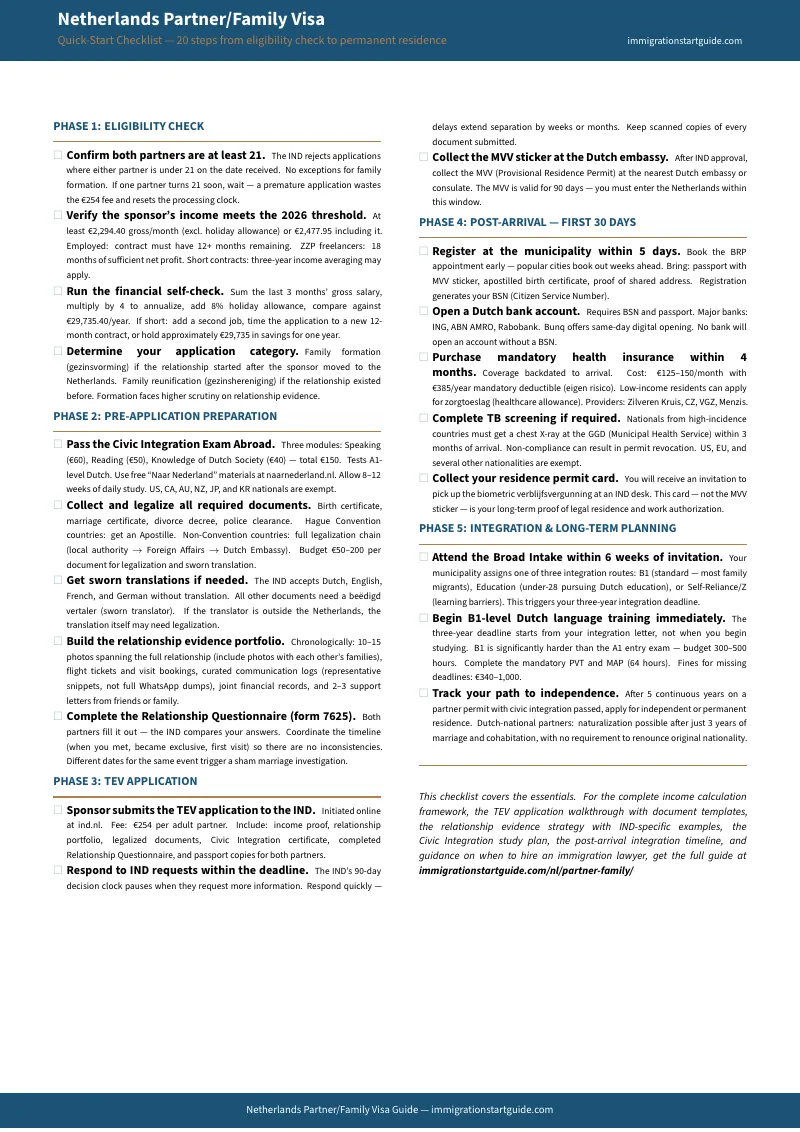
The 20 critical steps distilled into a single action sheet organized by phase: eligibility check, pre-application preparation, TEV submission, post-arrival setup, and long-term planning. Enough to audit your situation tonight and identify the first action to take tomorrow.
Who This Guide Is For
This guide is for non-EU partners of Dutch residents navigating the partner visa for the first time:
- International couples in long-distance relationships who met through travel, online dating, or diaspora communities — and need to convert years of love across borders into an IND-approvable dossier with the right evidence, the right income proof, and the right timing.
- Partners of Highly Skilled Migrants (Kennismigranten) who need to understand their dependent status, work rights, and integration obligations independently of their sponsor's employment permit.
- Unmarried couples who must prove a "durable and exclusive" relationship without the straightforward documentation of a marriage certificate — the guide provides the evidence portfolio structure and the Relationship Questionnaire strategy.
- Same-sex couples — the Netherlands fully recognizes same-sex marriages, registered partnerships, and unmarried partnerships with identical legal requirements and rights.
- Sponsors worried about income — freelancers, short-contract workers, and single-income households who need the specific calculation methods, the three-year averaging rule, and the savings alternative to meet the IND threshold.
- Partners of non-Dutch EU citizens who benefit from the more favourable "Europe Route" — no integration exam abroad, lower fees, and a simpler income standard (covered in Chapter 14).
This guide is not for: EU/EEA/Swiss nationals (you have automatic free movement rights), asylum seekers pursuing family reunification (different procedure and timeline), or non-EU nationals seeking work permits without a family connection (see the Netherlands Highly Skilled Migrant Visa Guide or the Netherlands DAFT Self-Employment Visa Guide).
Why Not Free Resources?
Free information on the Dutch partner visa exists across government websites, law firm blogs, and expat communities. Here is what it actually delivers:
- IND.nl states the requirements: €2,294.40 income threshold, 21+ age requirement, relationship evidence, Civic Integration Exam. It does not explain the three-year averaging rule for sponsors on temporary contracts, the 18-month profit assessment for freelancers, the savings alternative, or what "durable and exclusive" actually means in terms of the evidence the IND expects. It tells you the "what." It does not tell you the "how."
- Reddit and Facebook groups give you anecdotes. "We were approved in two weeks." "We waited four months." "We sent 200 pages of WhatsApp chats and were denied." Each story is real. None tells you why the outcomes differ, what evidence structure works, or which income calculation applies to your sponsor's situation. You read fifty stories and come away less certain than when you started.
- Immigration lawyers charge €1,000 to €3,000 for a standard partner filing. They handle the IND application. They do not help you pass the Civic Integration Exam, build the relationship evidence portfolio, or navigate the three-year post-arrival integration program with its fines and deadlines. Their fee covers the filing. Your exam preparation, evidence gathering, and post-arrival life setup are your responsibility.
- Language schools charge €400 to €600 for an A1 course. They teach Dutch. They do not explain the visa process, the income requirements, the document legalization rules, or anything beyond language instruction. You get the exam skill but not the immigration context.
This guide fills the gap between "I know I need a partner visa" and "My application is approved and I know exactly what to do after I land" — the space where genuine couples still fail because they miscalculated income, submitted weak evidence, skipped the legalization step, or discovered the post-arrival integration deadline after the fines had already started.
— Less Than the Cost of One Failed Exam Retake
A single failed module on the Civic Integration Exam costs €40 to €60 to retake and three months of delay — three more months apart while you study, rebook, and wait for results. An income calculation error that leads to a refusal costs you the non-refundable €254 application fee and another three to six months of separation while you reapply. A missing Apostille causes an administrative rejection that resets the entire 90-day processing clock. An immigration lawyer charges €1,000 to €3,000 for a standard filing — and does not cover exam preparation, evidence strategy, or post-arrival integration.
This guide costs less than a single exam retake and covers every step, every calculation, every evidence template, and every post-arrival requirement between your first Dutch word and your permanent residence card. The income self-check alone can save you the €254 application fee by telling you whether you qualify before you apply.
You have found the person you want to build a life with. The Dutch system has a path for you — structured, predictable, and designed for international couples. But the system rewards preparation. Couples who understand the income rules, build the right evidence, and manage the integration timeline get approved. Couples who trust Reddit anecdotes, submit incomplete dossiers, and discover the post-arrival deadlines too late get refused, fined, or separated for months longer than necessary.
Money-back guarantee, no time limit. If the income strategies, the evidence portfolio structure, and the integration roadmap do not make your application stronger, you pay nothing.
Download the free Quick-Start Checklist to verify your eligibility, check whether your sponsor's income qualifies, and identify the first step in your application timeline tonight. When you are ready for the complete Reunification Roadmap — the full guide, the exam study plan, the evidence templates, the document legalization guide, the arrival sequence, and the citizenship pathway — the full guide is here.
The path exists. The requirements are clear. Now execute the application that brings you together — correctly, efficiently, and with every step in the right order.