
You've Scored 80 Points on Paper. The Real Test Is Not Losing Them at the Counter.
You ran the points calculator. Academic degree, annual income above ¥10M, age bonus — you're well over the 70-point threshold. You've read the Immigration Services Agency PDF. You've skimmed the Reddit megathread. You're fairly confident you qualify for the Highly Skilled Professional visa.
But here's what the calculator doesn't tell you: points are claimed, not awarded. Immigration examines your evidence bundle and decides whether your claimed points are substantiated. That ¥10M salary? If your offer letter says "base salary ¥8.5M" and you're counting bonuses that aren't guaranteed in writing, you just lost 10 points at the counter. That "business management experience" you're claiming for the bonus points? If your title says "Senior Engineer" and you can't produce an organizational chart showing direct reports, the examiner deducts it. You walk into the Immigration Bureau thinking you have 85 points. You walk out with 65 and a standard Engineer visa.
Or maybe you already hold the HSP visa and you've heard about the 1-year or 3-year fast-track to permanent residency. You've been in Japan long enough. Your points are high enough. But nobody's explained the compliance requirements that run continuously from the day you're granted HSP status through your PR application date. One month of late National Pension payment during those three years — one month you forgot because your company switched payroll providers — and your PR application is refused. Not delayed. Refused. And the ¥200,000 PR filing fee that takes effect in 2026 is non-refundable.
The Japan Highly Skilled Professional Visa Guide is a Points-to-PR Accelerator. It covers everything from initial points verification through permanent residency approval — including the Retroactive PR Calculation strategy that most applicants (and many immigration lawyers) don't know exists. One document replaces the scattered free information, the ¥150,000-to-¥300,000 immigration lawyer, and the months of anxious guesswork about whether your compliance history will survive examination.
What's Inside the Points-to-PR Accelerator
12 chapters plus 5 standalone printable tools covering initial HSP application through permanent residency approval, plus a printable quick-start checklist:
Points Verification Engine (Chapter 2)
The official points table looks straightforward. The evidence requirements are not. This chapter maps every claimable category — academic background, professional career, annual income, age, bonus points — to the exact documents that substantiate each claim at examination. Which income documents count bonuses? When does a "related field" degree qualify versus not? How do you prove 10 years of professional experience when three of those years were at a company that no longer exists? Every point you claim is only as strong as the paper behind it. The chapter includes an evidence-matching worksheet so you verify every claimed point against the required proof before you file, not after the examiner tells you it's insufficient.
The Retroactive PR Calculation Strategy (Chapter 5)
Most applicants believe you must hold the HSP visa for 1 or 3 years before applying for PR. This is wrong. Immigration allows retroactive calculation — if you can demonstrate that you would have scored 70+ or 80+ points during a prior period while holding a different visa status (Engineer, Specialist in Humanities, etc.), that period counts toward your PR eligibility. This means a senior engineer who has been in Japan for 4 years on an Engineer visa, earning ¥12M for the past 3 years, can potentially apply for PR immediately after switching to HSP — without waiting an additional 1-3 years. The chapter provides the exact evidence package required to substantiate a retroactive calculation claim, the specific language to include in your PR application, and the compliance continuity requirements that apply to the retroactive period. This single strategy can save you 1-3 years of waiting.
HSP Application Architecture (Chapter 3)
The complete filing package structure for HSP-1 (Advanced Academic Research), HSP-2 (Advanced Specialized/Technical), and HSP-3 (Advanced Business Management) — including which category to choose when you qualify for multiple, the points calculation form walkthrough with common errors flagged, and the document assembly sequence that immigration examiners expect. Because the form asks for "annual income" but the definition of what counts differs between categories, and the wrong interpretation puts your entire application at risk.
Compliance Continuity Framework (Chapter 6)
The PR application isn't just about points. Immigration examines your entire compliance history during the qualifying period — tax payments, pension contributions, health insurance, residence card updates, re-entry permits. A single month of missed pension payment can result in refusal. A late residence card address update after moving apartments can raise questions about "good conduct." This chapter provides the month-by-month compliance audit checklist, explains what to do if you discover a gap (and whether it's fixable before filing), and covers the specific pension scenarios that catch tech professionals: company changes, gaps between jobs, the transition from National Pension to Employee's Pension, and what happens when your company's payroll department makes a mistake.
Income Maximization Strategies (Chapter 4)
The points threshold between 69 and 70 is the difference between a standard visa and fast-track PR. Between 79 and 80, it's the difference between a 3-year and a 1-year path. This chapter covers which income components are countable (and how to document them), how stock options and RSUs are treated, the timing of your application relative to annual income cycles, and the legitimate structuring strategies that push borderline candidates over the threshold. Not creative interpretation — documented, accepted approaches that examiners regularly approve.
PR Application Masterplan (Chapters 7-8)
The permanent residency application itself is a separate process with its own requirements, forms, and evidence bundle. These chapters cover the PR application form walkthrough, the guarantor (身元保証人) requirement and how to approach it, the ¥200,000 fee (effective 2026) and the timing considerations around it, the realistic processing timeline (4-12 months), and what happens after approval — including the permanent residence card, re-entry permit considerations, and the ongoing obligations that most new permanent residents don't know about.
2026 Fee Increase Strategy (Chapter 9)
The PR filing fee is increasing from ¥8,000 to approximately ¥200,000 in 2026. This isn't a rumour — it's passed legislation. If your qualifying period ends in the next 6-12 months, the timing of your application relative to the fee implementation date could save you ¥192,000. This chapter covers the exact timeline, the transition rules, and the filing strategy that maximizes your chances of submitting under the current fee structure.
5 Standalone Printable Tools
Print-ready reference materials for your filing preparation: Points Verification Worksheet (map every claimed point to its evidence), Compliance Audit Checklist (month-by-month pension/tax/insurance tracker), HSP Document Assembly Checklist (complete filing package list), PR Application Document Checklist (everything needed for the permanent residency filing), and Income Documentation Reference Card (which salary components count and how to prove them). Each is a standalone PDF you can work through independently.
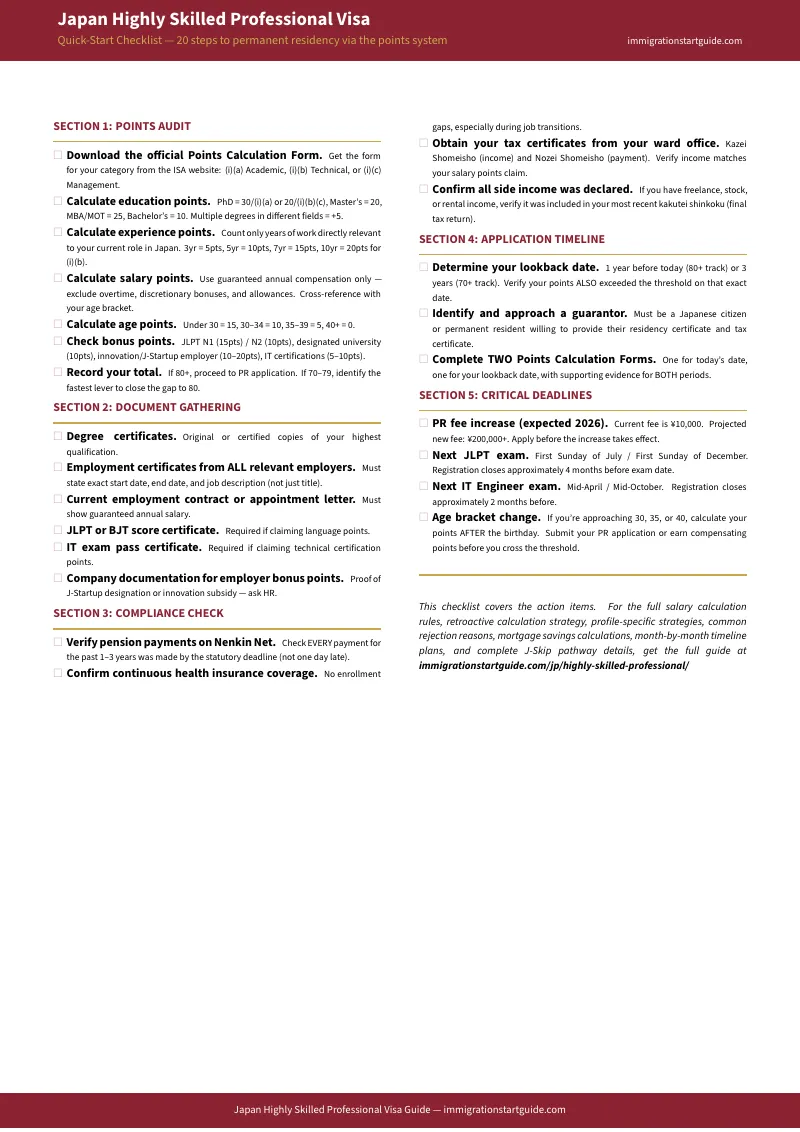
Quick-Start Checklist (free download)
The critical first steps distilled into a single action sheet: verify your points with evidence, check your compliance history, determine your optimal filing timeline, and identify whether the retroactive calculation applies to you. Enough to audit your situation tonight.
Who This Guide Is For
This guide is for professionals working in Japan who score 70+ points on the HSP system and want to convert that score into permanent residency as fast as legally possible:
- You're a tech professional at a FAANG office, Rakuten, LINE, or a funded startup — earning ¥7M+ with a relevant degree — and you want mortgage access, career flexibility, and freedom from visa renewal anxiety
- You've been on an Engineer/Specialist in Humanities visa for 3+ years and you want to know whether the retroactive PR calculation applies to you — potentially skipping the 1-3 year HSP holding period entirely
- You already hold the HSP visa but you're not sure whether your compliance history is clean enough for PR — especially pension payments during job transitions or gaps between companies
- You're at 65-69 points and need to understand exactly which categories offer legitimate room to reach 70 — not guesswork, but documented evidence strategies that examiners accept
- You want to file before the 2026 fee increase takes your PR application cost from ¥8,000 to ¥200,000 — and you need a clear timeline for whether that's achievable
- You've consulted an immigration lawyer who quoted ¥150,000-¥300,000 for HSP + PR support, and you know your case is straightforward enough to self-file — if you had a verified framework to follow
Why Not Free Resources?
Free information on the HSP visa exists across dozens of sources. Here's what each actually delivers:
- The ISA website and points table PDF give you the scoring categories and statutory requirements in bureaucratic Japanese-to-English translation. You'll learn that "annual income" is worth up to 40 points. You won't learn which components of your compensation package actually count, or what happens when the examiner disagrees with your calculation.
- Reddit (r/japanlife, r/movingtojapan) and GaijinPot forums are collections of individual experiences from people whose income, nationality, company, and filing year you don't know. A strategy that worked for someone at Google in 2023 may not apply to your Rakuten offer in 2026. You're building a multi-year PR strategy on anecdotes from strangers.
- Immigration lawyers (¥150,000-¥300,000) handle the filing for you — but most don't proactively audit your compliance history, don't explain the retroactive calculation option unless you ask, and don't help you optimize your points before filing. You're paying for form submission, not strategy.
- Employer HR departments handle your visa sponsorship but have no incentive to help you reach PR faster. In fact, your permanent residency makes you less dependent on them. Don't expect your company to volunteer information about the fast-track pathway.
This guide fills the strategy gap. It doesn't replace a lawyer for contested cases or complex legal disputes. It gives you the verified framework to audit your points, confirm your compliance, execute the retroactive calculation if eligible, and file with confidence — at a fraction of what a lawyer charges for the same outcome.
— Less Than One Hour of Immigration Lawyer Time
Immigration lawyers in Tokyo charge ¥20,000-¥40,000 per hour for consultations. Full HSP + PR support packages run ¥150,000-¥300,000. The upcoming PR filing fee alone will be ¥200,000 — non-refundable even if refused.
The guide gives you the strategic framework to file correctly the first time. If the retroactive calculation applies to you, it could save you 1-3 years of waiting. If your compliance audit reveals a fixable gap before filing, it prevents a ¥200,000 non-refundable rejection. If your points verification catches an evidence weakness before the examiner does, it saves you from a refused application and months of resubmission.
Money-back guarantee, no time limit. If the framework doesn't give you a clear, actionable path to PR, you pay nothing.
Download the free Quick-Start Checklist to audit your points and compliance tonight. When you're ready for the Retroactive PR Calculation strategy, the compliance continuity framework, and the complete Points-to-PR Accelerator, the full guide is here.
The 2026 fee increase is coming. Your qualifying period is already running. Make sure it counts.