
You've Lived in Japan for a Decade. One Late Pension Payment Can Erase All of It.
You've been here long enough. Ten years on a work visa, maybe longer. You've paid your taxes, renewed your residence card, built a career, signed leases, opened bank accounts. You've done everything right. Permanent residency should be a formality at this point.
It isn't. Roughly one in three PR applications is rejected, and the primary reason is not a lack of qualifications. It's a compliance failure the applicant didn't know existed. A pension payment that arrived two weeks late during a job change in 2023. A resident tax bill that slipped into "Ordinary Collection" (普通徴収) between employers. A single month of health insurance that lapsed when payroll switched providers. The Immigration Services Agency sees all of it — they cross-reference your Nenkin Net records, your municipal tax certificates, and your My Number history — and in the current regulatory environment, even one late payment in the last 24 months can result in denial after 14 to 18 months of waiting in Tokyo.
That denial is now more expensive than ever. The PR application fee has increased from ¥8,000 to ¥100,000 — non-refundable even if refused. And starting April 2027, a new revocation law means even approved PR holders can lose their status for deliberate non-payment of taxes or social insurance. The bar for getting in just went up. The consequences of falling short just got permanent.
The Japan Permanent Residency Guide exists because the gap between "technically eligible" and "actually approved" is a compliance audit — and no free resource teaches you how to do one. The guide's Compliance Self-Audit Method walks you through your own tax certificates, pension records, and insurance enrollment the same way an ISA examiner will, so you find and fix problems before you file rather than discovering them in a denial letter 18 months later.
What's Inside the Compliance Self-Audit Method
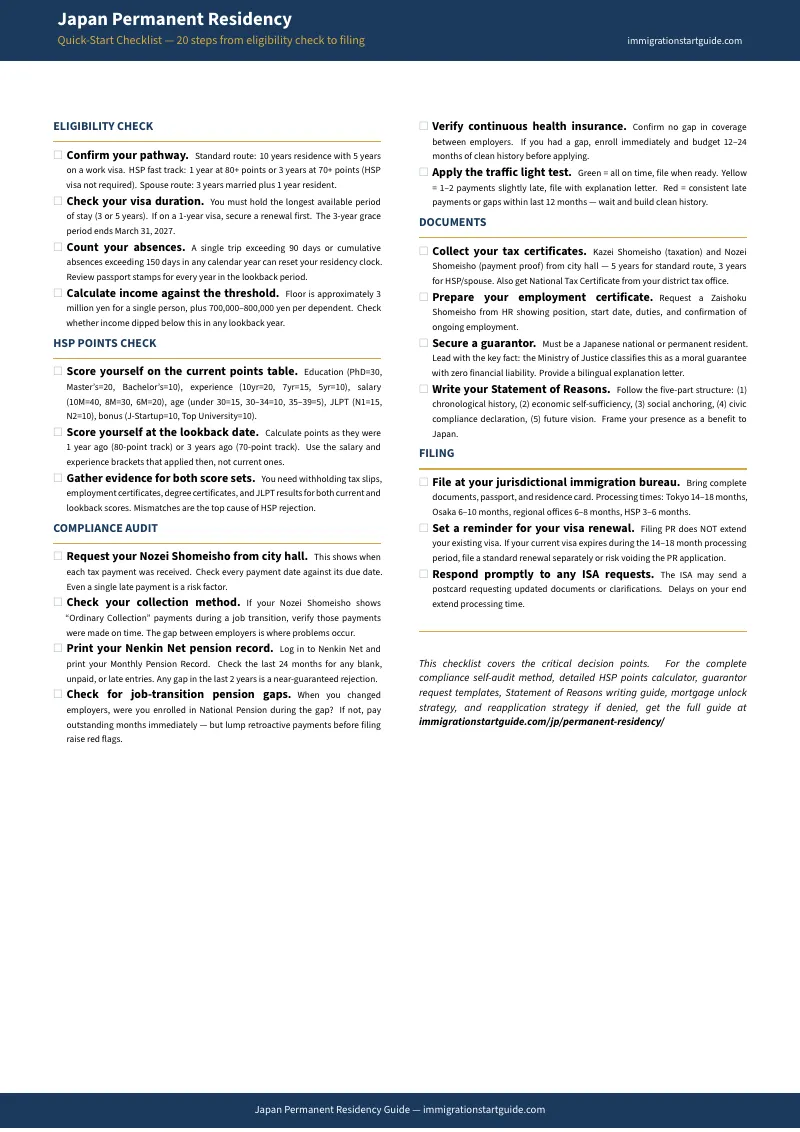
10 chapters covering every pathway from eligibility assessment through post-approval obligations, plus a printable Quick-Start Checklist:
The Compliance Self-Audit (Chapter 4)
This is the most important chapter in the guide. It teaches you how to read your own Nozei Shomeisho (tax payment certificate), Nenkin Net pension record, and health insurance enrollment history to identify exactly what the ISA will see when they examine your file. You'll learn the difference between "Special Collection" and "Ordinary Collection" on your tax certificate — and why a gap between employers that pushed you into Ordinary Collection may have created a late payment you never noticed. The chapter includes a traffic light system: green means file when ready, yellow means file with an explanation letter, red means wait and build clean history first. Every professional who has changed jobs in the last five years needs this chapter.
Eligibility Pathways (Chapter 2)
The three routes to PR mapped side by side: the standard 10-year pathway, the HSP fast track (1 year at 80+ points or 3 years at 70+ points — without switching visas), and the spouse route (3 years of marriage plus 1 year of residence). Each route has its own residency duration requirements, absence limits, and lookback periods. The chapter covers the "maximum period of stay" rule that trips up long-term residents still on 1-year visas, the absence thresholds that can reset your residency clock (90 days single trip, 150 days cumulative per year), and the 3-year visa grace period ending March 2027.
HSP Retrospective Calculation (Chapter 3)
You do not need to hold an HSP visa to use the HSP fast track. If you can document that you would have scored 70+ or 80+ points at the lookback date while holding any work visa, that period counts toward your PR eligibility. A senior engineer on a standard Engineer visa earning ¥10M with a master's degree may already qualify for 1-year fast-track PR — without ever switching visa categories. This chapter covers the points calculator in detail, the evidence requirements for both current and lookback scores, and the retrospective calculation strategy that most applicants (and many immigration lawyers) don't know exists.
Document Checklist (Chapter 5)
Every form, certificate, and supporting document organized by pathway — standard route, HSP route, and spouse route. Kazei Shomeisho, Nozei Shomeisho, Nenkin records, employment certificates, National Tax Certificate (納税証明書その3), Juminhyo, and pathway-specific requirements. Each document entry includes where to obtain it, what it costs, what the ISA examiner looks for in it, and the specific details that trigger additional scrutiny.
The Guarantor System (Chapter 6)
The guarantor requirement stops more applicants than any other single element — not because it's legally complex, but because people are afraid to ask. The Ministry of Justice classifies the PR guarantor as a moral guarantee with zero financial liability. Your guarantor cannot be sued, cannot be fined, and will never be asked to pay anything on your behalf. This chapter explains the legal framework, who qualifies (Japanese national or permanent resident), the documents they need to provide, and how to approach the conversation without making it sound like you're asking them to co-sign a loan.
Statement of Reasons Template (Chapter 7)
The Statement of Reasons (理由書 — Riyusho) is the only part of your application where you speak directly to the examiner. Most applicants write it wrong — either too short ("I like Japan and want to stay") or too long and unfocused. The chapter provides a five-part narrative structure: chronological history in Japan, economic self-sufficiency, social anchoring, civic compliance declaration, and future vision. It explains the tone the ISA expects (humble, factual, Japan-benefit-oriented) and the red flags that signal a Statement written by someone who doesn't understand how Japan evaluates "national interest."
The Mortgage Unlock (Chapter 10)
PR is a multi-million-yen financial decision. Without it, you're limited to a handful of banks willing to lend to non-PR holders at 1.2% to 3.0% interest with 10-35% down payments. With PR, you access the full range of Japanese housing loans at 0.3% to 0.7% — including Flat 35 fixed-rate products. On a ¥50M property over 35 years, the interest rate spread alone saves ¥8-15M. Add the difference in required down payment, and PR's total financial impact on a single home purchase can exceed ¥25M. This chapter includes a bank-by-bank comparison and the down payment advantage calculation.
2027 Revocation Law and Post-Approval Obligations (Chapter 9)
Getting PR is no longer the finish line. Starting April 2027, the ISA can revoke permanent residency for deliberate non-payment of taxes or social insurance. The chapter explains the revocation criteria (intentional non-payment, not genuine oversights), the warning system the ISA has outlined, and the ongoing compliance habits that protect your status for life. Also covers residence card renewal (every 7 years), re-entry permit rules, and what happens to your PR if you leave Japan for an extended period.
Quick-Start Checklist (free download)
The 20 critical steps distilled into a single action sheet: confirm your pathway, check your visa duration, count your absences, audit your tax and pension records, apply the traffic light test, and identify your filing timeline. Enough to assess your readiness tonight.
7 Standalone Printable Tools
The guide includes standalone worksheets you can print and bring to city hall, your bank, or your guarantor meeting: Compliance Self-Audit Worksheet (tax dates + pension grid + traffic light assessment), HSP Points Calculator (side-by-side current and lookback scoring), Document Checklist by Pathway (every certificate with source and cost), Guarantor Request Letter (bilingual EN/JP explanation for your guarantor), Statement of Reasons Template (five-part writing template with prompts), Mortgage Comparison Reference (bank-by-bank rate comparison), and Filing Timeline Planner (month-by-month reverse schedule).
Who This Guide Is For
This guide is for foreign professionals who have built their lives in Japan and want to convert years of residence into permanent status — without paying a lawyer ¥150K-¥500K and without gambling on scattered Reddit advice:
- You've been in Japan 10+ years on a work visa and you're ready to file — but you're not sure whether your compliance history is clean enough, especially during job transitions when pension and tax collection methods change
- You score 70+ or 80+ on the HSP points system and want to use the fast track — but you've never held an HSP visa and need to understand the retrospective calculation and the evidence package required to prove your points at the lookback date
- You're married to a Japanese national and meet the 3+1 year requirement — but you need the document checklist, guarantor guidance, and Statement of Reasons structure specific to the spouse route
- You want to buy property in Japan and you've realized that PR is the key to accessing 0.3-0.7% mortgage rates instead of the 1.2-3.0% rates available to non-PR holders — and the ¥8-15M interest savings on a ¥50M loan makes a ¥100,000 application fee look trivial
- You've heard about the 2027 revocation law and the ¥100,000 fee increase, and you want to file correctly the first time rather than waiting another 14-18 months for a second attempt
- You consulted an immigration lawyer who quoted ¥150,000-¥500,000 for PR support, and your case is straightforward enough to self-file — you just need a verified framework to follow instead of piecing together advice from GaijinPot and r/japanlife
Why Not Free Resources?
Free information on Japanese permanent residency exists. Here's what each actually delivers:
- The ISA website and application guidelines tell you which forms to submit and what the eligibility criteria are. They don't tell you how to read your own tax certificate for late payments, how to interpret your Nenkin Net record for gaps, or what the traffic light assessment of your compliance history means for your chances. The ISA tells you the rules. It doesn't help you audit yourself against them.
- Reddit (r/japanlife, r/movingtojapan) and GaijinPot forums are collections of individual experiences from people whose employment history, nationality, regional immigration bureau, and filing year are different from yours. One person's "I had a late pension payment and still got approved" was filed in Osaka with a 6-month processing time. Your application in Tokyo faces 14-18 months of scrutiny. Anecdotes are not strategy.
- Immigration lawyers (¥150,000-¥500,000) handle the filing for you — but the budget tier (¥70K-¥120K) just checks your documents without proactive compliance auditing, while the premium tier charges for services you may not need if your case is straightforward. Most don't volunteer the retrospective HSP calculation unless you already know to ask about it.
- Employer HR departments process your visa renewals but have no incentive to help you reach PR faster. Your permanent residency makes you less dependent on them. Don't expect your company to audit your compliance history or advise on the HSP fast track.
This guide fills the audit gap. It doesn't replace a lawyer for contested cases or complex legal disputes. It gives you the self-audit method, the document preparation framework, and the filing strategy to submit a clean application the first time — at a fraction of what a lawyer charges for the same outcome.
— Less Than One Hour of Immigration Lawyer Time
Immigration lawyers in Tokyo charge ¥20,000-¥40,000 per hour for consultations. Full PR support packages run ¥150,000-¥500,000. The PR filing fee itself is now ¥100,000 — non-refundable even if refused.
The guide gives you the compliance self-audit to find problems before the ISA finds them. If your audit reveals a fixable gap, you address it before filing instead of discovering it in a denial letter 18 months later. If the retrospective HSP calculation applies, it could cut years off your wait. If the Statement of Reasons template helps you write the narrative the ISA expects instead of the one most applicants guess at, it saves you from a refusal that costs ¥100,000 and another 14-18 months.
Money-back guarantee, no time limit. If the compliance self-audit and filing framework don't give you a clear, actionable path to PR, you pay nothing.
Download the free Quick-Start Checklist to audit your eligibility and compliance tonight. When you're ready for the full Compliance Self-Audit Method, the HSP retrospective calculation strategy, the Statement of Reasons template, and the mortgage unlock analysis, the complete guide is here.
The ¥100,000 fee is already in effect. The 2027 revocation law is coming. Every month you wait is another month your compliance record needs to stay clean. File right the first time.