
You Got the Job Offer. Now You Need to Decode the ISA's Reasoning Before They Decide Your Application.
You passed the interviews. You signed the employment contract. Your future employer in Tokyo or Osaka sent you a congratulations email. And now you are staring at the single most opaque immigration process in the developed world.
The MOFA website gives you a list of forms. It does not tell you that the Immigration Services Agency reviews your university transcripts line by line to determine whether your degree "logically underpins" your job duties. It does not tell you that a Computer Science graduate applying for a marketing analytics role will receive a "Request for Further Evidence" unless the transcripts show sufficient coursework in statistics or data analysis. It does not tell you that your employer's withholding tax history determines whether you submit 3 documents or 30, or whether you receive a 1-year visa or a 5-year one. And it certainly does not tell you that the single document that makes or breaks borderline applications is the Statement of Reasons — a narrative explanation that most applicants have never heard of and most HR departments have never written.
Reddit tells you "just let your company handle it." But your company is a 40-person startup in Shibuya. Their HR manager has sponsored two foreigners before, both from the same country, both with engineering degrees for engineering roles. Your situation is different — maybe your degree is in a related but not identical field, maybe you are applying from a country with additional departure requirements, maybe your employer is a Category 3 or 4 company that the ISA treats with significantly more scrutiny. The HR manager does not know what the ISA's internal "Points of Review" are for your specific combination. The Reddit thread from 2023 was written under different rules. And the immigration lawyer who could decode all of this charges 110,000 to 220,000 yen.
The Japan Work Visa (Engineer/Specialist) Guide is an Approval Logic System — the complete framework for understanding how the ISA evaluates your application internally, not just what forms to submit. It decodes the degree-job relevance doctrine that determines whether your academic background passes or fails. It maps the company category system that controls your documentation burden and visa duration. It provides the Statement of Reasons framework that transforms a borderline application into a clear approval. And it covers the 2025-2026 regulatory changes — the new language requirement for Category 3 and 4 hires, the Joint Compliance Pledge for dispatch workers, and the Myna Insurance transition — that most English-language resources have not caught up with yet.
What's Inside the Approval Logic System
The complete guide plus 4 standalone printable tools and a quick-start document checklist — everything you need from job offer to settled residency in Japan:
The Degree-Job Relevance Doctrine (Chapter 2)
The ISA does not simply check whether you have a degree. It checks whether your degree logically supports the work you will perform. A Computer Science graduate applying for a Software Developer role is a direct match — approval is straightforward. An Economics graduate applying for a Marketing Analyst role is a theoretical match — acceptable because both fields draw on quantitative reasoning. A Mechanical Engineering graduate applying for a Software Developer role will trigger a Request for Further Evidence, and success depends on whether your transcripts show enough programming coursework. A Music Performance graduate applying for an IT role will be rejected outright. The guide maps the ISA's internal logic for common degree-job combinations, explains the difference between "flexible relevance" for university graduates and "strict relevance" for vocational school graduates, and shows you how to frame borderline matches so the ISA sees the connection between your academic background and your contracted duties. This chapter alone can prevent the most common reason for CoE rejection.
The Company Category System (Chapter 3)
Your visa outcome is not just about your qualifications. It is about your employer's financial profile. The ISA classifies every sponsoring company into one of four categories based on size and tax history. Category 1 companies — listed corporations and government entities — submit minimal documentation and their applicants receive near-automatic approval. Category 2 companies — those paying more than 15 million yen in annual withholding tax — submit a single tax receipt. Category 3 companies — standard SMEs below that threshold — must provide full financial statements, tax certificates, and a company brochure. Category 4 companies — startups and new firms with no tax history — face the heaviest burden: detailed business plans, office floor plans, bank statements, and evidence of capital. The guide explains exactly what each category means for your application: the number of documents required, the likelihood of receiving a 1-year versus 3-year or 5-year visa, and the practical steps to take if your employer is a Category 3 or 4 company that has never sponsored a foreign worker before — including an Employer's Checklist you can hand directly to your HR department.
The Statement of Reasons Framework (Chapter 4)
The Statement of Reasons is a narrative document submitted by the applicant explaining why they are qualified for the position. It is not a required form — the ISA does not list it as mandatory. But for any application where the degree-job relevance is not immediately obvious, where the company is Category 3 or 4, or where the applicant has an unusual career path, this document is what separates approval from denial. The guide provides the structural framework for writing a Statement of Reasons that addresses the ISA's specific concerns: the logical link between your academic background and your job duties, your professional trajectory, your employer's business need for a foreign worker, and the sustainability of the position. It explains what the ISA is actually looking for — not a personal essay, but a compliance argument that maps your qualifications to the statutory criteria.
The Certificate of Eligibility Process (Chapter 5)
The CoE is the pre-approval document that your employer files at the Regional Immigration Bureau before you can apply for a visa at the Japanese embassy. The guide covers the complete process: who can file (the employer, a legal proxy, or a registered immigration assistant), where to file (the bureau with jurisdiction over the employer's office location, not the applicant's nationality), standard processing times (1 to 3 months depending on company category and bureau workload), the digital CoE system introduced in 2023 that allows electronic transmission instead of international mail, and the 3-month validity window that determines your arrival timeline. It also covers what happens when the CoE is denied — specifically, how to request the reason for denial from the bureau and how to prepare a re-application that addresses the identified deficiency.
The 2025-2026 Regulatory Changes (Chapter 6)
Three significant changes have reshaped the E/SH/IS visa landscape, and most English-language resources are still citing pre-2025 rules. First: the new Japanese language proficiency requirement effective April 2026, which mandates JLPT N2 or equivalent for applicants joining Category 3 and 4 companies in communication-intensive roles. Category 1 and 2 hires and highly technical roles where the working language is English remain exempt. Second: the Joint Compliance Pledge, mandatory since March 2026, which requires both dispatch agencies and host companies to formally certify that the foreign worker will not perform manual labor — targeting the grey market of professionals on E/SH/IS visas being used for warehouse or construction work. Third: the Myna Insurance transition from December 2024, which replaced traditional health insurance cards with the integrated My Number system — new arrivals must now proactively apply for their My Number Card to access healthcare. The guide explains who is affected by each change, what documentation is required, and how to prepare.
Source Country Requirements (Chapter 7)
The administrative burden of a Japan work visa varies dramatically by nationality because of bilateral treaties and local labor protections. Filipino professionals face the strictest departure regulations in the world: a verified employment contract stamped by the Migrant Workers Office in Japan, an Overseas Employment Certificate from the DMW, compulsory medical insurance, and a Pre-Departure Orientation Seminar — without an OEC, you will be denied boarding regardless of your Japanese residence status. Indian professionals benefit from reciprocal IT examination agreements but face degree attestation requirements from local universities and may qualify for the HSP fast-track. Vietnamese professionals must now complete mandatory pre-entry tuberculosis screening at a designated panel clinic. The guide maps the complete additional requirements for the top source countries so you can start the parallel processes early instead of discovering them after your CoE is already approved.
Post-Arrival: The Golden 14 Days (Chapter 8)
The transition from visa holder to legal resident happens in your first two weeks. You land at a major airport and receive your Residence Card. Within 14 days, you must visit the ward office to register your address — which triggers your My Number enrollment, your health insurance registration, and your pension enrollment. Mistakes in this phase — a late registration, a missed pension payment, an overlooked notification — do not seem serious at the time, but the ISA scrutinizes your compliance record during your first visa renewal. Unpaid resident tax or pension contributions are the most common reason for a 5-year visa being downgraded to 1 year, or for a Permanent Residency application being rejected years later. The guide covers the step-by-step post-arrival sequence, the critical deadlines, and the compliance habits that protect your long-term residency options.
The Path to Permanent Residency (Chapter 9)
The standard route to PR requires 10 years of continuous residence including 5 years on a work visa. But the Highly Skilled Professional points system offers a shortcut that most E/SH/IS holders do not know about: if you can demonstrate that you would have scored 70 points on the HSP scale at any point during your residence, you can apply for PR after just 3 years. Score 80 points and the threshold drops to 1 year. The critical insight: you do not need to formally hold the HSP visa. You can remain on your standard E/SH/IS status and claim the fast-track retroactively at the time of your PR application. The guide includes the HSP point calculator with the scoring matrix for education, income, age, and language proficiency, and explains how to plan your documentation from day one so the PR application is a formality when the time comes.
Standalone Printable Tools (included with the full guide)
- Application Document Checklist — every form and supporting document broken down by company category (1 through 4), plus the professional experience pathway and IT certification waiver requirements. Print it. Check off each item as you gather it.
- Employer's CoE Filing Checklist — a standalone reference you hand directly to your HR department. Explains what they need to prepare by company category, where to file, processing timelines, and the common mistakes that delay applications.
- The Golden 14 Days — a one-page post-arrival action plan: ward office registration, My Number enrollment, health insurance, pension, bank account, phone number. Pin it on your fridge the day you land.
- HSP Points Calculation Worksheet — a fillable scorecard for estimating your Highly Skilled Professional points. Education, income, age, language, bonus categories. Know whether you qualify for the 3-year or 1-year PR fast-track before you arrive.
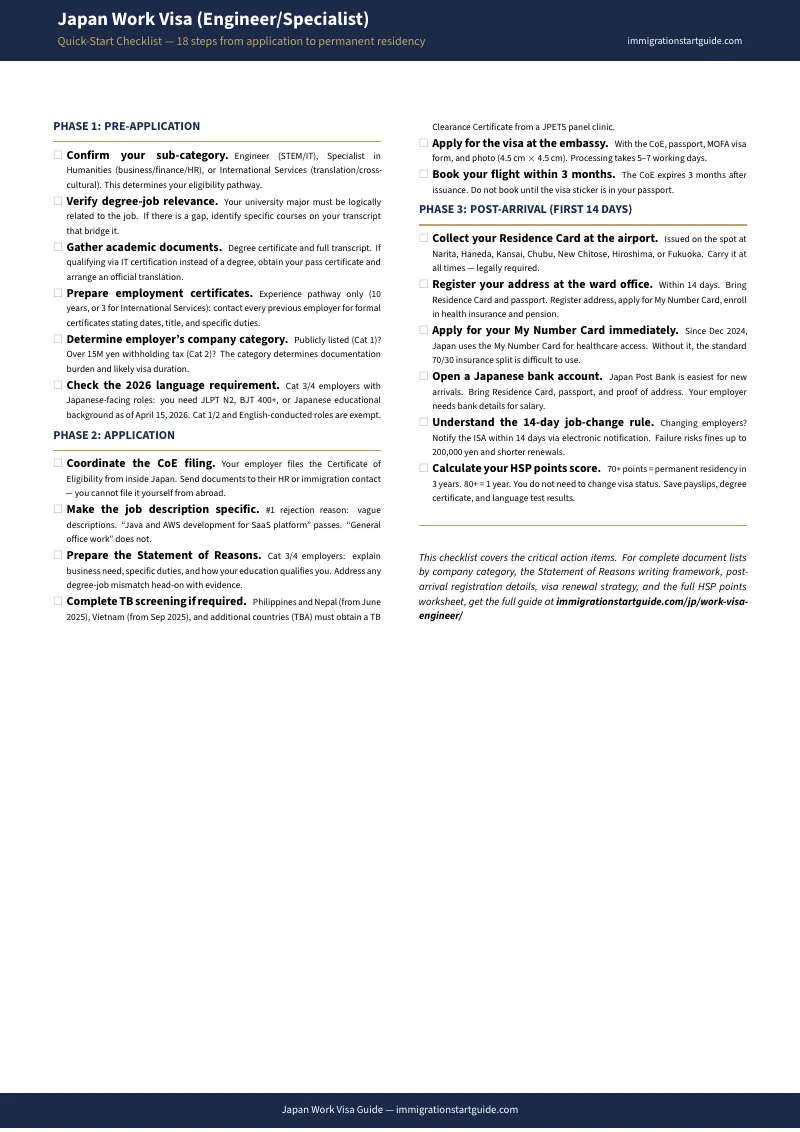
Quick-Start Document Checklist (free download)
A one-page action plan covering the essentials: identify your company's category, assess your degree-job relevance, verify your source country's additional requirements, and confirm whether the 2026 language requirement applies to your situation. Enough to identify your first concrete step tonight.
Who This Guide Is For
This guide is for engineers, IT specialists, and humanities professionals with a Japanese job offer who want to understand how the ISA evaluates their application — not just what forms to fill out:
- Software developers, systems engineers, and IT professionals joining Japanese tech companies or startups who need to understand how the company category system affects their documentation burden and visa duration
- Professionals with degrees in related but not identical fields to their job duties — an Economics graduate in a marketing role, an Engineering graduate in a data analysis role — who need to frame the degree-job relevance so the ISA sees the logical connection
- Applicants joining Category 3 or 4 companies (SMEs and startups) where the HR department has limited visa sponsorship experience and the applicant needs to drive the CoE process forward themselves
- Filipino, Indian, and Vietnamese professionals who face additional departure requirements — OEC/DMW registration, degree attestation, TB screening — that run in parallel to the Japanese immigration process and must be started early
- Professionals without a university degree who qualify through the 10-year experience pathway or recognized IT certifications and need to understand exactly what documentation the ISA requires as evidence
- Anyone who has received a CoE denial or a Request for Further Evidence and needs to understand why, and how to prepare a re-application that addresses the specific deficiency
- E/SH/IS holders planning ahead for Permanent Residency who want to understand the HSP retrospective points strategy from the start of their Japanese career
This guide is not for: professionals seeking the Highly Skilled Professional visa as their primary status (see the Japan Highly Skilled Professional Visa Guide), workers in the Specified Skilled Worker categories for designated industries (see the Japan Specified Skilled Worker Visa Guide), or residents already on a work visa who want to apply for Permanent Residency (see the Japan Permanent Residency Guide).
Why Not Free Resources or an Immigration Lawyer?
Free information about the E/SH/IS visa exists. Here is what each source actually delivers:
- The MOFA and ISA websites list the required forms and the statutory criteria. They do not explain how the ISA interprets those criteria — the internal logic of the degree-job relevance assessment, the company category implications, or what makes a Statement of Reasons persuasive versus generic. You get the "what" but never the "why."
- Reddit and online forums are where someone tells you their visa was approved with an unrelated degree (they were in Category 1 — you are in Category 4), that the Statement of Reasons is optional (it is, until your application is borderline), or that the new language requirement does not apply to engineers (it depends on your company category and your role's communication requirements, not your job title). Anecdotes from different years, different categories, and different regional bureaus do not generalize to your specific situation.
- Blog posts from immigration law firms provide accurate but deliberately incomplete information. They explain enough to demonstrate expertise and generate inbound leads, but stop short of the operational detail you need to file without hiring them. The "contact us for a free consultation" at the bottom is the entire point of the article.
- Immigration lawyers (gyosei shoshi) charge 110,000 to 220,000 yen for a CoE application. For complex cases — Category 4 sponsors, borderline degree matches, prior denials — they are worth every yen. But many professionals at Category 1 and 2 companies, or with clear degree-job matches, do not need a lawyer. They need the ISA's internal logic decoded in plain English so they can assemble a strong application themselves.
This guide fills the logic gap — the space between the MOFA website's form list and the immigration lawyer's 110,000 yen invoice. It explains how the ISA thinks, not just what the ISA requires, so you can assess your own case and make an informed decision about whether you need professional help or whether you can drive the process yourself.
— Less Than One Hour of a Lawyer's Time
An immigration lawyer charges 110,000 to 220,000 yen for a CoE application. The government application fee is zero — the CoE itself is free. The cost of a visa rejection is not measured in money but in time: 1 to 3 months of processing wasted, a job offer that may not survive the delay, and the uncertainty of a re-application where you still do not understand what went wrong.
The guide costs less than a single consultation with a gyosei shoshi. It covers the complete Approval Logic System — the degree-job relevance doctrine, the company category framework, the Statement of Reasons structure, the 2025-2026 regulatory changes, source country requirements, the post-arrival compliance sequence, and the Permanent Residency fast-track — so you enter the process understanding why the ISA makes the decisions it makes, not just hoping your paperwork is correct.
Money-back guarantee, no time limit. If the Approval Logic System does not make you materially better prepared to navigate the E/SH/IS visa process, you pay nothing.
Download the free Quick-Start Document Checklist to assess your situation tonight. Check your company's category. Evaluate your degree-job relevance. Confirm whether the 2026 language requirement applies to you. Identify your source country's additional requirements. When you are ready for the complete framework — the ISA's internal logic decoded, the Statement of Reasons template, the post-arrival survival guide, and the PR fast-track strategy — the full guide is here.
The ISA does not explain its reasoning. This guide does.