
You Want to Work in Japan. The System Between You and That Job Is Designed for People Who Read Japanese.
You found the SSW listing. You match one of the 16 designated industries. You are ready to study for the language test and the skills test and move to Japan for the salary that is three to five times what you earn at home. And now you are navigating the most consequential career decision of your life through a patchwork of government websites written in bureaucratic Japanese, Facebook group advice from strangers who applied under different rules, and recruitment agents who may or may not be licensed to send you anywhere.
The official SSW portal tells you there are two visa types, 16 industries, and mandatory tests. It does not tell you that the JFT-Basic language test has a 45-day retest ban if you fail — meaning one bad exam day can cost you a job offer that will not wait. It does not tell you that the "recruitment agency" messaging you on TikTok with a polished video interview is using AI-generated deepfakes of a Japanese hiring manager who does not exist. It does not tell you that your former TITP employer told you that you must return home before applying for SSW status — which is not true and never has been. And it does not tell you that the "training fee" your agent is demanding violates every bilateral agreement between Japan and your country, and that the legitimate pathway costs you zero in recruitment fees.
Your friend who went through a broker paid $5,000 and spent 18 months repaying the debt from his Japanese salary. The worker in your Facebook group signed a contract she could not read and discovered her actual wage was 30% below the regional minimum. The former technical intern in Aichi prefecture does not know he can transfer employers within his industry without leaving Japan, because nobody told him in a language he understands.
The Japan Specified Skilled Worker Visa Guide is an SSW Shield System — the complete framework for navigating your SSW application from test preparation through employer verification to settled worker status in Japan, with an integrated protection layer that identifies illegal fees, scam recruiters, and rights violations before they cost you money, time, or your legal status. It covers all 16 industries, both SSW Type 1 and Type 2, the five major sending countries (Philippines, Vietnam, Indonesia, Nepal, Myanmar), the 2026 regulatory changes, and the Ikusei Shuro transition arriving in April 2027 — decoded from the original Japanese sources into operational English that tells you exactly what to do, when, and why.
What's Inside the SSW Shield System
The complete guide plus 5 standalone printable tools and a quick-start checklist — everything you need from first exam registration through settled working life in Japan:
The Two-Test Strategy: Language and Skills (Chapters 2-3)
Every SSW Type 1 application requires two passing scores: a Japanese language test and an industry-specific skills evaluation. The language test gives you two options — the JLPT N4 (offered twice a year, results in two months) or the JFT-Basic (offered up to six times a year, results on the same day). The guide does not just describe both tests. It explains the strategic difference: the JFT-Basic tests practical "survival Japanese" for daily life — ordering food, reading a work schedule, understanding safety instructions — while the JLPT N4 tests formal grammar and reading comprehension. For workers who need results fast because a job offer has an expiration date, the JFT-Basic's same-day scoring and more frequent test windows make it the tactical choice. For workers who already studied formally and are comfortable with grammar-based evaluation, the JLPT N4 may be the stronger option. And for workers who fail either test, the guide explains the 45-day retest waiting period and the scheduling strategy that ensures a failed attempt in April does not destroy a June job offer.
The skills evaluations are where most applicants hit a wall. Each of the 16 industries has its own exam body, its own format, its own registration process, and its own pass rates. The nursing care exam runs 60 minutes with 45 questions plus a practical component using patient care images. The food and beverage manufacturing exam is 70 minutes of CBT with a heavy focus on HACCP hygiene principles. The industrial manufacturing exam was overhauled in July 2026 with seven new categories and a split written-plus-practical format where you cannot return to the written section once the practical starts. The guide maps every industry's exam format, content focus, registration system, and scheduling windows — so you know exactly what you are studying for, not a generic "skills test."
For former TITP interns who completed Technical Intern Training (ii): you are exempt from both the language test and the skills test for SSW Type 1. The guide explains the specific documentation that proves your exemption, because many former interns do not realize this exemption exists and waste months studying for tests they do not need to take.
The Recruitment Scam Shield (Chapter 4)
The single biggest financial risk in the SSW pathway is not the exam fee or the visa application. It is the recruitment agent who charges you $3,000 to $7,000 for a service that legitimate employers provide for free. Under the bilateral Memoranda of Cooperation between Japan and every major sending country, the employer pays recruitment costs — not the worker. A licensed Philippine agency operating under DMW oversight cannot legally charge you a recruitment fee. A DOLAB-registered Vietnamese sending organization operates under fee ceilings set by Vietnamese law. An Indonesian agency registered with BP2MI operates under a government-mandated zero-fee policy. Yet the average Vietnamese worker still pays over $6,500, and the average Filipino worker pays $2,000 to $5,000, because the information about what is legal and what is not exists only in government databases that most workers have never heard of.
The guide provides the country-specific verification system that tells you exactly how to confirm whether your agency is legitimate before you pay a single dollar. For the Philippines: search the DMW's licensed agency database at dmw.gov.ph, check whether the specific Japanese employer is listed in the agency's approved Job Orders, and call the DMW Hotline 1348 to verify in real time. For Vietnam: confirm the sending organization appears on the DOLAB-approved list and cross-reference it against the OTIT portal in Japan. For Indonesia: verify the agency holds a valid PMI Recruitment Permit through bp2mi.go.id. For all countries: search the Japanese company on the OTIT/ISA portal at otit.go.jp to confirm the employer is registered as an SSW Accepting Organization.
In 2026, the scam landscape has gotten worse. Generative AI now powers deepfake "video interviews" with hiring managers who do not exist, AI-generated job listings on TikTok and WhatsApp that look professional but lead only to a request for a "training deposit," and bot-driven urgency messages claiming "only 2 slots remaining" to pressure immediate payment. The guide includes the 2026 Red Flag Checklist that identifies AI-driven scams by their specific behavioral signatures — what a real employer process looks like versus what a ghost job operation looks like — so you can distinguish legitimate opportunities from expensive traps before you share your passport scan or transfer money.
The 16-Industry Navigator (Chapter 5)
The SSW program covers 16 designated shortage industries, each with its own exam, its own employer ecosystem, its own regional demand patterns, and its own career trajectory. Nursing care in aging rural prefectures. Construction in Osaka's Expo preparation zones. Food service in Tokyo's post-pandemic restaurant recovery. Agriculture in Hokkaido and Tohoku. Automobile maintenance, building cleaning, industrial manufacturing, shipbuilding, fisheries, aviation, hospitality, food and beverage manufacturing — and in 2026, expanded sub-categories within manufacturing that added furniture, rubber products, and printing to the eligible sectors.
The guide does not just list the industries. It maps the practical reality of each: the regional minimum wages that determine your actual take-home pay (a construction worker in Tokyo earns significantly more than the same role in Kagoshima), the typical employer types (direct hire versus staffing agency), the career progression from SSW Type 1 to Type 2 where available, and the industries where Type 2 pathways now exist (expanded to 11 sectors in 2026, up from the original 2 in construction and shipbuilding). If you are choosing between industries or between regions within an industry, this chapter gives you the information to make that decision based on earnings, working conditions, and long-term residency potential — not based on whichever recruiter contacted you first.
Your Rights as an SSW Worker (Chapter 6)
Under Article 3 of Japan's Labor Standards Act, discrimination in wages or working hours based on nationality is prohibited. SSW workers are entitled to the regional minimum wage, a written employment contract in a language they understand, enrollment in health and pension insurance, paid annual leave after six months, the right to join a labor union, and the right to change employers within the same industry. Your employer cannot retain your passport or residence card. The Labor Standards Inspection Office provides free, confidential consultations on wage and hour disputes — in your language.
Knowing your rights is different from being able to exercise them. The guide translates each right into a specific action: what to do if your payslip shows deductions you did not agree to, how to contact the Labor Bureau's multilingual hotline, what happens if your employer threatens to cancel your visa status (they cannot — your visa is tied to the SSW program, not to a single employer), and how to initiate an employer transfer if your working conditions violate your contract. For workers coming from the TITP system, where employer transfer was effectively impossible, this chapter is the clearest explanation in English of how SSW rights work in practice and not just on paper.
The guide also covers the Registered Support Organization (RSO) system — the organizations that employers must use if they cannot provide the 10 mandatory types of worker support themselves. Pre-arrival guidance, airport pickup, housing assistance, bank account setup, disaster preparedness orientation, and a 24/7 consultation hotline in your native language. The guide explains what your RSO is legally required to provide, how to verify your RSO's registration, and what to do if the support you were promised is not being delivered.
The Employer Transfer Protocol (Chapter 7)
The right to change employers is what separates the SSW visa from the old Technical Intern Training Program, where workers were tied to a single employer and had no legal exit from abusive conditions. Under the SSW system, you can transfer to any employer in the same designated industry without a new skills test. If you want to move to a different industry entirely — agriculture to food service, for example — you must pass the new industry's skills evaluation, but you do not need a new language test.
The guide covers the complete transfer process: the notification requirements, the timeline for maintaining valid residence status between employers, how to find new SSW-eligible employers through the official ISA job matching system, and the specific documentation needed to prove your transfer is within the same industry field. It also covers the 2027 Ikusei Shuro transition, which will expand the legal grounds for transfer to include "contract breaches" and "human rights violations" — giving workers a formal legal exit from employers who fail to honor their contracts. If you are a former TITP intern who was told you must return home before switching employers, this chapter explains why that is wrong and what the actual process looks like.
Country-Specific Pathways (Chapter 8)
The SSW application process looks different depending on where you are applying from, because each sending country has its own departure requirements, its own government agencies, and its own recruitment regulations.
For the Philippines: the DMW (Department of Migrant Workers) requires an Overseas Employment Certificate, verification of the recruitment agency's license, and a Pre-Departure Orientation Seminar. Without completing these steps, you will be denied boarding at the airport regardless of your Japanese visa status. The guide walks through the complete DMW process from initial agency verification through PDOS attendance to airport departure.
For Vietnam: DOLAB (Department of Overseas Labour) regulates sending organizations and sets fee ceilings under Law 72. The guide explains how to verify your sending organization on the DOLAB-approved list, what fees are legal (one month's salary per year of contract) versus what brokers actually charge, and the OTIT cross-reference that confirms the Japanese employer is registered.
For Indonesia: BP2MI enforces a zero-fee policy for government-to-government (G-to-G) placements. The guide covers the PMI Recruitment Permit verification, the government testing centers, and the specific protections that apply to Indonesian workers under bilateral agreements.
For Nepal and Myanmar: the guide covers the specific testing schedules, the registration processes, and the departure requirements that apply to workers from these countries — including the agencies authorized to process SSW applications and the common scam patterns specific to each country's recruitment market.
The Path Forward: SSW Type 2, Ikusei Shuro, and Permanent Residency (Chapter 9)
The SSW Type 1 visa is a five-year maximum. For workers who want to stay in Japan permanently, the guide maps the three forward pathways. First: the SSW Type 2 upgrade, now available in 11 industries as of 2026, which removes the five-year cap, permits family accompaniment, and provides a direct pathway to Permanent Residency. The Type 2 skills test is harder — it evaluates advanced vocational proficiency — but the language test is generally waived because you are expected to have acquired practical Japanese during your Type 1 years. The guide covers each industry's Type 2 availability, the exam requirements, and the timeline for transitioning.
Second: the Ikusei Shuro (Employment for Skill Development) system launching in April 2027, which replaces the TITP and creates a new bridge pathway into SSW Type 1. If you are currently in the TITP system or planning to enter the Japanese workforce through the new Ikusei Shuro program, the guide explains how the transition works, what the new "Freedom to Transfer" provisions mean for your employer mobility, and how the pathway connects to SSW Type 1 and eventually Type 2.
Third: Permanent Residency itself. The standard route requires 10 years of continuous residence including 5 years on a work visa. Time spent on SSW Type 2 counts toward this threshold. The guide covers the PR application requirements, the tax and pension compliance record that determines approval or denial, and the planning you should begin during your first year in Japan — not in your tenth.
Standalone Printable Tools (included with the full guide)
- Exam Registration Tracker — a one-page reference listing the registration windows, test dates, and results timelines for both the JFT-Basic and JLPT N4 language tests plus the skills evaluations for all 16 industries. Pin it on your wall when you start studying.
- Agency Verification Checklist — the step-by-step process for verifying your recruitment agency's license through your country's official database (DMW for Philippines, DOLAB for Vietnam, BP2MI for Indonesia), plus the Japanese OTIT/ISA employer check. Complete this before you sign anything or pay anything.
- Worker Rights Reference Card — the 10 critical rights every SSW worker has under Japanese law, printed in plain English. Your minimum wage, your contract rights, your transfer rights, your insurance entitlements, and the phone numbers for free legal consultation. Keep it in your wallet from the day you arrive.
- Red Flag Checklist — the specific warning signs that distinguish legitimate recruiters from scam operations, updated for 2026 AI-driven tactics. Deepfake interviews, ghost job listings, urgency pressure, upfront "training fees," passport collection. If your recruiter triggers three or more flags, stop the process.
- Post-Arrival First 14 Days Planner — ward office registration, residence card update, My Number enrollment, health insurance, pension, bank account opening, mobile phone. Every deadline and action step for your first two weeks in Japan, in the order you need to complete them.
Quick-Start Checklist (free download)
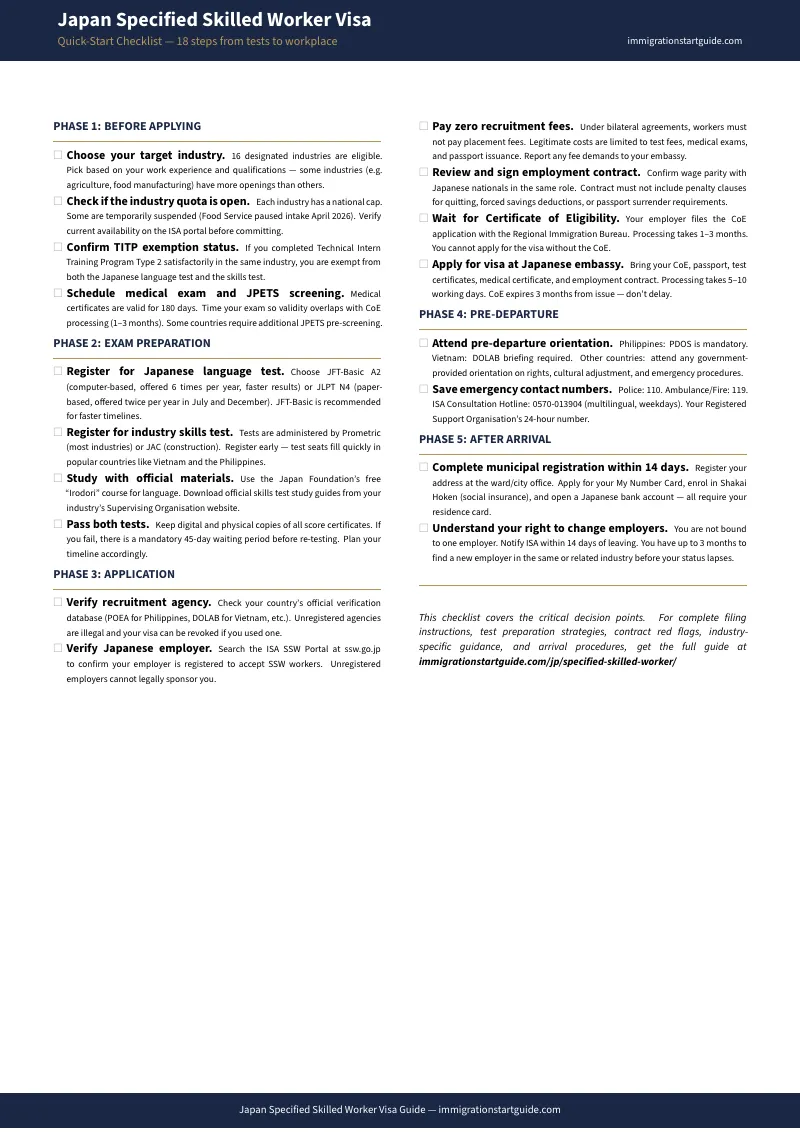
A one-page action plan covering the essentials: identify which of the 16 industries matches your experience, check whether you need to take the language and skills tests or qualify for an exemption, verify your recruitment agency against the official database for your country, and confirm the next available test date in your region. Enough to identify your first concrete step tonight.
Who This Guide Is For
This guide is for workers in designated shortage industries who want to build a career in Japan through the SSW pathway — and who refuse to pay a broker thousands of dollars for information the Japanese government provides for free:
- Workers in the Philippines, Vietnam, Indonesia, Nepal, Myanmar, and other SSW-eligible countries applying for their first SSW Type 1 visa and navigating the dual test requirement (language plus industry skills) for the first time
- Former TITP interns who want to transition to SSW status without returning home — including those who are exempt from both the language and skills tests but do not know the paperwork required to claim that exemption
- Workers choosing between industries or between regions within an industry who want to compare actual wages, working conditions, and long-term career paths rather than relying on whichever recruiter contacted them first
- Anyone who has been approached by a recruitment agent demanding fees and wants to verify whether the agency is licensed, whether the fees are legal, and whether the Japanese employer actually exists before committing money
- SSW Type 1 holders preparing for the Type 2 upgrade who want to understand which industries now offer the pathway, what the advanced skills test requires, and how Type 2 connects to Permanent Residency
- Workers currently in the TITP system or entering through the 2027 Ikusei Shuro program who want to understand how the new system bridges into SSW and what the "Freedom to Transfer" provisions mean in practice
- Anyone who has been told something by an agent, an employer, or a social media post and wants to verify it against the actual legal framework — because in the SSW ecosystem, the cost of wrong information is measured in years and thousands of dollars
This guide is not for: professionals applying for the Engineer/Specialist in Humanities/International Services visa (see the Japan Work Visa (Engineer/Specialist) Guide), professionals qualifying for the Highly Skilled Professional points-based visa (see the Japan Highly Skilled Professional Visa Guide), or long-term residents applying for Permanent Residency through the standard route (see the Japan Permanent Residency Guide).
Why Not Free Resources or a Recruitment Agent?
Free information about the SSW visa exists. Here is what each source actually delivers:
- The official SSW portal (ssw.go.jp) lists the eligible industries, the test requirements, and the visa categories. It is primarily in Japanese. The English pages provide an overview, not operational instructions. They do not explain the 45-day retest ban strategy, the agency verification process for your specific country, or what to do when your employer violates your contract. You get the program description but never the survival manual.
- Facebook groups and TikTok are where someone tells you their agency is "legit" because their friend got to Japan through them (their friend also paid $4,000 in fees that were illegal), that you must study for 12 months before taking the JFT-Basic (the JFT-Basic tests practical daily Japanese, not academic grammar — study time depends on your starting level), or that SSW workers cannot change employers (they can, in every industry). Social media advice from different years, different countries, and different industries does not generalize to your situation — and the people giving advice may be agents themselves.
- Recruitment agencies provide information that serves their business model. Licensed agencies with approved Job Orders are legitimate and handle the process professionally. But they will not tell you that you could apply directly through an employer without an agency, that the fees they are charging exceed the legal ceiling in your country, or that the Japanese company they represent has a history of labor complaints. The agent's incentive is to place you as quickly as possible, not to ensure you understand your rights before you arrive.
- Immigration lawyers in Japan charge 110,000 to 220,000 yen for visa consultation and filing. For complex cases — employer disputes, denied applications, status changes — professional legal help is essential. But for the standard SSW Type 1 pathway where the primary risk is not legal complexity but information asymmetry and recruitment fraud, what you need is the complete operational framework in your language, not a lawyer.
This guide fills the information gap — the space between the government portal's Japanese-language overview and the recruitment agent's self-serving advice. It gives you the verification tools, the test strategy, the rights framework, and the scam detection system so you can navigate the SSW pathway as an informed participant, not a dependent one.
— Your Exploitation Insurance
A recruitment broker charges $3,000 to $7,000 for a service that legitimate employers provide for free. A failed skills test costs the exam fee plus a 45-day delay — potentially $1,500 in lost earnings if your job offer expires. A signed contract you cannot read can lock you into wages 30% below the legal minimum for years. An illegal dismissal you do not know how to fight ends your residency status and your Japanese career.
The guide costs less than one percent of an average broker fee. It covers the complete SSW Shield System — the two-test strategy with scheduling and retest planning, the recruitment scam verification system for all five major sending countries, the 16-industry navigator, the worker rights framework, the employer transfer protocol, the country-specific departure pathways, the Ikusei Shuro transition guide, and the road to Permanent Residency — so you enter Japan understanding every right you have and every risk you face, before anyone can exploit what you do not know.
Money-back guarantee, no time limit. If the SSW Shield System does not make you materially better prepared to navigate the Specified Skilled Worker pathway, you pay nothing.
Download the free Quick-Start Checklist to assess your situation tonight. Identify your industry. Check your test exemption status. Verify your recruitment agency. Find the next exam date in your country. When you are ready for the complete framework — the scam shield, the test strategy, the rights reference, the employer transfer protocol, and the path to permanent residency — the full guide is here.
The SSW system was designed in Japanese. This guide translates it into your career.