
You Found the Job. Now Survive the Bureaucracy.
You have a job offer from a New Zealand employer. That should be the hard part — but it's actually the beginning. Between you and that job are three separate government gates, each with its own fees, forms, and refusal risks. Your employer handles two of them. You handle the third. And if anyone gets any step wrong, the entire chain resets.
Immigration advisers charge NZD $4,700–$10,500 to guide you through what is fundamentally an administrative process. Most of that money pays for form-filling and document-chasing — not legal expertise. Unless you have a criminal record, a prior visa decline, or a serious medical condition, you don't need a lawyer. You need a system.
The Three-Gate Navigation System
This guide maps the complete AEWV process as it actually works in 2026 — not how the INZ website describes it in legal language, but how real applications succeed or fail. It covers the employer's accreditation and Job Check (so you can verify they're not making mistakes that will sink your visa), your own application (with every document, fee, and formatting requirement), and the residency pathways that turn a temporary visa into a permanent life in New Zealand.
What You Get
- The Complete AEWV Guide — 14 chapters covering all three gates: employer accreditation requirements, Job Check preparation, your worker visa application, the ANZSCO/NOL classification system, wage calculations, English language requirements, and post-arrival employer obligations
- Document Checklists — Separate print-and-tick checklists for employers (accreditation and Job Check) and workers (visa application and family applications), with the specific evidence formats INZ actually accepts
- Residency Pathway Maps — Green List Tier 1 and Tier 2 occupation lists, the SMC 6-point calculator, the new August 2026 pathways (Skilled Work Experience and Trades & Technician), and the wage grandfathering rules that protect you from median wage increases
- Cost and Timeline Planner — Full fee breakdown for both employers and workers, side-by-side comparison of DIY vs. immigration adviser costs, and a realistic 11–20 week timeline from start to arrival
- Sector-Specific Guidance — Healthcare, construction and trades, hospitality, care workforce, and transport — with the specific wage thresholds, advertising requirements, and residency eligibility for each sector
- 8 Standalone Printable Tools — Every major reference section extracted as its own PDF: occupation classification guide, employer compliance guide, family sponsorship planner, exploitation protection guide, and more — print only what you need
The Information Gap This Fills
Right now, your options are the INZ website (1,000 pages of legal language written for immigration officers, not humans), Reddit threads (anecdotal, often outdated), or an immigration adviser (NZD $2,500–$5,000 per application). There is almost nothing in between.
This guide is the missing middle ground. It translates the bureaucratic process into step-by-step instructions with the same checklists that professional advisers use — the correct ANZSCO codes, the exact advertising requirements, the pay calculation formulas, the common PPI triggers that get applications flagged.
The Traps Most Applicants Don't See
The AEWV has several "hidden gates" that trip up even experienced applicants:
- Dead-end roles — Skill Level 4 and 5 jobs not on the Green List give you a maximum of 3 years with no pathway to residency. Many people don't discover this until they've already moved their family to New Zealand
- The maximum hours pay trap — INZ calculates your hourly rate using the maximum hours in your employment agreement, not the standard hours. An agreement saying "40–50 hours/week" at $70,000 gives you $26.92/hour (using 50), not $33.65 (using 40)
- The Chef vs. Cook mismatch — Calling the role "Chef" but describing Cook duties triggers longer advertising requirements and potential decline. This is the single most common Job Check failure in hospitality
- The stand-down cliff — Workers who arrived on 3-year AEWVs in 2022 are hitting their maximum continuous stay right now. Without a residency pathway, they face a mandatory 12-month departure from New Zealand
Who This Is For
- Workers with a job offer who want to understand every step, fee, and risk before committing — and who want to verify that their employer is handling Steps 1 and 2 correctly
- Employers hiring their first migrant worker who need a compliance roadmap for accreditation, Job Checks, and the post-arrival obligations that get audited
- Anyone planning the AEWV-to-residency journey who needs to know which roles lead to permanent residence and which are three-year dead ends
What About Free Resources?
The INZ website tells you what the law says. It doesn't tell you how to comply. It won't explain why your job description will get flagged as a Cook instead of a Chef. It won't give you the pay calculation formula that INZ officers actually use. And it won't map the interaction between the three gates — how a mistake in Step 1 cascades into a decline in Step 3.
Forum advice is worse. Immigration rules changed significantly in March 2025 and again in March 2026. Most Reddit threads reference outdated median wage thresholds and visa durations that no longer apply.
The Free Checklist
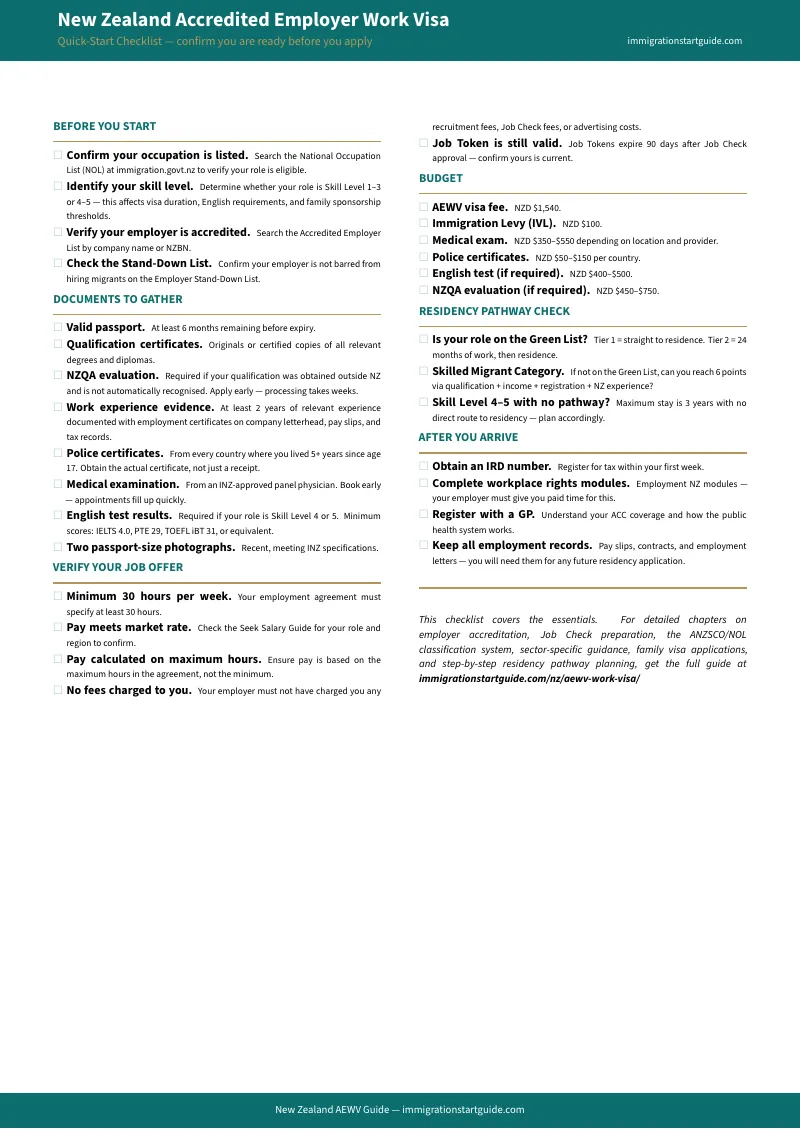
Not sure if you're ready to apply? Download the free Quick-Start Checklist — it covers the 20 essential items you need to verify before starting your application. If the checklist reveals gaps, the full guide shows you how to close them.
— Less Than a Single Immigration Consultation
A 20-minute phone call with an immigration adviser costs NZD $80–$280. This guide replaces dozens of those calls with a permanent reference you can return to at every stage of the process — from your first Job Token to your residency application years later.