
The NZ$5,810 Gamble Most Sponsors Take Blind
You have been in the ballot pool for months. Your name gets drawn. The adrenaline hits — finally. You pay the NZ$5,360 application fee, rush to get your parent's medical done, and wait.
Then the letter arrives: "Your parent's projected healthcare cost over the next ten years exceeds the significant cost threshold of NZ$81,000. The application is declined."
No refund on the fee. No appeal on the medical assessment without new evidence. Months of preparation — and thousands of dollars — gone because nobody told you that a managed heart condition your parent has lived with for twenty years would disqualify them.
This is not a rare scenario. The health assessment is where the majority of Parent Resident Visa applications fail after ballot selection. And it is almost entirely preventable with the right information upfront.
The Sponsor's Roadmap System
This guide is built around one principle: know before you spend. Before you pay the EOI fee, before your name enters the ballot, before your parent flies to a panel physician — you should already know whether your family's situation is viable, which pathway fits your income and your parent's health, and exactly what evidence INZ needs to say yes.
The Sponsor's Roadmap covers the full journey from eligibility self-assessment through ballot, application, medical strategy, and the 10-year sponsorship period. It is the strategic layer that immigration advisers charge NZ$3,000–$8,000 to deliver piecemeal across consultations — synthesized into a single reference you can work through at your own pace.
Income Threshold Mastery
The 2026 income thresholds are indexed to a median wage of NZ$35.00/hour (NZ$72,800 annually). For a single sponsor bringing one parent, that means NZ$109,200 per year — proven for two of the last three tax years via IRD records.
The guide breaks down every nuance: the "two out of three tax years" rule that creates a latency period for recent salary increases, the exact IRD documents you need (Summary of Income, IR3, PAYE records), how self-employed sponsors should structure shareholder salaries and dividend drawings to meet the threshold, and the joint sponsorship math that lets two earners combine incomes.
The Medical Pre-Screening Protocol
This is the chapter that could save your family thousands. Instead of waiting until after ballot selection to discover your parent's health status, the guide provides a structured pre-screening protocol you can run with any doctor in your parent's home country.
You will learn the exact NZ$81,000 threshold calculation, which conditions are high-risk (neurological, cardiovascular, renal), which are manageable (controlled hypertension, stable diabetes), and which are absolute bars with no waiver possible (dialysis, active tuberculosis, conditions requiring full-time residential care). You will also learn why offering to pay for private insurance does not waive the requirement — a misconception that costs families dearly.
Centre of Gravity — Worked Examples
The Centre of Gravity test counts where your parent's adult children live permanently. The catch: siblings on temporary work visas in the Gulf, Singapore, or the UK are often counted as residing in their country of origin — not their current location. For Indian and Filipino families with siblings spread across multiple countries, this single test can make or break eligibility.
The guide provides worked examples for families of two to six children across multiple countries, with evidence strategies for ambiguous residence situations.
Ballot Odds and Parallel Strategy
With approximately 5% selection odds per quarterly draw and a 2-year EOI expiry, the ballot is a waiting game. The guide provides the actual selection data from 2024–2025 draws, a cumulative probability analysis, and the parallel application strategy: running the Parent Boost Visitor Visa alongside the ballot so your parents can be in New Zealand while you wait for the lottery to resolve.
Three Pathways Compared
The Parent Resident Visa is not the only option. Families with NZ$1.5 million in combined capital can bypass the ballot entirely through the Parent Retirement Resident Visa. The new Parent Boost Visitor Visa offers up to five years of temporary stay with no investment requirement. The guide compares all three pathways side by side — fees, timelines, work rights, and the hidden costs of each (including the year-3 departure requirement on the Parent Boost that nobody warns you about).
Country-Specific Chapters
India, China, South Africa, the Philippines, and the UK each have their own documentation quirks, police certificate timelines, medical risk profiles, and Centre of Gravity complications. The guide includes dedicated sections for each major source country so you are not left guessing about PSA certificates, hukou translations, SAPS processing times, or ACRO criminal records requests.
The Full Application — Start to Finish
A complete document checklist broken down by sponsor and parent, the 4-month ITA deadline strategy, the NZ$11,000–$29,000 total cost budget (including hidden costs most guides ignore), the 10-year sponsorship undertaking and what it legally binds you to, the path from resident visa to Permanent Resident Visa, and what to do if your application is declined — including the 42-day IPT appeal window.
Who This Is For
- Professional migrants earning above the NZ$109,200 threshold who want a clear, structured plan instead of piecing together advice from Reddit threads and law firm marketing pages
- Self-employed sponsors who need to understand how IRD classifies shareholder salaries, trust distributions, and schedular payments for sponsorship purposes
- Families with elderly parents who need to know whether a parent with chronic conditions will pass the medical before committing to application fees
- Anyone evaluating the Parent Resident, Parent Retirement, and Parent Boost pathways and wants a side-by-side comparison with real numbers
Why Not Free Resources?
Government pages list the rules but do not explain the strategy. Reddit and Facebook groups are full of advice from people who applied five years ago under different thresholds. Law firm blogs are lead magnets designed to scare you into a NZ$3,000 consultation.
None of these sources tell you how to pre-screen your parent's medical viability, how to structure self-employment income to meet the threshold, or whether the Parent Boost is a genuine alternative or just a consolation prize with hidden costs. This guide does.
What You Get — 10 PDFs
- Complete Guide (PDF) — 14 chapters covering eligibility, income thresholds, Centre of Gravity test, ballot mechanics, medical strategy, alternative pathways, country-specific guidance, and the full application process
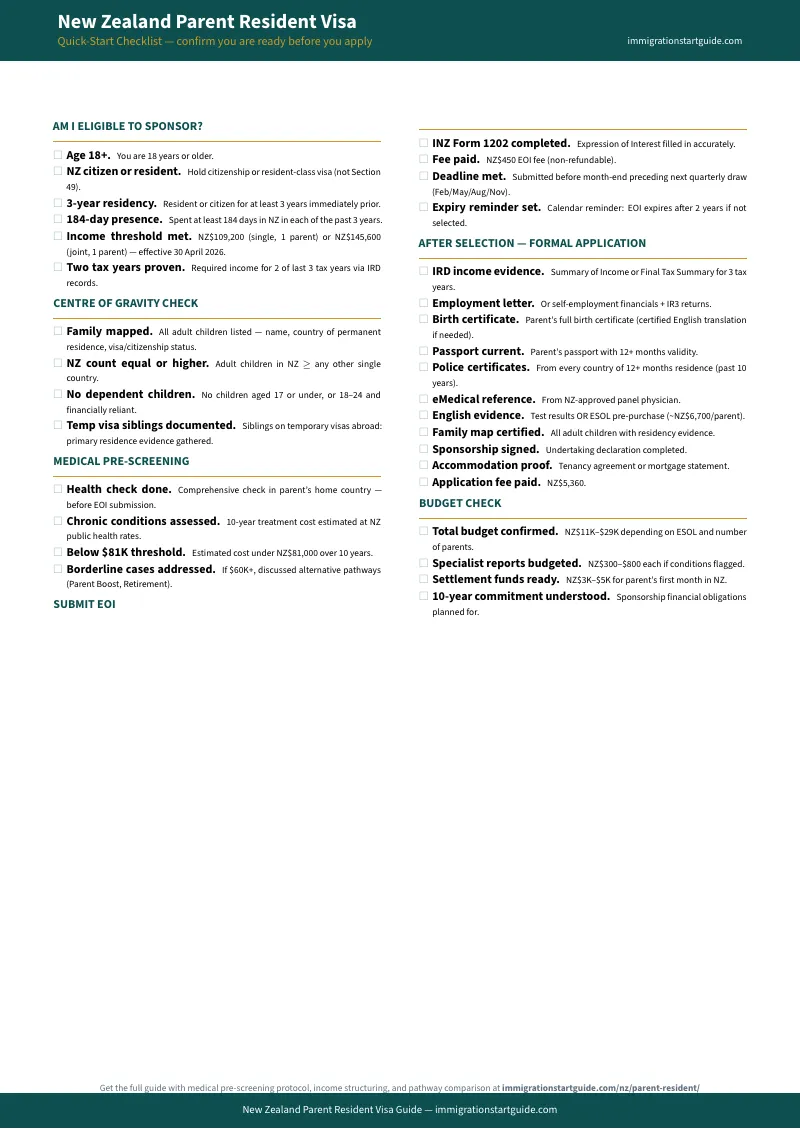
- Quick-Start Checklist (PDF) — 20-item checklist across 6 categories — your at-a-glance reference for tracking progress from eligibility check to arrival
- Medical Pre-Screening Protocol (PDF) — Take-to-the-doctor checklist with the NZ$81,000 threshold, high-risk conditions table, 3-step pre-screening process, and a doctor's findings form
- Income Threshold Reference Card (PDF) — 2026 income tables for single and joint sponsors, the "two out of three tax years" rule, and self-employment documentation guide
- Centre of Gravity Worksheet (PDF) — Fillable family mapping table with worked examples for 2–6 children and evidence strategies for ambiguous residence situations
- Document Checklist (PDF) — Print-and-tick tracker for every sponsor and parent document, organized by source with application fee summary and status tracking table
- Pathway Comparison Guide (PDF) — Side-by-side comparison of Parent Resident, Parent Retirement, and Parent Boost visas with the parallel application strategy and family scenario decision table
- Budget Template (PDF) — Fillable cost calculator covering all visible fees (NZ$11K–$29K) plus hidden costs most guides ignore
- EOI Ballot Timeline (PDF) — Quarterly draw schedule, 2024–2025 selection data, cumulative odds analysis, and stage-by-stage timeline from EOI to arrival
- Country-Specific Reference (PDF) — Quick reference for India, China, South Africa, Philippines, and UK — police certificate timelines, medical risk profiles, and documentation requirements
Satisfaction Guarantee
If the guide does not deliver the strategic clarity you need, email us and we will make it right. You are risking NZ$5,000+ on application fees — this guide exists to make sure that money is not wasted.
— A Fraction of One Immigration Consultation
A single initial consultation with a licensed immigration adviser costs NZ$200–$500 and typically confirms what you could learn in Chapter 3 of this guide. The full advisory fee runs NZ$3,000–$8,000. This guide gives you the complete strategic framework for a fraction of one consultation — so you spend your money on the application itself, not on being told the rules.
Download the free Quick-Start Checklist to see the approach, then get the full guide when you are ready to build your application.