
Your $560 Application Fee Is Non-Refundable if DIA Declines You
You have been in New Zealand for five years. You have a career, a home, maybe a family. You are ready to make it official. You pay the $560 application fee, submit Form NZCS 1, and wait.
Then the letter arrives: "Your application does not meet the physical presence requirement. You were 11 days short of the 1,350-day threshold in the relevant five-year period."
Eleven days. Maybe a work trip to Melbourne you forgot about. Maybe a family emergency in December 2022 that ran longer than you thought. You cannot remember the exact dates because e-gates do not stamp passports, your old boarding passes are gone, and you never requested your travel movements from Customs.
This is not a rare scenario. The physical presence calculation is where self-managed citizenship applications fail. The requirement is strictly enforced: 1,350 days over five years and 240 days in each of those years. No rounding. No discretion. And since New Zealand moved to automated e-gates, most residents have no passport stamps to prove when they were actually in the country.
The First-Time-Right System
This guide is built around one principle: submit once, get approved once. Before you pay the $560 fee, before you book a referee, before you upload a single document to RealMe — you should already know your exact day count, which absences put you at risk, and precisely what evidence DIA needs to say yes.
The First-Time-Right System covers the full journey from presence calculation through application, good character evidence, dual citizenship strategy, and the ceremony itself. It is the strategic layer that licensed immigration advisers charge $500 to $1,500 to deliver across consultations — synthesized into a single reference you can work through at your own pace.
Presence Calculation Mastery
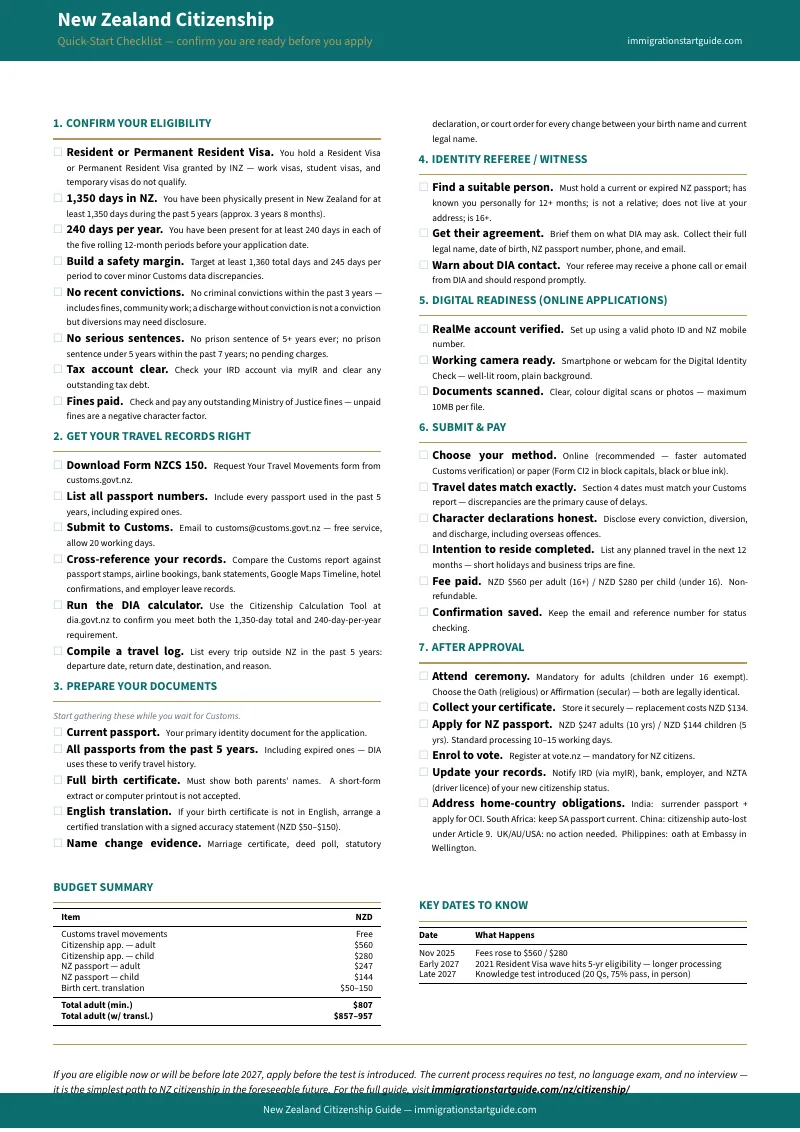
The 1,350-day and 240-day-per-year rules sound simple until you try to count five years of travel from memory. The guide provides a step-by-step method for reconstructing your travel history using Form NZCS 150 from NZ Customs (free, but takes 20 working days), cross-referencing with airline booking records, bank transaction locations, and employer leave records.
You will learn the exact counting rules — which days count as "in New Zealand" (any part of a day counts), how to handle the rolling 12-month calculation that trips up applicants who think in calendar years, and the Safety Margin strategy that recommends waiting until you hit 1,360+ days to absorb any counting discrepancies between your records and the government's.
The Australia Unlock
For many permanent residents, this is the real reason to naturalize. A New Zealand permanent resident has zero automatic rights in Australia. A New Zealand citizen gets a Special Category Visa (subclass 444) the moment they land — live, work, and access social services indefinitely, with a path to Australian citizenship after four years.
The guide maps the full trans-Tasman picture: what SCV 444 gives you from day one, the July 2023 changes that opened Medicare and social security to NZ citizens, and the four-year pathway to Australian citizenship that only NZ passport holders can access.
Beat the 2027 Citizenship Test
From late 2027, most adult applicants aged 16 to 65 will sit a 20-question multiple-choice test covering the Bill of Rights Act, voting rights, democratic principles, and government structure. You need 75% to pass.
If you apply before the test takes effect, you skip it entirely. No study. No exam. No risk of failure. The guide provides the timeline, the cutoff strategy, and the application pacing you need to lodge before the new requirement kicks in.
Dual Citizenship Roadmaps
New Zealand allows dual citizenship, but your home country might not — or might impose conditions you need to manage carefully. The guide includes dedicated roadmaps for the major source countries:
- India — mandatory renunciation, the 2026 e-OCI digital system, biometric enrollment requirements, and managing the gap between surrendering your Indian passport and receiving your NZ one
- South Africa — the May 2025 Constitutional Court ruling that ended automatic citizenship loss, why you still must enter and exit SA on your SA passport, and what the retention letter situation looks like post-ruling
- China — the irrevocable loss of Chinese nationality under Article 9, hukou cancellation consequences, and the honest cost-benefit analysis of a world top-5 passport versus domestic rights in mainland China
- UK, Philippines, Fiji, Samoa — country-specific documentation, police certificates, and the Samoa pre-1949 pathway
Good Character and the RealMe Application
A minor traffic conviction from four years ago. A name change after marriage. A lapsed passport with a different spelling. These are the details that delay applications by months or trigger requests for further information.
The guide walks you through the good character requirement with specifics: what DIA actually checks, how to handle convictions (including the threshold where disclosure is required), how to prepare the digital identity check so your selfie and video are not rejected by the automated system, and a script you can send to your identity referee explaining exactly what details they need to provide.
The Full Application — Start to Finish
A complete document checklist organized by stage, the RealMe portal walkthrough with technical specs for document uploads (color, under 10MB), the witness and referee requirements that catch applicants off guard (must hold a current NZ passport, known you for one year, not a relative, not a housemate), realistic processing timelines from 3 to 14 months, and what to do if your application is declined.
Standalone Worksheets & Reference Cards
In addition to the 59-page guide and document checklist, your download includes 7 standalone printables — each designed to be used independently at the relevant stage of your application:
- Presence Calculator Worksheet — fill in your five rolling 12-month periods and check both thresholds before paying the application fee
- Travel Log Template — record every trip outside NZ alongside your Customs travel movements report (Form NZCS 150)
- Dual Citizenship Reference — country-specific steps for India, South Africa, China, UK, Philippines, Fiji, and Samoa — take to your embassy appointment
- Identity Referee Briefing — give this page to your referee so they know what the DIA will ask and what details you need from them
- Application Walkthrough — section-by-section quick reference to keep open while filling in the RealMe application
- Cost & Budget Worksheet — plan the full spend from permanent residency to passport for your entire family
- Post-Citizenship Actions — after your ceremony, tick off every record update and home-country obligation
Who This Is For
- Permanent residents approaching or past the five-year mark who want to confirm their presence calculation is airtight before paying the $560 fee
- Frequent travellers and remote workers who have gaps in their passport stamps and need to reconstruct five years of travel movements from scratch
- Anyone considering the move to Australia who needs NZ citizenship to unlock the Special Category Visa and trans-Tasman rights
- Residents who want to apply before the 2027 citizenship test and need a clear timeline and pacing strategy
- Indian, South African, and Chinese nationals navigating dual citizenship rules that changed significantly in 2025 and 2026
Why Not Free Resources?
The DIA website lists the rules but does not explain the strategy. It will not tell you how to reconstruct your travel history when e-gates left no stamps, how to handle a minor conviction from years ago, or how to time your application to beat the 2027 test. The official Self-Check Tool tells you if you are eligible today — it does not help you plan for eligibility three months from now.
Citizenship.co.nz offers a presence calculator for $1.99, but it is a single-purpose tool, not a strategy guide. It cannot walk you through dual citizenship implications, good character evidence, or the Australia pathway.
Reddit and Facebook groups are full of advice from people who applied under different fee structures and before the 2027 test was announced. A licensed immigration adviser will confirm what Chapter 2 of this guide covers — for $500 or more per consultation.
None of these sources give you the complete picture: presence strategy, travel reconstruction, dual citizenship roadmap, 2027 deadline planning, and application walkthrough in one place. This guide does.
Satisfaction Guarantee
If the guide does not deliver the strategic clarity you need, email us and we will make it right. You are risking $560 on a non-refundable application fee — this guide exists to make sure that money is not wasted.
— Less Than One Immigration Consultation
A single initial consultation with a licensed immigration adviser costs $200 to $500 and typically confirms what you could learn in the first two chapters of this guide. The full advisory fee runs $500 to $1,500. This guide gives you the complete strategic framework for a fraction of one consultation — so you spend your money on the application itself, not on being told the rules.
Download the free Quick-Start Checklist to see the approach, then get the full guide when you are ready to submit your application.