
You Need 6 Points and a Job Offer. You Have a Master's Degree, Three Years of Experience, and No Idea Whether That Gets You to 6. This Guide Turns the Simplified System Into a Precise Residency Campaign.
You read the Immigration New Zealand website. Six points. Three pillars. Binary eligibility. It sounds straightforward. Then you try to calculate your score.
Your overseas master's degree should be worth 5 points — but only if NZQA assesses it at Level 9. Your university is not on the List of Qualifications Exempt from Assessment, so you need an International Qualification Assessment. That costs $445 to $746 and takes 10 weeks. If the IQA comes back at Level 8 instead of Level 9, you lose a point — which means 24 months of New Zealand work experience instead of 12. One NZQCF level changes your timeline by a full year.
You check the Green List. Your occupation appears on Tier 2, which means residence after 24 months of NZ work. But you also qualify for 5 SMC points via qualifications — meaning you could reach 6 points through SMC after just 12 months of experience. The Green List route would actually take longer. The government publishes both pathways but does not tell you which one is faster for your specific profile.
You consider hiring a Licensed Immigration Adviser. They quote $5,000 to $7,000 NZD. But LIAs handle compliance — completing forms, certifying documents, lodging the application. They are not in the business of telling you that a three-year Indian B.Sc. may assess below NZQCF Level 7, or that the March 2026 median wage increase to $35.00/hr means your $34.50/hr offer resets your entire work experience clock, or that the August 2026 reforms will introduce a locked-in wage rule that protects future applicants from exactly this problem — if you time your arrival correctly.
The New Zealand Skilled Migrant Category Guide is the 6-Point Residence Blueprint — the strategic planning system that sits between Immigration New Zealand's impenetrable instructions and a Licensed Immigration Adviser's $5,000+ retainer. It transforms scattered government rules, NZQA mapping tables, Green List occupation codes, and community anecdotes into a precise, sequenced campaign to reach 6 points, secure your Resident Visa, and lock in Permanent Residence.
What's Inside the 6-Point Residence Blueprint
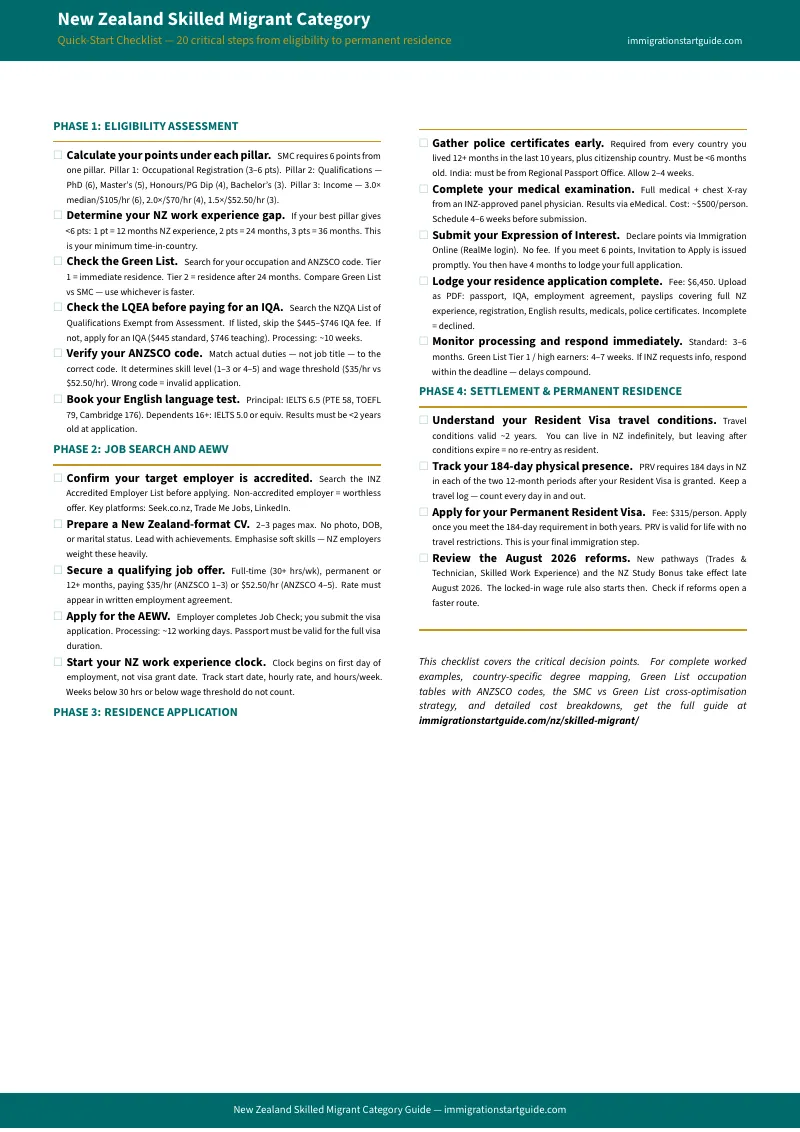
The complete kit includes the 13-chapter guide, the 20-step quick-start checklist, and 8 standalone printable worksheets and reference cards — everything you need to assess your eligibility, choose the optimal pathway, prepare your documents, and execute your application. Print the worksheets, fill them in, and bring them to your adviser consultation or keep them at your desk as you work through the process.
The Three-Pillar Points Analyzer — the SMC awards points from one pillar only: Occupational Registration, Academic Qualifications, or High Income. You cannot mix them. The guide maps every scenario: a PhD (6 points, apply directly), a master's degree (5 points, bridge with 12 months NZ experience), a bachelor's degree (3 points, bridge with 36 months), a registered nurse with 4-year training (4 registration points, bridge with 24 months), an IT manager earning $105.00/hr (6 income points, no experience needed). The pillar you choose determines whether your residency timeline is 14 months or 5 years. The guide runs the numbers for every combination so you pick the pillar that gets you there fastest.
The Green List Cross-Optimizer — the Green List offers a parallel residency track for shortage occupations, but it is not always faster. A master's-holding engineer on Green List Tier 2 needs 24 months of NZ work. Through SMC, they need 12. A tradesperson with a 2-year registration needs 36 months via SMC but only 24 via Green List Tier 2. The guide maps every Tier 1 and Tier 2 occupation with ANZSCO codes and compares the Green List timeline against the SMC timeline for your specific qualification level — so you pursue whichever pathway opens first.
The NZQA Qualification Mapping Engine — before you pay the $445-$746 IQA fee, you need to predict where your degree will land. The guide provides country-specific mapping for India (B.Tech, M.Tech, three-year B.Sc. risk zone, IIT exemptions), South Africa (B.Eng. at Level 8, National Diploma risk zone), the United Kingdom (three-year bachelor's at Level 7, integrated MEng at Level 9), and the Philippines (BSN at Level 7, but the Registration pillar at 4 points is the smarter play for nurses). Includes the LQEA check protocol that can save you the entire IQA fee.
The Accredited Employer Job Search System — a skilled job offer from an accredited employer is the prerequisite for almost every SMC pathway. The guide covers how to verify employer accreditation before accepting any offer, the NZ CV format (2-3 pages, no photo, no date of birth, soft skills emphasis), offshore job search strategy for applicants still in their home country, the six key job platforms (Seek, Trade Me Jobs, Working In NZ, LinkedIn, Mahi, Tahatu), and the "contrived arrangement" red flags that INZ investigators look for.
The AEWV-to-Residence Pipeline — the Accredited Employer Work Visa is the gateway that most SMC applicants need before they can apply for residence. The guide sequences the three-step process (employer accreditation, job check, visa application), explains the 12-working-day processing timeline, maps the wage requirements that must be maintained continuously throughout your experience period, and flags the wage slippage trap — where a $0.50/hr pay reduction resets your entire work experience clock to zero.
The August 2026 Reform Navigator — three new pathways take effect in late August 2026: the Trades and Technician route (18 months NZ experience for Level 4+ vocational qualifications), the Skilled Work Experience pathway (2 years NZ experience at 1.1x median wage), and the NZ Study Bonus (1 extra point for NZ-earned qualifications). The locked-in wage rule also starts then, protecting future applicants from rising median wage thresholds. The guide maps which applicants benefit from each reform, the Red and Amber occupation lists that restrict access, and the timing strategy for applicants who are mid-process when the reforms take effect.
The Two-Step Residence Progression — New Zealand does not grant "Permanent Residency" in one step. You receive a Resident Visa first, with 2-year travel conditions. If you leave after those conditions expire, you lose your residency. The Permanent Resident Visa requires 184 days of physical presence in New Zealand in each of two consecutive years. The guide explains the travel condition trap that catches applicants who return home "temporarily," the 184-day counting methodology, and the alternative commitment pathways (tax residence, $1M investment, business establishment).
Country-Specific Guidance — dedicated chapters for India (police certificate changes, IIT exemptions, ACS vs NZ Engineering registration, NZ vs Australia strategic comparison), South Africa (degree recognition for UCT/Wits/Stellenbosch/UP, trade certificate pathways, safety-motivated timeline planning), the United Kingdom (NVQ and City & Guilds mapping for the Trades and Technician pathway, electrical and plumbing registration bridging), and the Philippines (nursing registration pathway with TruMerit, NCNZ, and OSCE costs totalling $4,365+, Green List Tier 1 eligibility for registered nurses).
The Complete Cost Breakdown — every fee for individuals and families, laid out with no surprises. The $6,450 residence application. The $445-$746 IQA. The $750 AEWV. The $500 medical examination. English language tests. Professional registration fees by profession. Police certificates by country. The ESOL tuition alternative for dependents who cannot meet the language threshold ($1,735-$6,795). Family application cost estimates for a family of four ($13,870-$15,470+). And the comparison table showing what a Licensed Immigration Adviser charges for the same guidance: $5,000-$12,000.
Who This Guide Is For
- You hold an overseas master's degree and want the fastest route to NZ residence. You need to know whether your degree maps to NZQCF Level 9 (5 points, 12 months to residence) or Level 8 (4 points, 24 months) — and whether the Green List offers a shortcut or a detour for your specific occupation.
- You are an Indian IT professional considering New Zealand instead of Australia. Australia's Subclass 189 has multi-year backlogs requiring 90+ points. New Zealand's SMC is binary — 6 points and a job offer. You need the NZ vs Australia comparison, the IIT degree exemption check, and the December 2025 police certificate change that affects every Indian applicant.
- You are a UK or South African tradesperson looking at the Green List. Your electrician's licence or plumbing certification needs NZ registration before it counts for anything. You need to know whether your qualification maps to the Green List Tier 2 (24 months), the new Trades and Technician pathway (18 months from August 2026), or the standard SMC (36 months) — and which NZ registration board handles your trade.
- You are a Filipino nurse with a BSN and clinical experience. Registered Nurses are Green List Tier 1 — immediate residence with no NZ experience required. But the upfront registration cost ($4,365+ NZD) means you need to know the exact sequence of TruMerit, NCNZ, and OSCE before committing.
- You are already in New Zealand on an AEWV and your work experience clock is ticking. You need to verify your wage meets the threshold after the March 2026 median wage increase, understand whether the August 2026 locked-in wage rule will protect you, and confirm that your ANZSCO code matches your actual duties — not just your job title.
- You are weighing $5,000-$7,000 for a Licensed Immigration Adviser. You want to understand exactly what an LIA provides — and whether your case (standard qualifications, clean record, genuine job offer) actually needs one, or whether you can self-manage the process with the same decision framework the professionals use.
This guide does not replace a Licensed Immigration Adviser for cases involving character concerns, health waivers, previous visa refusals, or complex employment arrangements. It gives you the strategic architecture that Immigration New Zealand does not provide and that advisers are not incentivised to deliver at the consultation stage.
Why Not Free Resources?
- Immigration New Zealand publishes every rule. The 6-point table is public. The Green List is online. The wage thresholds are updated annually. But the rules do not tell you that a master's-holding engineer reaches residence faster through SMC than Green List Tier 2, or that the NZQA Level 7 vs Level 8 distinction on your IQA changes your timeline by 12 months, or that accepting a $34.50/hr offer when the threshold is $35.00 resets your work experience to zero. The system is designed to be navigated, not optimised.
- Reddit and forums (r/newzealand, r/IWantOut, ExpatForum) host thousands of posts from applicants who filed under the old 180-point sliding scale. The 160-point trap is still the most-upvoted advice for "how many points do I need." The distinction between Resident Visa and Permanent Resident Visa is routinely confused — community members use "PR" to mean the initial Resident Visa, missing the travel condition trap that can void residency entirely. Legacy information is structural in these communities.
- Licensed Immigration Advisers quote $5,000 to $7,000 NZD for full SMC management. They handle the paperwork. They rarely deliver the strategic layer — whether you should pursue SMC or Green List, which pillar maximises your points, whether the August 2026 reforms change your optimal timing, or whether your specific degree will map to Level 8 or Level 9 before you pay for the IQA. The $130-$250 initial consultation confirms your eligibility. It does not build your strategy.
This guide fills the strategy gap — the space between "I think I qualify" and "I have a sequenced, evidence-ready campaign to reach 6 points and submit a complete application that gets approved in weeks, not months."
— Less Than One LIA Consultation Hour
A single consultation with a Licensed Immigration Adviser costs $130 to $250 NZD. Full SMC application management runs $5,000 to $7,000 NZD. And the applicant still does the real work — passing the English test, obtaining the IQA, gathering employment evidence, coordinating police certificates from every country they have lived in, and making the strategic decisions about which pillar to claim and which pathway to pursue.
Your total SMC residence costs will exceed $9,500 NZD for an individual applicant. For a family of four, mandatory fees alone exceed $13,800 NZD. This guide represents a fraction of that commitment — and it is the piece that determines whether your $6,450 application fee produces a Resident Visa or a rejection letter because your ANZSCO code did not match your duties, your IQA came back one level lower than expected, or your wage dipped $0.50 below the threshold during a contract renegotiation you thought was trivial.
Money-back guarantee, no time limit. If the 6-Point Residence Blueprint does not sharpen your strategy, you pay nothing.
Download the free Quick-Start Checklist to calculate your points under each pillar, check the Green List for your occupation, and identify your NZ work experience gap tonight. When you are ready for the complete 6-Point Residence Blueprint — the 13-chapter guide, the 20-step checklist, and all 8 standalone worksheets and reference cards — the full kit is here.
The government simplified the rules. This guide makes them strategic.