
You Know Your Relationship Is Real. Now Prove It to a Case Officer Who's Never Met You.
You've been together for years. You share a home, a bank account, a life. But Immigration New Zealand doesn't know any of that. All they see is a stack of documents — and they've been trained to detect arrangements of convenience. Your entire case comes down to one question: is this partnership "genuine and stable"? And the standard for proving it is deliberately subjective. There's no checklist on the INZ website. No points system. No pass/fail threshold. Just an immigration officer reading your evidence and making a judgment call about whether two strangers are actually in love.
So you start researching. You find Reddit threads where someone got approved with "just a few photos and a joint lease." You find Facebook groups where someone else was declined despite living together for three years. You read that you need 12 months of cohabitation but you're not sure if it counts when you lived with your partner's parents for the first six months. You find conflicting advice about whether a joint Spotify subscription counts as financial interdependence. You discover that your partner sponsored a previous partner and now there's a stand-down period you didn't know about. And everywhere, the same warning: hire a Licensed Immigration Adviser. At NZD $2,000 to $8,000 per case.
The New Zealand Partner Visa Guide replaces that fragmented, contradictory research with a systematic framework built around how INZ case officers actually evaluate partnership applications. At the centre is the Four-Pillar Evidence Framework — a structured methodology that maps your relationship evidence to the four dimensions case officers assess: shared residence, financial interdependence, commitment, and social recognition. Instead of guessing which documents matter, you build an evidence package that addresses every dimension the officer is looking for. Systematically, not hopefully.
What's Inside the Four-Pillar Evidence Framework
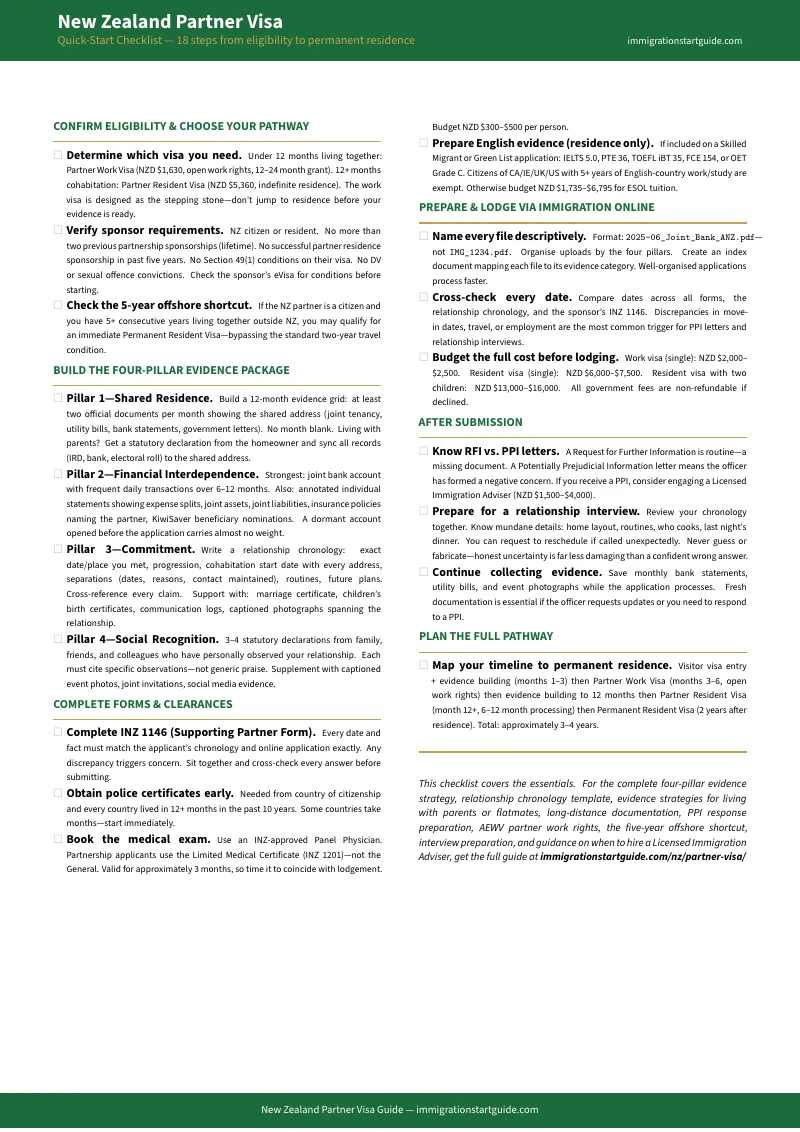
12 chapters covering every partnership pathway from initial eligibility through permanent residence, plus a printable 18-point quick-start checklist:
The "Genuine and Stable" Standard Decoded (Chapter 2)
INZ doesn't publish a scoring rubric. But internal operational guidelines, tribunal decisions, and years of case outcomes reveal consistent patterns in what officers look for and what triggers doubt. This chapter breaks down the subjective standard into concrete, addressable factors — the cohabitation duration threshold, the evidence weighting hierarchy, the red flags that escalate cases to a second officer, and the specific language patterns that appear in decline letters. You stop guessing what "genuine and stable" means and start building to the standard that's actually applied.
Four-Pillar Evidence Framework (Chapters 3-4)
The core methodology of the guide. Each pillar — Shared Residence, Financial Interdependence, Commitment, and Social Recognition — maps to a dimension that case officers evaluate. For each pillar, the framework provides: the specific documents that carry weight, how to present them, what counts and what doesn't, and how to compensate when one pillar is weaker than the others. A joint bank account with regular shared transactions matters. A joint account you opened last week with one deposit does not. A statutory declaration from a friend who witnessed your relationship over years carries more weight than five letters from people who met you once. The framework teaches you to think like the person reading your file.
The "Jigsaw Puzzle Approach" for Non-Traditional Housing (Chapter 4)
The 12-month cohabitation requirement is the single most misunderstood rule in NZ partner immigration. What if you lived with your partner's parents? What if you shared a flat with other people and neither name is on the lease? What if you were in the same city but maintaining separate addresses for part of the year? The Jigsaw Puzzle Approach shows you how to build a cohabitation narrative from overlapping fragments — mail addressed to the same location, shared utility accounts, flatmate statutory declarations, medical records with consistent addresses, and delivery receipts — when no single document alone proves shared residence. This is where most free advice fails, because forum posts that say "just get a joint lease" don't help the thousands of couples living in family homes, shared flats, or transitional housing.
Partnership Visa Pathways Mapped (Chapter 1)
NZ offers four distinct partnership visa pathways — partner of a New Zealander work visa, partner of a New Zealander resident visa, partner of a worker visa, and the culturally arranged marriage visitor visa — each with different eligibility rules, processing times, and entitlements. The guide maps all four with decision criteria so you choose the right one the first time. Most applicants don't know that NZ offers a direct-to-residence pathway that's significantly faster than Australia's three-plus-year process, or that the April 2026 AEWV two-tier work rights system changes what partner-of-worker visas actually let you do.
Sponsor Eligibility and Lifetime Limits (Chapter 6)
Your NZ partner can only sponsor a limited number of partners in their lifetime, with stand-down periods between sponsorships. If your partner previously sponsored someone, you need to know whether the stand-down has cleared, whether an exception applies, and what character requirements your partner must meet independently. The guide covers the full sponsorship framework including the scenarios where a sponsor's own immigration history creates problems neither of you anticipated.
PPI Letters and Relationship Interviews (Chapter 9)
A Potentially Prejudicial Information letter means the case officer has identified concerns — and you have one chance to address them before a decision is made. This chapter covers what triggers a PPI letter, how to structure a response that directly addresses the officer's concern without volunteering new information that creates additional questions, and how to prepare for the relationship interview that sometimes follows. The difference between a well-structured PPI response and a panicked over-explanation is often the difference between approval and decline.
Culturally Arranged Marriage Pathway (Chapter 11)
Couples in culturally arranged marriages face unique challenges: no cohabitation history, limited pre-marriage contact, and a bridging pathway that requires demonstrating genuine commitment through alternative evidence. This chapter covers the culturally arranged marriage visitor visa, the bridging work visa that follows, and the specific evidence strategies that satisfy the "genuine and stable" test when traditional cohabitation evidence doesn't exist yet. Designed for South Asian, Middle Eastern, Pacific Island, and other communities where arranged marriage is the cultural norm.
Pathway Planning: Visitor to Permanent Resident (Chapter 10)
The NZ partner visa isn't a single application — it's a pathway. From visitor visa through work visa through resident visa through permanent residence, each transition has its own timing windows, application requirements, and potential pitfalls. The chapter maps the full sequence including the five-year offshore permanent residence shortcut that many applicants don't know exists, and the critical travel and work restrictions at each stage.
Application Process Step-by-Step (Chapter 5)
Immigration Online account setup, form-by-form walkthrough, document formatting requirements (file size limits, certified translation specifications, police certificate jurisdictions), fee payment, and submission confirmation. Every mechanical step mapped so you don't lose time to avoidable administrative errors.
Health, Character, and English Language (Chapter 7)
Medical examination requirements, panel physician locations, police certificates from every country you've lived in for 12+ months, and English language pathway options. The guide covers the specific health conditions that trigger additional assessment and the character thresholds that create problems for applicants with prior visa overstays or criminal history.
Processing Times and Post-Lodgement (Chapter 8)
Current processing time ranges for each partnership pathway, what to expect during the wait, how to respond to additional information requests, what triggers a second officer review, and when to escalate a delayed case. Because submitting the application is not the end — it's the beginning of a period where knowing what's normal and what's a warning sign saves weeks of unnecessary anxiety.
18-Point Quick-Start Checklist (free download)
The critical action items distilled into a single printable action plan: confirm eligibility, build your four-pillar evidence package, assemble forms and clearances, lodge through Immigration Online, manage post-submission steps, and plan your pathway from work visa through permanent residence. Enough to take your first concrete step tonight.
7 Standalone Printable Tools (paid guide only)
Print-ready worksheets, checklists, and reference cards you can use at your desk, bring to meetings, or pin on the wall: the 12-Month Evidence Grid for tracking evidence across all four pillars month by month, a Relationship Chronology Template with the 7-section structure case officers need, a Sponsor Eligibility Checklist for your NZ partner to complete before you start gathering evidence, a Document Organiser reference card with file naming conventions and the 6-category evidence structure, a Fee and Budget Planner covering all government fees and additional costs by pathway, a PPI Response Framework with the 5-step rebuttal structure, and a Visa Pathway Timeline mapping each stage from arrival through permanent residence.
Who This Guide Is For
This guide is for partners of New Zealand citizens, residents, or work visa holders who are applying for a partner-based work visa or resident visa:
- You've been living with your NZ partner and you need to prove that your relationship is "genuine and stable" — but you don't know what evidence actually carries weight with INZ, how much is enough, or how to present it
- You're living with your partner's family or in a shared flat, and you're struggling to prove 12 months of cohabitation when neither of your names is on the lease and your mail goes to different addresses
- You're in a long-distance relationship or recently moved to New Zealand, and you need to build a cohabitation record while navigating visitor visa conditions that restrict your ability to work or settle
- You're in a same-sex partnership and concerned about how your relationship evidence will be evaluated, especially if you come from a country where your relationship wasn't legally recognized
- Your marriage was culturally arranged and you have limited cohabitation history — you need the specific bridging pathway and alternative evidence strategies that apply to your situation
- You received a PPI letter raising concerns about your relationship and you need to structure a response that addresses the case officer's specific doubts without creating new ones
- You consulted a Licensed Immigration Adviser who quoted NZD $2,000 to $8,000 and you want to understand the process well enough to decide whether you actually need that level of help, or whether you can file confidently with the right framework
Why Not Free Resources?
Free information on the NZ partner visa is everywhere. Here's what it actually delivers:
- Immigration New Zealand's website provides the application forms and basic eligibility requirements — but deliberately avoids explaining how the "genuine and stable" standard is actually assessed. You'll learn that you need to demonstrate your relationship is genuine. You won't learn what evidence carries weight, how much is enough, or how to compensate when your living situation doesn't fit the standard template.
- Facebook groups and Reddit threads are full of personal anecdotes from people who were approved or declined — with no context about the strength of their evidence package, the specific visa pathway they applied under, or whether their situation remotely resembles yours. A success story from someone who had a joint mortgage and three years of cohabitation is not relevant if you're living with your partner's parents and have been together for 14 months.
- Immigration adviser blogs publish helpful overviews of the partnership visa process — because their business model is to establish credibility and then offer a $3,000 consultation to do the actual work. They'll tell you the Four Pillars matter. They won't give you the framework to systematically build each one.
- ExpatForum and NZReady resources provide general relocation guidance that treats the partner visa as one checkbox in a broader move. They cover the application forms but not the evidence strategy that determines whether those forms lead to approval or decline.
This guide fills the evidence gap. It doesn't compete with free information about what forms to fill out — it provides the structured methodology for building the evidence package that determines whether your application is approved. The Four-Pillar Evidence Framework gives you the same systematic approach that Licensed Immigration Advisers use to prepare cases, at a fraction of the cost of professional representation.
— Less Than One Hour of Adviser Fees
A Licensed Immigration Adviser charges NZD $2,000 to $8,000 for a partnership visa case. Government filing fees alone run NZD $1,630 for a work visa and NZD $5,360 or more for a resident visa. An initial consultation costs $200 to $500 before any work begins.
The guide doesn't replace an adviser for cases involving serious character issues, complex immigration history, or appeals. But it gives you the evidence framework and application strategy that prevents the weak submissions that lead to PPI letters and declines — the mistakes that cost thousands in additional adviser fees and months of uncertainty. If you're self-filing, it's your complete blueprint. If you're hiring an adviser, it transforms you from a confused client into a prepared partner who understands what strong evidence looks like and can assemble it before the clock starts running on billable hours.
Money-back guarantee, no time limit. If the framework doesn't make your application stronger, you pay nothing.
Download the free Quick-Start Checklist to see the 18 critical action items across eligibility, evidence building, and lodgement. When you're ready for the Four-Pillar Evidence Framework, the PPI response strategies, and the complete pathway-planning playbook, the full guide is here.
Your relationship is real. Your evidence package should leave no room for doubt.