
Your Family Is Committing NZD $20,000 Per Year in Living Costs Alone. One Wrong Course Selection and That Money Buys You a One-Year Restricted Visa With No Path to Residence.
You have spent weeks comparing New Zealand to Australia and Canada. You have read the INZ website, scrolled through r/newzealand threads full of locals arguing about immigration, bookmarked the Green List page three times, and watched YouTube videos from Indian students documenting their arrival in Auckland. An education agent quoted you $2,000 and keeps pushing a private institution you have never heard of. Your family is preparing to transfer tuition fees that represent years of savings. You are almost ready to commit.
But here is what nobody is laying out clearly: the New Zealand study-to-residence pipeline is not one visa application. It is a chain of interdependent decisions — course level, institution, qualification framework alignment, post-study visa timing, wage thresholds, occupational registration, points calculations — where the first decision you make (which course to enroll in) determines whether you get a three-year open work visa or a one-year restricted permit, whether your partner can work or sits idle, whether your children pay domestic school fees or full international rates, and whether you reach permanent residency in one year or never. A Level 7 Bachelor's degree gives you three years and three SMC points. A Level 5 Diploma gives you one year and zero points. That single enrollment decision — a difference of perhaps NZD $10,000–$20,000 in tuition — is the difference between a viable residency timeline and an effectively impossible one.
Free resources cannot solve this. The INZ website tells you what the rules are. It does not tell you that enrolling in a Level 6 Diploma when a Level 7 Graduate Diploma gives you triple the post-study visa duration was the single most expensive mistake you could have made. It does not explain that your one-time Post-Study Work Visa — which you only get once in your entire lifetime — starts a three-month countdown the moment your student visa expires, and missing that deadline by one day permanently forfeits your right to work in New Zealand. Education agents earn commission from institutions. They are structurally incentivised to recommend the school that pays them, not the course that maps to a Green List Tier 1 occupation giving you immediate permanent residency. Reddit threads contain hundreds of contradictory anecdotes from people under different rules in different years arguing about whether a Graduate Diploma counts for the PSWV (it will, from late 2026, with strict conditions most threads get wrong).
The New Zealand Student Visa + Post-Study Work Guide is built around one principle: every enrollment decision is a residency decision. This is the complete study-to-residence pipeline: a single document that maps every step from course selection strategy and the genuine intentions assessment through the Fee Paying Student Visa, through the Post-Study Work Visa and its one-time rule, through the Green List fast-track and the SMC 6-point system, through the August 2026 reforms, and all the way to permanent New Zealand residence. Every course choice is mapped to its residency outcome. Every fee is itemised. Every deadline is flagged.
What's Inside
The complete guide, a quick-start checklist, and printable document checklists — covering every stage from choosing your course through securing permanent New Zealand residence:
Course Selection as a Residency Decision
The single chapter that justifies the entire guide. It maps every NZQCF qualification level to its exact post-study visa duration, SMC points value, partner work rights, and Green List alignment. A PhD gives you 6 points (immediate residence eligibility), unlimited work rights during study, and domestic tuition rates of NZD $6,500–$9,000 per year instead of the NZD $26,000–$48,000 international students pay for coursework degrees. A Master's gives you 5 points (one year of work to residence). A Bachelor's gives you 3 points (three years of work — your entire PSWV with zero margin for error). The guide forces you to run this calculation before you accept any offer, not after you have committed two years of tuition and discovered your course does not connect to a viable pathway.
The Green List — Straight to Residence and Work to Residence
New Zealand's roster of shortage occupations that bypass years of work-experience requirements entirely. Tier 1 means immediate permanent residency after securing a job offer — no waiting period, no points calculation, no multi-year timeline. Tier 2 means 24 months of work, then residence. The guide identifies which study pathways map to which Green List roles (nursing, software engineering, civil engineering, construction trades, teaching, early childhood education), the occupational registration requirements that can take 3–12 months to complete, and the wage thresholds that must be met for your work time to actually count. Time in a below-threshold role does not accumulate — you burn through your PSWV with nothing to show on your residence application.
The SMC 6-Point System and the August 2026 Reforms
For graduates whose professions do not fall on the Green List, the Skilled Migrant Category is the primary residence route. The guide breaks down the 6-point calculation — qualification points plus NZ work experience points — and the critical August 2026 reforms introducing Red Lists (blocked occupations), Amber Lists (restricted occupations requiring higher thresholds), and the domestic education premium that awards bonus points for New Zealand qualifications over overseas equivalents. These reforms fundamentally change the residency calculus for non-Green-List graduates, and most online resources have not caught up.
The Post-Study Work Visa: Rules, Traps, and the One-Time Constraint
The PSWV is a three-year open work visa for degree graduates — but it comes with rules that destroy applications when misunderstood. You get one PSWV in your entire lifetime. Returning to study at a higher level does not grant a second one. The application must be lodged within three months of your student visa expiry (six months for PhD graduates), and missing that deadline by one day permanently forfeits your eligibility. The fee is NZD $1,670 plus NZD $5,000 in maintenance funds. The guide also covers the new late-2026 Graduate Diploma pathway and the Short-Term Graduate Work Visa — a 6-month option for qualifications that do not qualify for the standard PSWV.
The Genuine Intentions Assessment
This is the leading cause of student visa refusals in New Zealand. INZ officers evaluate whether you genuinely intend to study and whether your post-study plans are coherent. The guide provides a structured framework for the four dimensions officers assess: academic relevance (why this course builds on your background), home country ties (property, family, employment evidence), long-term financial trajectory (how you will fund subsequent years), and academic history (explaining any gaps). Generic, copy-pasted Statements of Purpose are an immediate red flag. The guide shows you how to build a specific, verifiable, personalised statement that passes the test.
Partner and Dependent Visa Rights
If you are bringing a partner and children, your course level determines their rights — and the financial impact is enormous. Level 9–10 students: your partner gets an open work visa, your children pay domestic school fees. Level 7–8 students in Green List-aligned courses: same benefits. Level 7–8 students in non-Green-List courses: your partner gets a Visitor Visa only (no work rights), your children pay full international school fees. This single distinction can represent tens of thousands of dollars in household costs per year. The guide maps these cascading benefits so you factor them into your course selection from day one.
The Full Financial Architecture
Every fee from the NZD $850 student visa application through the NZD $1,670 PSWV through the residence application — plus living cost proof requirements (NZD $20,000 per year), health insurance costs (NZD $600–$900 annually), the Approval in Principle mechanism that protects your tuition funds until your visa is conditionally approved, the Funds Transfer Scheme for applicants from countries with foreign exchange controls, and the financial evidence standards that prevent your bank statements from being flagged as "show money."
NZ vs. AU vs. CA — The Head-to-Head Comparison
Side-by-side comparison of every metric that matters: visa fees (NZD $850 vs. AUD $2,000 vs. CAD $150), living cost proof (NZD $20,000 vs. AUD $29,710 vs. CAD $22,895), post-study visa duration, age caps (NZ has none — Australia now caps post-study visas at age 35), work rights during study, residency timelines, and total cost-to-PR over a two-year Master's degree. The data, not marketing claims.
9 Printable Standalone Tools
In addition to the 57-page guide and the quick-start checklist, the toolkit includes 9 standalone printable PDFs you can use independently — pin to your wall, take to an adviser meeting, or fill in as you plan:
- Course-to-Residency Map — NZQCF level mapped to post-study visa duration, SMC points, and Green List alignment on a single page
- Document Checklists — Itemised requirements for the Student Visa and Post-Study Work Visa applications
- Financial Planner — Fill-in worksheet covering every fee from student visa through residence, with running totals
- Genuine Intentions Framework — The four-dimension assessment worksheet for building your Statement of Purpose
- SMC Points Calculator — The 6-point system on one page: qualification points, work experience points, and the high-income bypass
- Green List Reference — Tier 1 and Tier 2 occupations with study pathways and registration requirements
- Country Comparison — NZ vs. AU vs. CA head-to-head: fees, living costs, PSWV duration, age caps, work rights, PR timeline
- Partner & Dependent Rights — Course level mapped to partner work visa type, children's school fee status, and open work visa eligibility
- Master Timeline — Month-by-month pipeline from enrollment through student visa, study, PSWV, Green List/SMC, and residence
Who This Guide Is For
- International students choosing between NZ, Australia, and Canada — you need a clear-eyed comparison of the three pipelines: costs, timelines, age caps, post-study work rights, and residency probabilities. Australia just capped post-study visas at age 35. Canada raised its financial proof to CAD $22,895 and introduced hard permit caps. New Zealand has no age cap, a 91% student visa approval rate, and a three-year open post-study work visa for degree graduates. The guide quantifies exactly what each pathway costs and delivers.
- Students from India and South Asia planning their course selection — you are the ROI maximiser. You view education as a capital investment that must yield permanent residency. The guide maps every qualification level to its exact points value, residency timeline, and partner eligibility so you can calculate the return before committing your family's savings. It also covers the financial evidence standards that trip up applicants whose bank statements show sudden, unexplained deposits.
- Healthcare and vocational students from the Philippines and Pacific Islands — nursing, trades, and construction roles sit on the Green List with accelerated residence pathways. The Nursing Council registration process, the Competence Assessment Programme for internationally trained nurses, and the August 2025 additions of metal fabrication and heavy machinery trades to Tier 2 are all covered with exact step-by-step requirements.
- Students who have already accepted an offer but have not yet applied for their visa — the genuine intentions assessment is the leading cause of refusals. The guide provides the structured framework you need to build a Statement of Purpose that passes the four-dimension test, plus the financial evidence strategy that prevents your funds from being classified as temporary show money.
- Students already studying in NZ who need to plan the post-graduation transition — your PSWV clock starts the moment it is granted, not when you find a job. The guide covers the three-month application deadline, the one-time-only rule, the median wage threshold trap, the Green List and SMC pathways, and the AEWV bridge visa for when your PSWV runs short.
Why Not Free Resources?
- The INZ website and government resources provide legally accurate, procedurally correct information spread across dozens of pages in dense bureaucratic language. They tell you the PSWV exists. They do not tell you that choosing a Level 5 Diploma over a Level 7 Bachelor's costs you two years of post-study work rights and all your SMC points. They list the Green List occupations. They do not explain that your work experience only counts toward residence if you are paid at or above the median wage threshold — and that time in a below-threshold role burns through your PSWV while accumulating zero points. The guide translates static regulations into a strategic execution plan.
- Education agents charge NZD $2,000–$5,000 and earn commission from institutions. This creates a structural incentive to recommend the school that pays the agent, not the course that maps to a Green List Tier 1 occupation with immediate residence eligibility. The guide has no institutional partnerships. Every recommendation maps to the regulatory framework and the residency outcome, not to a commission structure.
- Reddit and online forums — r/newzealand is notoriously hostile to immigration questions, with local users frequently citing domestic housing costs and wage suppression as reasons not to come. ENZForum contains highly technical fragments that require expert-level context to interpret. Neither provides a unified, chronological pipeline from enrollment through residence. You can spend months piecing together a strategy from contradictory anecdotes — or you can follow a single document that maps the entire chain in order.
- Licensed Immigration Advisers charge NZD $2,000–$5,000 for personalised advice. If you have a complex legal situation (prior refusals, character issues, medical inadmissibility), you need one. But if your situation is straightforward and you need a strategic roadmap — which course to choose, how to structure your genuine intentions statement, how to calculate your SMC points, when to apply for the PSWV — the guide covers the planning layer that prevents the upstream mistakes which make downstream legal intervention necessary.
— Less Than a Single Week of NZ Living Costs
The NZD $20,000 annual living cost proof alone represents years of savings for many families. International tuition runs NZD $26,000–$48,000 per year. A Licensed Immigration Adviser charges NZD $2,000–$5,000. Enrolling in the wrong course — a Level 5 Diploma instead of a Level 7 degree — does not just waste tuition money. It gives you a one-year restricted work visa instead of a three-year open visa, strips your partner of work rights, charges your children full international school fees, awards you zero SMC points instead of three, and makes permanent residency effectively unreachable. That is a decision worth tens of thousands of dollars in downstream consequences, made at the enrollment stage when most students do not even know the variables exist.
This guide does not replace a Licensed Immigration Adviser for complex legal situations. But it covers the strategic planning layer — the course-to-residency mapping, the genuine intentions framework, the PSWV timing and one-time rule, the Green List and SMC points calculation, the wage threshold trap, the partner visa cascading benefits, the August 2026 reforms — that prevents the upstream mistakes which make downstream legal intervention necessary.
If it prevents one wrong course enrollment, saves you from one education agent steering you toward a commission-paying institution, or ensures you do not miss the three-month PSWV deadline that permanently forfeits your post-study work rights, it pays for itself before you finish the first chapter.
Money-back guarantee, no time limit. If the guide does not make your New Zealand immigration pathway clearer, you pay nothing.
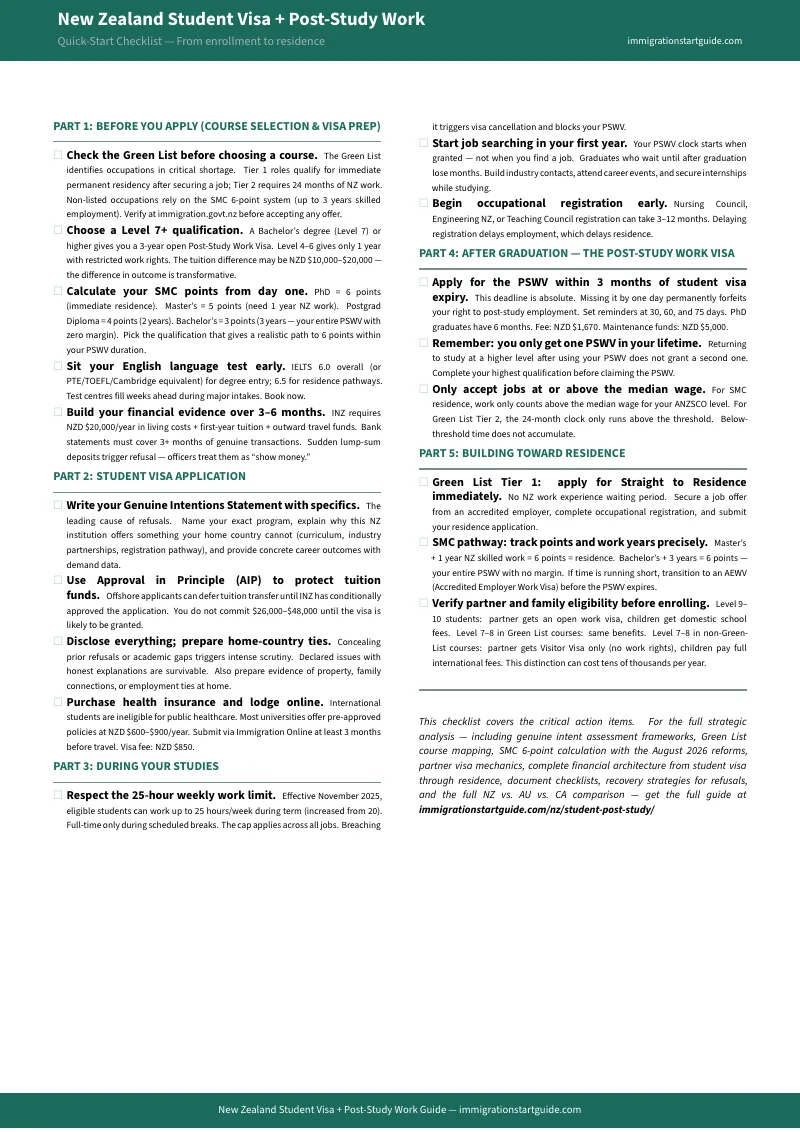
Download the free Quick-Start Checklist to see the highest-stakes action items across the entire pipeline — from Green List course selection through PSWV timing through SMC points calculation. When you are ready for the complete study-to-residence blueprint, the genuine intentions framework, the full financial architecture, and the month-by-month timeline from enrollment to permanent residence, the full guide is here.
New Zealand is offering a 91% student visa approval rate, 25-hour in-study work rights, a three-year open post-study work visa, no age cap, and a transparent points-based path to permanent residence. It is not offering to explain how to navigate the pipeline that connects all of it. This guide does.