
Your Employer Signed the Contract. Now the German Government Gets to Decide If You Actually Start.
You have a job offer from a German company. The salary is right. The contract is signed. You told your family. You started looking at apartments in Berlin or Munich.
Then you opened the embassy website. Erklärung zum Beschäftigungsverhältnis. Zentralstelle für ausländisches Bildungswesen. A salary threshold that changed three times in three years. A degree recognition database — entirely in German — that returns H+/- for your university and no one can explain what that means. A form your employer has never seen before, and if they fill it out wrong, your application gets rejected before anyone reads it.
You search Reddit. One person says their Blue Card took three weeks. The next says theirs took five months because the ZAB returned their degree assessment as "not comparable" and they had to start over. A third person says their employer's HR department abandoned the process after the first rejection. The advice is contradictory, the regulatory citations are from 2022, and the salary thresholds don't match what Make-it-in-Germany says for 2026.
Here's the structural problem: the German immigration system changed more between 2023 and 2026 than in the previous two decades combined. Salary thresholds are now dynamically linked to the pension ceiling and adjust every January. IT specialists without university degrees can now get the Blue Card. Over 163 shortage occupations qualify for a reduced salary threshold. The degree-to-job matching requirement was eliminated. And the information ecosystem hasn't caught up — free blogs still cite the old rules, embassy websites contradict each other, and your employer's HR department is learning the process for the first time alongside you.
The Germany EU Blue Card Guide is a Bureaucratic Navigation System. Not a summary of what the law says — a structured execution framework that maps every dependency, identifies every failure point, and produces the exact documentation the German authorities need to approve your application. It replaces months of contradictory research with a process you can work through systematically, chapter by chapter.
What's Inside the Bureaucratic Navigation System
The complete guide plus 8 standalone printable tools — the 13-chapter reference covering every stage from eligibility confirmation through permanent residency, plus 7 standalone PDFs you print, share with your employer, and bring to appointments:
2026 Salary Thresholds With the Underlying Formula
The general threshold is €50,700 and the reduced threshold for shortage occupations, new graduates, and IT specialists is €45,934.20. But knowing the numbers is not enough. The guide explains how these thresholds are mechanically calculated from the pension insurance ceiling, how to verify your salary against the Federal Employment Agency's Entgeltatlas to survive the mandatory wage comparability check, and why a salary that meets the statutory minimum can still get rejected if it falls below regional market averages for your role.
The Complete Degree Recognition Pipeline
The single largest bottleneck for most applicants. The guide walks through the Anabin database lookup step by step, explains what H+, H+/-, and H- ratings actually mean, and covers the full ZAB Statement of Comparability process — including the expedited two-week Blue Card track that most applicants don't know exists. For Indian three-year bachelor's degrees, Turkish apostilles, and Egyptian consular legalisation chains, you get country-specific strategies that address the exact friction points these documents create. If ZAB issues an initial refusal, the guide covers the reassessment process through supplementary documentation — because an initial refusal is not the end.
The IT Specialist Pathway Without a University Degree
Since late 2023, experienced IT professionals can obtain the EU Blue Card without any academic qualification. The official guidance says you need to prove "theoretical knowledge equivalent to a university degree" — and then provides zero explanation of how. The guide gives you the concrete evidence blueprint: which vendor certifications carry weight (AWS Solutions Architect, Azure Administrator, CKA, CISSP), how to structure employer reference letters that cite specific project architectures rather than generic duties, what portfolio documentation to include, and how the B1 German language requirement for this pathway was abolished in March 2024.
Employer Compliance Templates for the Erklärung zum Beschäftigungsverhältnis
The form where most employer-caused rejections originate. If your German employer — particularly an SME or startup — has never hired a non-EU national, they will not know how to complete this document. The guide provides section-by-section guidance that you can hand directly to your HR department: how to write a job description that sounds "highly qualified" rather than generic, how to match the salary to both the statutory threshold and the Entgeltatlas benchmark, and how to handle overtime and bonus structures that the Federal Employment Agency scrutinises. This turns the guide from a reference document into a compliance tool that protects your job offer.
Three Application Pathways Compared
Standard consular processing from abroad (4-12 weeks plus appointment wait times), in-country status conversion for current Chancenkarte holders, students, and § 18b permit holders at the Ausländerbehörde, and the employer-initiated Fast-Track Procedure under § 81a that compresses the entire timeline to 4-8 weeks for a €411 fee. If you are applying from India, Turkey, Brazil, or any high-volume jurisdiction where embassy appointment backlogs exceed two months, the Fast-Track analysis alone is worth the guide.
Health Insurance Compliance
The difference between statutory public insurance and private coverage, why cheap expat travel policies get your visa rejected at the embassy, and the bridging insurance solution for the gap between your arrival date and your employment start date. This chapter prevents the surprisingly common failure where an otherwise complete application is rejected for inadequate health insurance documentation.
The 21-Month Permanent Residency Fast Track
The EU Blue Card's most powerful advantage — and the one that requires planning from day one, not month 20. The guide provides a month-by-month execution timeline covering B1 German language certification, the Leben in Deutschland integration test, continuous pension contributions, and the critical Ausländerbehörde appointment scheduling that must happen by month 18 if you want to hit the 21-month window. In Berlin, Munich, and Frankfurt, appointment backlogs mean a three-month advance booking. Miss that window and your fast track becomes a slow one.
Family Reunification — Spouse, Children, and Parents
Your spouse gets immediate, unrestricted access to the German labour market — no language requirement, no waiting period, dual-income household from day one. The guide covers the spousal visa application process, children's residence permits, and the new parental reunification rules introduced in March 2024 that allow Blue Card holders to sponsor parents and parents-in-law for the first time. Including the financial obligation (Verpflichtungserklärung), housing requirements, and private health insurance costs of roughly €2,500-€3,000 per parent annually.
EU Blue Card vs. Lesser Permits
A line-by-line comparison against the § 18a and § 18b skilled worker permits. The Blue Card gives you permanent residency in 21 months instead of 48-60 months, employer mobility after 12 months instead of 24, and intra-EU relocation rights that standard work visas simply do not provide. If your employer or an immigration officer suggests a "simpler" standard work visa, you need to understand exactly what you are giving up.
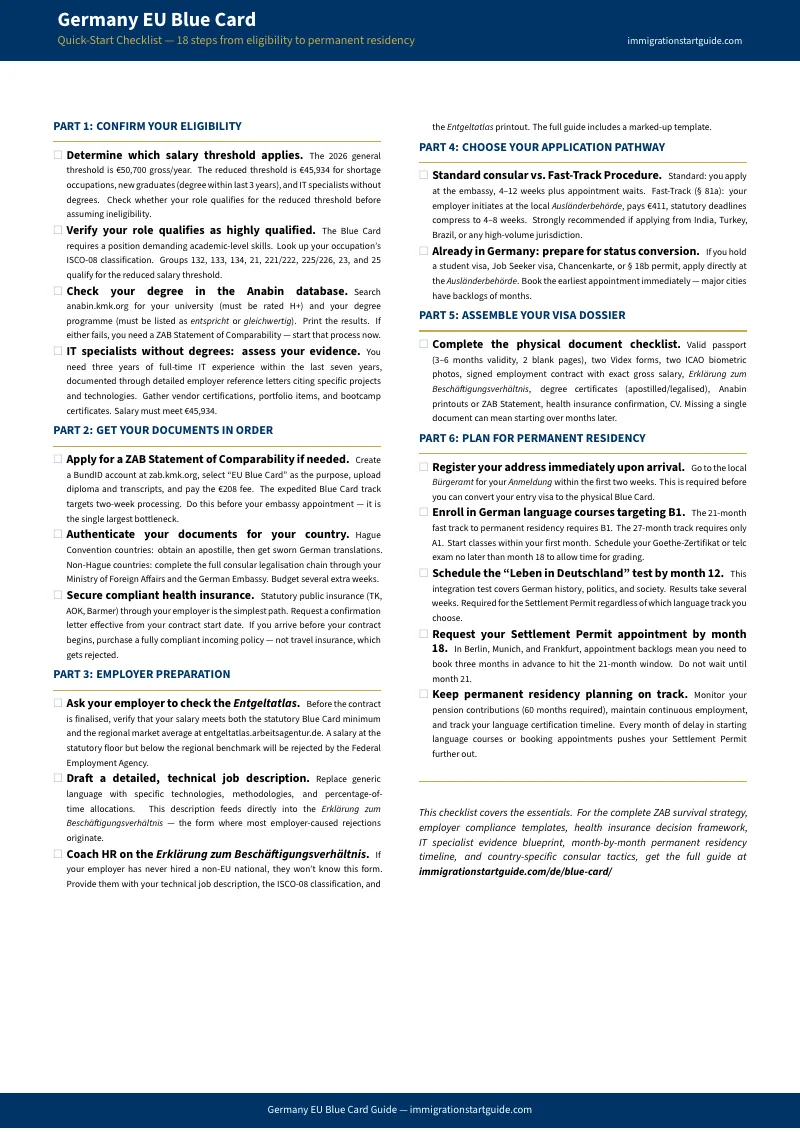
The 18-Point Quick-Start Checklist (free download)
A standalone action plan covering the essentials: confirm your salary threshold, verify your degree in Anabin, assess the ZAB timeline, check your ISCO-08 classification, prepare your employer, and choose your application pathway. Enough to start tonight.
Who This Guide Is For
This guide is for skilled professionals with job offers from German companies who:
- Have a signed contract meeting the Blue Card salary threshold and need to navigate the visa process from application through arrival — without paying €1,500-€3,000 for a relocation agency
- Are IT professionals without a university degree and need a concrete blueprint for proving "theoretical knowledge equivalent to a degree" to a German immigration officer who has never reviewed a coding bootcamp certificate
- Hold an Indian three-year bachelor's degree, a Turkish qualification requiring apostille, or an Egyptian degree requiring full consular legalisation — and need the degree recognition process to work on the first attempt because the ZAB backlog alone can cost three months
- Are currently in Germany on a Chancenkarte, student visa, or standard work permit and need to convert to a Blue Card without creating a gap in legal work authorisation
- Work at a company whose HR department has never processed a non-EU hire and need employer-ready templates they can hand directly to their hiring manager
- Want permanent residency in Germany in 21 months and need the month-by-month execution plan that makes that timeline actually achievable
Why Not Free Resources?
Free information on the EU Blue Card is abundant. Here's what it actually delivers:
- Make-it-in-Germany provides the salary thresholds and basic eligibility criteria. It does not explain how to handle a ZAB refusal, how to prove theoretical knowledge for the IT specialist pathway, or how to complete the Erklärung zum Beschäftigungsverhältnis when your employer has never seen the form. You get statutes, not execution strategy.
- Expat blogs (All About Berlin, Toytown Germany) offer readable summaries — many written before the 2023 reforms that changed the salary thresholds, expanded the shortage list, and introduced the IT specialist pathway. The advice may have been correct in 2021. It is dangerously incomplete for 2026.
- Reddit and forums (r/germany, r/berlin) are where someone says their Blue Card took three weeks, and someone with an identical profile says theirs took five months. You're getting survivorship bias from applicants who filed under different rules, at different embassies, with different degree backgrounds. The contradictions create anxiety, not clarity.
- Immigration agencies (VisaRight, MiGreat, Jobbatical) offer end-to-end relocation management for €1,500-€3,000 per applicant. Effective, but designed for corporate HR departments with relocation budgets — not for the individual professional who needs to understand and execute the process themselves.
This guide fills the execution gap — the space between "I understand the eligibility criteria" and "I can produce the documentation that gets approved." It provides the same structured frameworks and employer compliance tools that boutique agencies build internally, at a fraction of the cost of a single consultation.
— Less Than the ZAB Statement Fee
The ZAB Statement of Comparability alone costs €208. The Fast-Track Procedure fee is €411. The visa application itself is €75. An immigration attorney consultation starts at €200 per hour.
This guide doesn't replace legal counsel for complex appeals or exceptional circumstances. But it gives you the structured documentation frameworks, employer compliance templates, and strategic decision logic that prevent the most common application failures — the degree recognition that stalls, the employer form that triggers rejection, the salary that passes the statutory check but fails the market comparability review.
If it prevents a single ZAB reassessment or a single employer-caused rejection, it saves you months of delay and the very real risk of losing your job offer.
Money-back guarantee, no time limit. If the guide doesn't make your Blue Card application stronger, you pay nothing.
Download the free Quick-Start Checklist to see the 18-point action plan. When you're ready for the complete degree recognition pipeline, employer compliance templates, IT specialist evidence blueprint, and the 21-month permanent residency execution timeline, the full guide is here.
You have the job offer. Now build the application that gets you to Germany.