
You Don't Qualify for a Blue Card. Germany Still Needs You — Here's How to Prove It.
You have the skills. You have the job offer — or you're close. But the salary is €38,000, not €50,700. Or your degree came from a university that German databases don't recognize. Or you trained as a nurse in Manila, an electrician in Istanbul, a developer in Lagos — and every English-language guide you find talks about the EU Blue Card like it's the only door into Germany.
It isn't. The 2023-2024 Skilled Immigration Act (Fachkräfteeinwanderungsgesetz) created pathways that most expat blogs and relocation consultants don't cover — because they're still writing for senior software engineers earning six figures. The §18a and §18b skilled worker visas, the §19c IT specialist route, and the Recognition Partnership (§16d) were built for you: vocationally trained tradespeople, internationally educated nurses, junior developers, and mid-career professionals whose qualifications don't fit the Blue Card mold but whose labor Germany desperately needs.
The problem isn't eligibility. The problem is that the information you need is scattered across dense government portals in administrative German, contradictory Reddit threads, and recruitment agencies whose business model depends on you not understanding your own rights. One wrong form, one missed recognition deadline, one predatory retention clause buried in a contract — and months of preparation collapse.
The Germany Skilled Worker Visa Guide is a Recognition-to-Residency System. Not a summary of what the Ausländerbehörde website already says. A complete execution framework that takes you from "Do I even qualify?" through qualification recognition, visa application, employer compliance, and post-arrival integration — all the way to permanent residency in 36 months. Every chapter exists to solve a specific bureaucratic bottleneck that derails real applicants.
What's Inside the Recognition-to-Residency System
The complete guide covers 11 chapters plus standalone printable tools. Here's what each section does for you:
Visa Pathway Decision Matrix
Input your education level, years of experience, and offered salary. The matrix tells you definitively whether you should pursue §18a (vocational), §18b (academic), §19c (IT specialist), or the §16d Recognition Partnership — so you stop guessing and start applying on the right track.
Qualification Recognition Blueprint
Step-by-step instructions for every recognition pathway: Anabin database checks, ZAB Statement of Comparability for academics, IHK FOSA for industry trades, and HWK for crafts. Includes what to do when you receive a Defizitbescheid (deficit notice) — the document that tells most nurses and tradespeople their training doesn't fully match German standards. Instead of panic, you'll know exactly which adaptation hours to complete and how to structure them.
Recognition Partnership Toolkit
The §16d(3) visa lets you move to Germany and start earning before your qualifications are fully recognized — the single most important reform for healthcare workers and tradespeople. The toolkit breaks down employer vetting requirements, the Mustervereinbarung (model agreement) between you and your employer, and the exact clauses to negotiate. Because "starting work while you finish recognition" only works if the agreement actually protects you.
Salary Compliance and Negotiation Strategies
Unlike the Blue Card, §18a and §18b visas don't have a fixed salary minimum — they require "prevailing market rates" verified through the Federal Employment Agency's Entgeltatlas. The guide shows you how to check median wages for your occupation, how to restructure compensation packages to meet thresholds, and the hard salary floor (currently €55,770) that applies if you're over 45.
Sector-Specific Pathways
Healthcare workers face regulated-profession recognition through state health authorities. IT professionals without degrees use the §19c route with experience-based evidence. Physicians navigate Approbation licensing. Skilled tradespeople submit to IHK or HWK assessment. Each sector has its own chapter because the bureaucratic machinery is completely different — a one-size guide would fail all of them.
Employer Fast-Track Procedure (§81a)
Your employer can initiate an accelerated process through the local Ausländerbehörde that cuts processing to weeks instead of months. The guide explains who qualifies, how the employer initiates it, what the Erklärung zum Beschäftigungsverhältnis form requires, and how to prepare so your HR department doesn't become the bottleneck.
Agency Red Flag Guide and Contract Defense
Recruitment agencies routinely bury €3,000–€12,000 repayment clauses in contracts — demanding you pay "training costs" if you leave within 24–36 months. Recent German Federal Labor Court rulings have struck down many of these clauses as illegal. The guide teaches you to identify toxic retention terms, understand the Employer Pays Principle, and negotiate a clean employment contract before you board the plane.
36-Month Permanent Residency Timeline
The 2024 reforms cut the settlement permit (Niederlassungserlaubnis) timeline from four years to three — or just two years if you completed training inside Germany. The guide maps every milestone from day one: pension contributions, B1 certification, Leben in Deutschland integration test, and the exact month to book your appointment at the Ausländerbehörde.
Documentary Checklist and Fee Breakdown
Every document you need, in the exact order you need it: VIDEX application form, biometric photos, employment contract, recognition certificates, health insurance proof, blocked account details, and embassy-specific requirements. Plus a complete fee table so you budget accurately — no surprises at the embassy window.
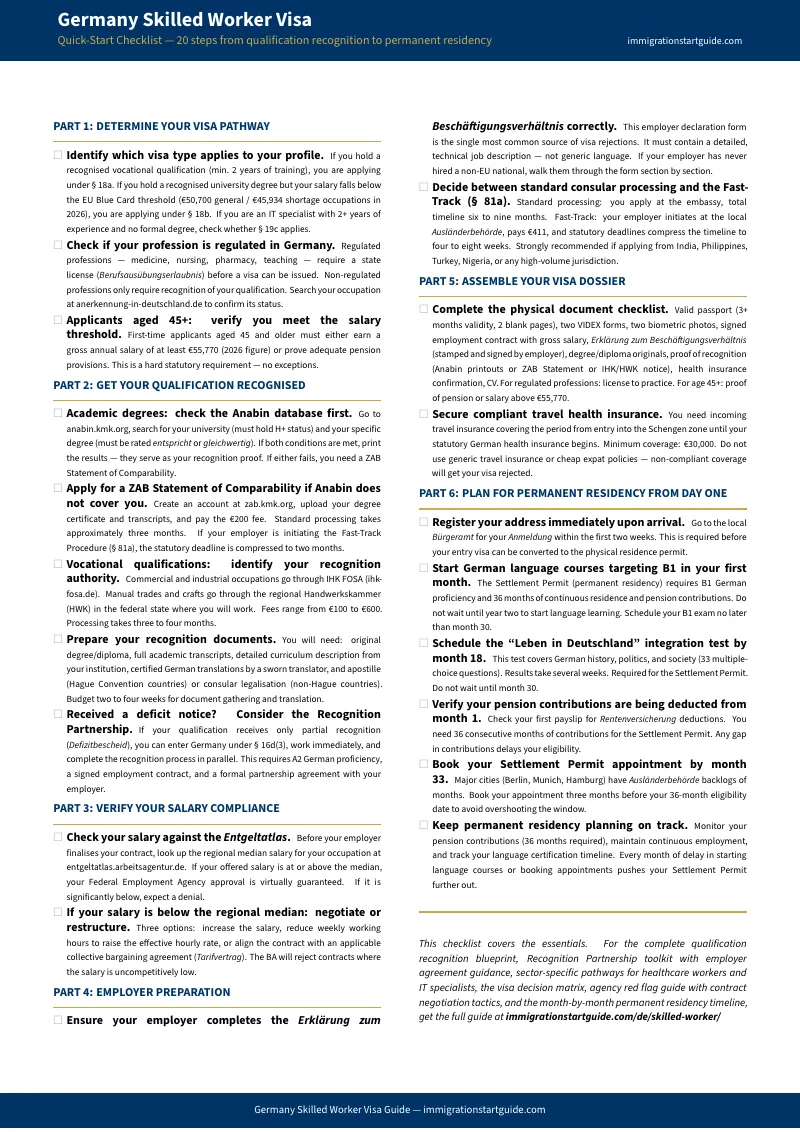
20-Point Quick-Start Checklist (free download)
A standalone printable action plan covering all six phases of the process — from pathway determination through permanent residency planning. Download it free to see where you stand before committing to the full guide.
Who This Guide Is For
- Nurses, physiotherapists, and healthcare workers with foreign training who need to navigate regulated-profession recognition, adaptation courses, and the Kenntnisprüfung knowledge test
- Electricians, mechatronics technicians, welders, and CNC operators whose vocational qualifications face IHK FOSA or HWK equivalence assessments
- Junior IT professionals and bootcamp graduates earning below the Blue Card threshold — who need the §18b or §19c pathway instead
- Mid-career professionals over 45 who must clear the elevated salary threshold or demonstrate pension provisions
- Anyone whose Blue Card application was rejected due to insufficient salary or unrecognized credentials — and who needs a tactical pivot to §18a, §18b, or §19c
- Employers and HR teams sponsoring a foreign skilled worker and navigating the Fast-Track procedure, Erklärung form, and Federal Employment Agency approval for the first time
Why Not Free Resources?
- Make-it-in-Germany is comprehensive and official — but it explains what you need, not how to get it. It won't tell you how to negotiate a Recognition Partnership agreement, what to do when your deficit notice arrives, or which agency contract terms are illegal under German labor law.
- Expat blogs are written for Berlin tech workers earning €70,000. They cover the Blue Card in detail and barely mention §18a, §18b, or the Recognition Partnership — the routes that 80% of skilled migrants actually use.
- Reddit and forums contain genuine experiences — mixed with outdated advice from before the 2023-2024 reforms. A tip that was correct in 2022 can now get your application rejected.
- Recruitment agencies provide "free" guidance — because the German employer pays them €3,000–€8,000 per placement. Their incentive is to fill the vacancy, not to protect your salary, your mobility, or your contract terms. The information they give you is shaped by their commission, not your interests.
- Immigration lawyers offer expert advice starting at €200 per consultation, with full case handling running €600–€2,500. For a nurse expecting €2,200/month net in Germany, that's a month's rent before the process even begins.
— Less Than One Hour With an Immigration Lawyer
A single consultation with a German immigration attorney costs €200–€350. The ZAB Statement of Comparability fee is €200. The Fast-Track procedure costs €411. You'll spend more on document translations than on this entire guide.
The Germany Skilled Worker Visa Guide covers every pathway, every recognition body, every form, every deadline, and every contract trap — for a fraction of what any single professional service charges. If the guide doesn't give you a clearer path to Germany than what you've found on your own, email [email protected] for a full refund.
Start with the free 20-Point Quick-Start Checklist to see where you stand. When you're ready for the complete Recognition-to-Residency System — the qualification blueprints, the agency defense toolkit, the sector-specific pathways, and the permanent residency timeline — the full guide is waiting.
You have the skills Germany needs. Now build the application that proves it.