
Your Family Scraped Together 11,904 Euros. One Procedural Mistake and That Money Sits in a German Bank Account You Cannot Touch.
You have spent months researching Germany. You have compared tuition fees with Canada, read every Reddit thread about the blocked account, watched YouTube videos from Indian students documenting their APS timelines, and bookmarked the DAAD website six times. Your education agent quoted you $1,500 and keeps recommending a private university you have never heard of. Your parents have started selling assets. You are almost ready to begin.
But here is what nobody is telling you clearly: the German student immigration pipeline is not one decision. It is a chain of roughly twenty sequential bureaucratic steps across multiple federal and state agencies, each with its own documentation standard, processing timeline, and failure mode. Get one wrong and the chain breaks. Your APS certificate arrives three days after the university admission deadline closes. Your blocked account shows a balance of 11,754 euros because Fintiba deducted its 150-euro setup fee from your deposit, and the consular officer rejects you for insufficient funds. Your motivation letter reads like a personal essay instead of a structured argument, and the visa officer stamps "unconvincing intent to return" on your file. Since July 2025, Germany abolished the remonstration appeal process. If your visa is rejected, your only options are a lawsuit at the Berlin Administrative Court or starting the entire application over from scratch.
Free resources cannot fix this. The DAAD tells you what the rules are. It does not tell you that transferring exactly 11,904 euros to a blocked account will result in a visa rejection after the provider deducts its fee. Embassy websites list required documents. They do not explain how to write a motivation letter that satisfies the "intent to return" test when your actual goal is to stay permanently through the EU Blue Card pathway. Reddit threads contain thousands of contradictory anecdotes from people at different stages, in different countries, under different rules, arguing about whether you need B1 German or not. Education agents charge $1,000 to $3,000 and earn commission from private universities that charge 10,000 to 20,000 euros per year in tuition, while public universities in Germany charge nothing.
The Germany Student Visa + Job Search Guide is built around one principle: university admission is not the goal — permanent European residency is. This is the complete pipeline blueprint: a single document that maps every step from university selection and APS certification through blocked account funding and visa interview preparation, through the 18-month post-study job search visa, through the EU Blue Card salary thresholds, and all the way to the 21-month fast-track permanent residence settlement permit. No gaps between stages. No conflicting advice. No commissions from any institution.
What's Inside
The complete guide, a quick-start checklist, and standalone printable tools — covering every stage from choosing your university through securing permanent European residence:
University Selection and Admission Architecture
How to navigate uni-assist, verify your prior qualifications against the German academic framework, identify tuition-free public universities offering English-taught master's programs, and avoid the private university trap. Education agents earn zero commission from public universities. They earn lucrative kickbacks from private institutions charging 10,000 to 20,000 euros per year. The guide maps every recommendation to the actual admissions requirements so you can verify whether a public university will accept you before an agent steers you toward an expensive private alternative.
APS Certification: The India, Pakistan, Bangladesh, Vietnam, and China Bottleneck
If you are applying from India, Vietnam, or China, you need an APS certificate before your visa application can be processed. The guide covers the exact documentation sequence, the DigiLocker digital repository strategy that has reduced some Indian processing times to under two weeks, courier protocols, and the timeline planning that prevents a delayed APS certificate from killing a hard-won university admission. For Pakistani and Bangladeshi applicants facing embassy appointment wait times exceeding twelve months, the guide details deferral strategies, scholarship exemptions, and consular portal monitoring techniques.
Blocked Account Funding Without the Setup Fee Trap
The 2025/2026 blocked account requirement is 11,904 euros. The guide compares Fintiba, Expatrio, and Coracle against traditional banking options, with fee structures, disbursement schedules, and refund policies. Most critically, it addresses the setup fee trap that silently destroys applications: if you transfer exactly 11,904 euros and the provider deducts an 89-to-150-euro setup fee from the principal, your balance certificate shows less than the statutory minimum and your visa is immediately rejected. The guide tells you exactly how much to over-fund. For Nigerian applicants navigating severe forex controls, it covers domiciliary account strategies, official bank forex allocations through GTBank and Zenith, and FinTech transfer pathways through Wise.
Visa Interview Preparation and the Motivation Letter Framework
Rejection rates for applicants from Pakistan run 15 to 25 percent. For Nigerian applicants, 20 to 30 percent. The primary drivers are weak financial proof, unconvincing motivation letters, and insufficient home country ties. The DAAD will not teach you how to draft a motivation letter that passes the "intent to return" test while your actual plan is to use the EU Blue Card PR pathway. The guide provides a structured framework: how to connect your prior education to the specific German curriculum, how to construct a plausible return narrative that satisfies the consular requirement without undermining your long-term settlement strategy, and how to present sponsor funding without creating a financial insufficiency argument.
The 18-Month Job Search Visa: Strategy, Not Just Survival
Upon graduation, you receive an unconditional 18-month residence permit allowing unrestricted full-time employment. The dangerous misconception is that a German degree guarantees a job. It does not. The white-collar and IT entry-level market is cyclically saturated in 2025/2026. English-only graduates face severe limitations outside Berlin, Munich, and Frankfurt tech hubs. The guide covers the Werkstudent strategy — how to secure a working student position during your master's degree (140 full days or 280 half days per year under the reformed Skilled Immigration Act) that functions as a prolonged job interview, builds your domestic professional network, and converts into a full-time contract at graduation. It includes German-format CV templates, cover letter frameworks, and a job search timeline that starts during semester three, not after your thesis defense.
EU Blue Card Qualification and Salary Threshold Navigation
The EU Blue Card is your ticket to fast-track permanent residence. The guide details the 2026 salary thresholds — 50,700 euros for standard occupations, 41,041 euros for designated shortage occupations in STEM and healthcare — and how to identify which threshold applies to your field. It clarifies the critical legal distinction between the Blue Card and the Opportunity Card (Chancenkarte): the Opportunity Card uses a points system, lasts only 12 months, and restricts work to 20 hours per week. The post-study job search visa is guaranteed upon graduation and permits unlimited full-time work. Do not confuse them. The guide makes sure you do not.
The 21-Month Permanent Residence Fast Track
Under the revised Skilled Immigration Act, EU Blue Card holders qualify for a settlement permit (Niederlassungserlaubnis) after 27 months of employment with A1 German. With certified B1 German proficiency, that timeline drops to 21 months. The guide maps the exact statutory milestones: securing qualified employment commensurate with your degree, meeting the Blue Card salary threshold, passing the "Living in Germany" civic integration test, and obtaining your B1 language certificate. It includes a month-by-month timeline from graduation through permanent residence so you know exactly where you should be at every stage.
Complete Fee Schedule and Multi-Year Timeline
Every government fee from the blocked account setup through the student visa application (75 euros) through the residence permit extension through the EU Blue Card application through the settlement permit — so there are no surprises. Plus a master planning timeline from your first university application through the day you hold a permanent European residence card.
Who This Guide Is For
- International students applying from India, Pakistan, Bangladesh, Nigeria, Turkey, Iran, Egypt, Vietnam, or Ethiopia — you face country-specific bottlenecks (APS certification, embassy wait times exceeding 12 months, forex conversion barriers, rejection rates up to 30%) that generic resources do not address. The guide covers the specific friction points for each major source country.
- Students choosing between Germany and Canada, the UK, or Australia — you need a clear-eyed comparison: free tuition and a 21-month PR pathway versus $30,000-$60,000 per year with 3-5 year PR timelines and collapsing post-study work permits. The guide quantifies exactly what each pathway costs and delivers.
- Families investing their savings in a blocked account — when 11,904 euros represents years of family savings or asset liquidation, you cannot afford a procedural error that traps that money in a foreign bank or results in a visa rejection with no appeal. The guide is an insurance policy against the catastrophic mistakes that free resources do not warn you about.
- Students already enrolled in Germany planning the post-graduation transition — you need the Werkstudent job search strategy, the EU Blue Card salary threshold analysis, and the month-by-month PR timeline to make sure your 18-month visa converts into permanent residence, not a flight home.
- Anyone who has already been refused a German student visa — with the remonstration process abolished since July 2025, your only options are a lawsuit or a fresh application. The guide covers how to identify the exact refusal grounds and rebuild your file to eliminate them.
Why Not Free Resources?
- The DAAD and embassy websites provide legally accurate information scattered across dozens of federal and state portals in dense, bureaucratic language. They tell you what the rules are. They are legally prohibited from telling you how to optimize them — how to fund a blocked account without triggering the setup fee trap, how to write a motivation letter that satisfies the intent-to-return test when your plan is permanent settlement, or how to time your Werkstudent applications to convert into full-time Blue Card employment. The guide translates static regulations into a strategic execution plan.
- Education agents charge $1,000 to $3,000 and earn commission from private universities. Public universities — the ones offering free tuition and globally recognized degrees — do not pay agents. This creates a structural incentive to steer qualified students toward expensive private institutions. The guide has no institutional partnerships. Every recommendation maps to the regulatory framework, not to a commission structure.
- Reddit and online forums contain thousands of anecdotes from people at every stage of the process, in different countries, under different rules, frequently contradicting each other. You can spend 200 hours piecing together a strategy from r/germany, r/studying_in_germany, and r/Indians_StudyAbroad threads — or you can follow a single document that maps the entire pipeline in chronological order. The guide replaces the forum-crawling phase entirely.
- Influencer courses at $100-$350 (Bharat in Germany, Simple Germany) offer broad expat relocation content or mass-market courses not specifically designed for the student-to-permanent-residence pipeline from developing nations. The guide is hyper-focused on exactly one pathway — tuition-free public university through EU Blue Card through 21-month PR — at a fraction of the cost.
— Less Than a Month of the Deutschlandticket
A blocked account locks up 11,904 euros. An education agent charges $1,000 to $3,000 to steer you toward a private university that costs 10,000 to 20,000 euros per year in tuition. A single visa rejection — caused by a blocked account that is 89 euros short, a motivation letter that reads like a personal essay, or an APS certificate that arrived three days too late — means restarting from scratch with no appeal, or hiring a lawyer for a Berlin Administrative Court lawsuit. The Deutschlandticket costs 63 euros per month. A semester at a German public university costs 100 to 400 euros.
This guide does not replace an immigration lawyer for complex legal situations or court proceedings. But it covers the strategic planning layer — the blocked account math, the motivation letter architecture, the APS timeline management, the Werkstudent conversion strategy, the Blue Card salary navigation, the 21-month PR execution — that prevents the upstream mistakes which make downstream legal intervention necessary.
If it prevents one visa rejection caused by the setup fee trap, saves you from one private university an agent recommended for the commission, or converts your Werkstudent position into a Blue Card instead of an expired job search visa, it pays for itself before you finish the first chapter.
Money-back guarantee, no time limit. If the guide does not make your Germany immigration pathway clearer, you pay nothing.
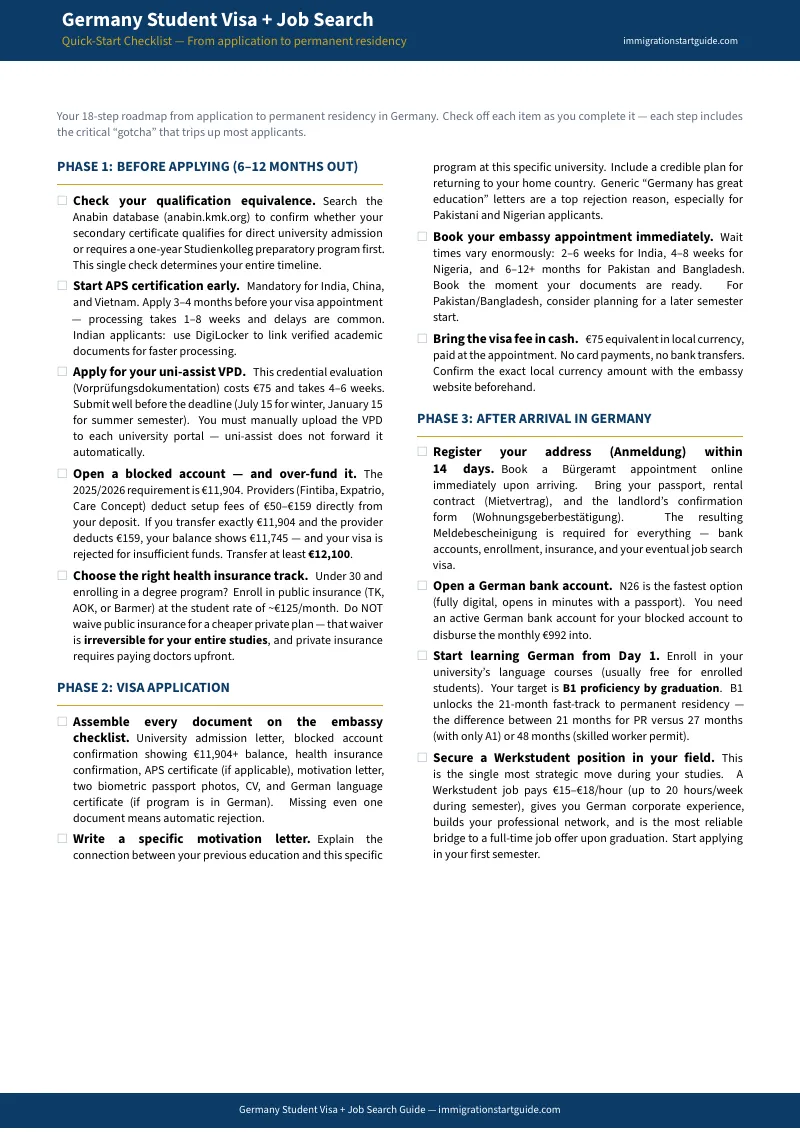
Download the free Quick-Start Checklist to see the highest-stakes action items across the entire pipeline — from blocked account funding through EU Blue Card qualification. When you are ready for the complete pipeline blueprint, the motivation letter framework, the Werkstudent job search strategy, and the month-by-month timeline from arrival to permanent residence, the full guide is here.
Germany is offering free tuition, an 18-month job search visa, and a 21-month path to permanent European residency. It is not offering to explain how to navigate the bureaucracy that stands between you and all of it. This guide does.