
The wrong classification costs you trade tax, an IHK evaluation, and a 40-page business plan. The right one gets you a visa in weeks.
You're a skilled professional — a developer, designer, consultant, writer, or engineer — and Germany's freelancer visa under §21 AufenthG is your path to building a career in Europe's largest economy. The opportunity is real: no employer needed, no job offer required, just proof that your skills are in demand.
But between the Freiberufler vs. Gewerbe classification that determines whether you pay trade tax, the "sustainability" business plan that looks nothing like a startup pitch, the health insurance maze where one wrong choice locks you in for life, and the city-by-city differences in what the Auslanderbehoerde actually accepts — one wrong move means rejection, wasted months, and thousands in sunk costs.
Free guides give you fragments. Reddit threads from 2022 contradict each other. Even the best English-language blogs stop at the visa itself and don't cover tax registration, invoicing compliance, or the classification strategy that determines your entire tax structure. Immigration lawyers charge €1,500–€5,000 for advice you can execute yourself — if someone shows you exactly how.
The §21 Classification Strategy
The Germany Freelancer/Self-Employment Visa Guide is built around the decision that shapes your entire German career: how you're classified under §21 AufenthG. Get classified as a Freiberufler (liberal profession) and you skip trade tax, skip the IHK evaluation, skip the 40-page business plan, and register only with the Finanzamt. Get classified as Gewerbetreibender (commercial trade) and you face all of it — plus annual IHK fees and double-entry bookkeeping requirements.
The guide doesn't just explain the difference. It provides a Professional Classification Decision Tree for 50+ modern professions — UX designers, cloud architects, data scientists, content strategists, coaches — showing you the exact German wording to use in your business description so the Finanzamt classifies you on the right side of the line.
What's Inside
Freiberufler vs. Gewerbe Decision Tree — The classification that determines whether you pay 0% or 15%+ in trade tax and whether your visa application needs a 3-page business concept or a 40-page business plan. Covers the "Katalogberufe" (catalog professions) and the critical grey zone where IT consultants, web developers, and coaches can be classified either way depending on how they describe their work. Includes the specific German phrasing that tips the decision in your favor.
The Sustainability Business Plan Template — German visa officers don't want a startup pitch deck. They want proof you won't become a burden on the state. The guide provides an annotated template showing exactly what a UX designer, IT consultant, or translator should write in each section — the 3-year revenue forecast (Ertragsvorschau), the financing plan (Finanzierungsplan), and the personal expense calculation that demonstrates self-sufficiency at German cost-of-living levels.
Letters of Intent (LOI) Framework — Most immigration offices expect 2–3 letters from prospective clients, and letters from German-based companies carry significantly more weight than international ones. The guide covers exactly what each LOI must contain: nature of the project, specific services, proposed remuneration, and estimated duration. Plus how to approach and secure LOIs before you've even set foot in Germany.
City-Specific Intelligence — Berlin's LEA now uses an online portal that grants Fiktionswirkung (automatic stay extension) once submitted. Munich's KVR requires all documents in German and scrutinizes income thresholds more aggressively. Hamburg processes visas faster than any major city but demands clear evidence of local clients. Leipzig offers the lowest cost-of-living thresholds for approval. The guide covers what each city's Auslanderbehoerde actually prioritizes — because federal law and local implementation are two different things.
Health Insurance Decision Tree — Public (GKV), private (PKV), or expat bridge insurance — and the age trap that makes switching back to public nearly impossible after 55. The guide walks through the real costs: GKV minimum of ~€286/month even at zero income, PKV at €250–€350/month for a healthy 30-year-old, and the Kunstlersozialkasse (KSK) option for creative professionals that cuts your premiums in half. One wrong choice here follows you for decades.
Tax Registration and Compliance from Day One — The ELSTER questionnaire walkthrough, the Kleinunternehmerregelung (small business exemption) thresholds for 2025/2026, the 10 mandatory invoice elements under §14 UStG, and the new e-invoicing mandate. Plus the "save 25–35% of every invoice" rule and how quarterly advance payments (Vorauszahlungen) work so you don't face a surprise tax bill in year two.
The Scheinselbstandigkeit Trap — If 80%+ of your income comes from one client, Germany may reclassify you as an employee. Your visa gets revoked and the "employer" faces years of backdated social security payments. The guide shows how to structure your client mix and contracts to stay clearly on the self-employed side.
Post-Arrival Playbook — The Anmeldung within 14 days, the Wohnungsgeberbestattigung from your landlord, business bank account setup (N26 Business, Kontist, or Qonto), the Steuernummer timeline, and the exact sequence for the first 30 days. Everything in the order you need to complete it — because doing things out of sequence creates cascading delays.
Financial Planning Calculator — City-by-city monthly cost thresholds (Berlin ~€1,800–€2,400, Munich ~€2,300–€3,100), the recommended €12,000–€15,000 savings buffer, and the full first-year budget from visa fees through apartment security deposit. Know your numbers before you commit.
Who This Is For
- Software developers, IT consultants, designers, engineers, and other tech professionals planning to freelance in Germany
- Writers, translators, journalists, artists, and creative professionals eligible for the Freiberufler track
- Coaches, consultants, and "borderline" professionals who need to know exactly how to frame their work to avoid Gewerbe classification
- Non-EU professionals from the US, UK, Canada, Australia, India, Brazil, or any third country applying under §21 AufenthG
- Professionals already in Germany on another visa type (student, job seeker) looking to convert to self-employment under §21 Abs. 6
- Anyone who can't afford a €1,500+ immigration lawyer but can't afford a classification mistake either
Why Not Just Use Free Resources?
"Make it in Germany" will tell you a business plan is required. It will not tell you that the Auslanderbehoerde in Munich expects a fundamentally different level of detail than Berlin, that the IHK evaluation can be avoided entirely if you qualify as a Freiberufler, or that the word "consulting" in your business description can trigger a Gewerbe classification if it's not framed around intellectual problem-solving.
Reddit will tell you the freelancer visa is "easy" if you're in IT. It will not tell you that a web developer who builds websites for clients may qualify as Freiberufler, but the same developer running a small agency with subcontractors is automatically classified as Gewerbe — a distinction that changes your tax rate, your registration requirements, and the complexity of your visa application.
The best English-language expat blogs cover the visa basics well. But they don't provide annotated business plan templates, LOI frameworks, the ELSTER questionnaire walkthrough, invoice compliance checklists, or the professional classification decision tree that prevents the most expensive mistake in the entire process.
Free resources give you the rules. This guide gives you the strategy — the specific decisions, wording, and sequencing that turn "I think I qualify" into "approved."
What You Get
- The complete 73-page guide covering classification strategy, business plan architecture, visa application process, health insurance, tax setup, invoicing compliance, and city-specific intelligence
- Professional Classification Decision Tree — fillable 2-page worksheet for 50+ modern professions with the exact German wording to use in your Tätigkeitsbeschreibung
- Annotated Business Plan Template — 8-page fillable Ertragsvorschau (revenue forecast), Finanzierungsplan (financing plan), and personal expense calculation in the sustainability format the Ausländerbehörde expects
- Document Checklist — 2-page stage-by-stage checklist of every item needed for the embassy, arrival registrations, and Ausländerbehörde appointment
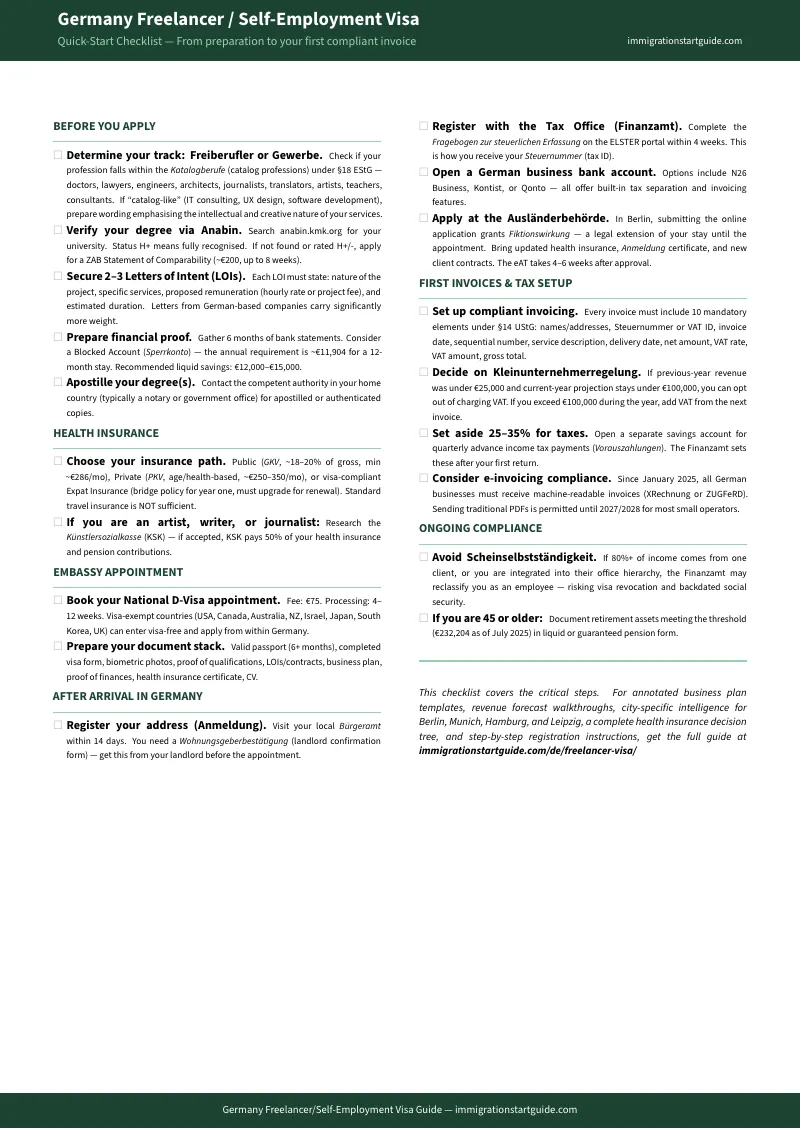
- Quick-Start Checklist — 1-page action summary from classification through your first compliant invoice
- Instant download — start your preparation today
The visa application fee is €75. A Gewerbe misclassification costs you 15%+ in trade tax every year you earn. An immigration lawyer charges €1,500–€5,000 for what this guide teaches you to do yourself. For , it pays for itself the moment it prevents one classification mistake.
100% Satisfaction Guarantee
If the guide doesn't give you a clearer path to freelancing in Germany than what you've pieced together from free resources, email us for a full refund. No questions, no hoops.