
Your Spouse Is in Another Country. Every Month Apart Costs You Thousands in Dual Rent and a Piece of Your Life You Don't Get Back.
You got married. You have a residence permit in Germany. You assumed the family reunion visa would be a formality — you're legally married, your spouse has no criminal record, you have a job, you have an apartment. Then you opened the embassy website.
Familiennachzug. Lebensunterhaltssicherung. Wohnungsgeberbestätigung. An A1 German language exam your spouse needs to pass before they can even apply — even though they'll be enrolling in a 660-hour integration course the moment they arrive. An income calculation that uses Bürgergeld rates and "warm rent" in a formula no government website actually explains. A housing requirement measured in square meters per person. An embassy appointment system that books out three to six months in advance — and that's before your spouse has even started studying German.
So you search online. One person says their spouse's visa took eight weeks. The next says theirs took eleven months because they studied for the A1 exam first, then gathered documents, then tried to book an embassy appointment — and by the time the appointment came, their A1 certificate had expired. A third person says their income was rejected because the immigration authority calculated it differently than the online income calculator did. The advice is contradictory. The timelines are all over the map. And every month you spend figuring this out is another month of dual rent in two countries — another €1,500 to €3,000 gone, another month of video calls instead of dinners, another month your children are growing up without both parents under the same roof.
Here is the structural problem: most people treat the family reunion process as a sequence — first learn German, then get documents, then book the embassy. This sequential approach routinely adds three to four months of unnecessary separation. The A1 exam takes three to six months of preparation. Document procurement with apostilles and translations takes weeks. Embassy appointments in India, Turkey, Pakistan, and the Philippines book out months in advance. Done one after another, you're looking at nine to eleven months apart. Done in parallel, five to seven.
The Germany Family Reunion Visa Guide is built around the Parallel Preparation Plan — a structured system for running all three tracks (language, documents, embassy booking) simultaneously so you spend the minimum possible time separated from your family. This is not a summary of what the law says. This is the execution framework that compresses a typical nine-to-eleven-month separation into five to seven months, handles the income calculation correctly the first time, identifies A1 exemptions that could save your spouse six months of studying entirely, and walks you through the exact process for your specific embassy jurisdiction.
What's Inside
The complete 17-chapter guide plus 6 standalone printable tools — covering every stage from eligibility confirmation through post-arrival registration:
The Parallel Preparation Plan
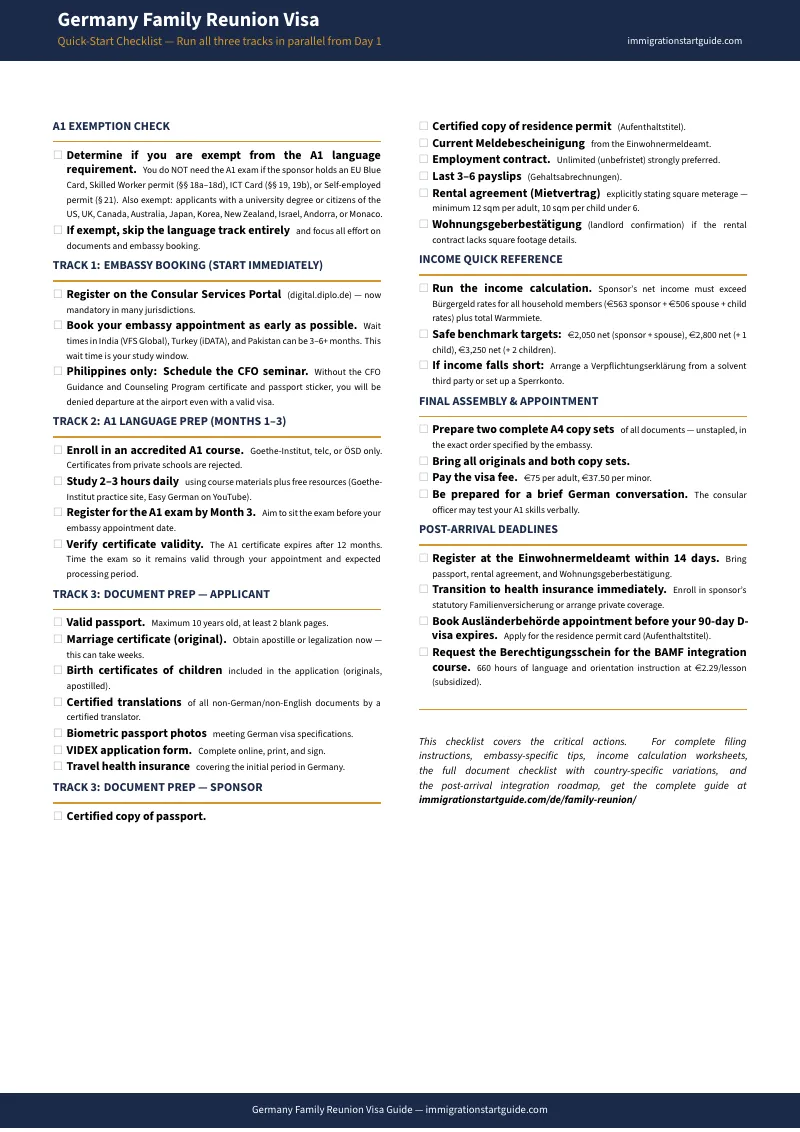
The guide's core framework. Instead of the sequential approach that costs most families three to four extra months, the Parallel Preparation Plan shows you how to start all three tracks on Day 1: book the embassy appointment immediately (the wait time becomes your study window), begin A1 preparation in parallel, and assemble documents simultaneously. The guide includes a month-by-month timeline showing exactly when each milestone needs to be completed, and how the tracks synchronize so your spouse arrives at the embassy appointment with every document, every certificate, and every form ready to submit.
The A1 Exemption Finder
This may be the most valuable section in the entire guide. Many applicants spend months studying for the A1 German language exam without realizing they're exempt. If the sponsor holds an EU Blue Card, a Skilled Worker permit (§ 18a, 18b, 18c, 18d), an ICT Card, or a Self-employment permit — the spouse is exempt from the A1 requirement. If the applicant holds a university degree from any country — exempt. If the applicant is a citizen of the US, UK, Canada, Australia, Japan, South Korea, New Zealand, or Israel — exempt. The guide walks through every exemption category, the specific legal basis for each, and what documentation proves the exemption to the embassy officer. Five minutes with this chapter could save your spouse six months of language preparation.
The Income Calculation Worksheet
The single most confusing requirement. The sponsor's net monthly income must exceed the sum of Bürgergeld standard rates for all household members (€563 for the sponsor, €506 for the spouse, plus child rates by age) plus the total warm rent. The guide explains why the "net income" the government needs is not the same number on your payslip, how to account for Kindergeld and other allowances, what the safe benchmark targets are (€2,050 net for a couple, €2,800 with one child, €3,250 with two children), and what to do if you fall short — including the Verpflichtungserklärung (financial guarantee from a third party) and the Sperrkonto (blocked account) options. This worksheet alone prevents the most common rejection reason for third-country national sponsors.
Country-Specific Embassy Playbooks
The family reunion visa process varies dramatically depending on where your spouse applies. The guide covers the exact procedures, appointment systems, and local requirements for the highest-volume jurisdictions: India (VFS Global outsourced processing, Bengaluru/Chennai/Hyderabad/Kolkata/Mumbai/New Delhi centers), Turkey (iDATA appointment system, 6-12 week processing), the Philippines (the mandatory CFO Guidance and Counseling seminar — without the CFO certificate and passport sticker, your spouse will be denied departure at the airport even with a valid visa), Pakistan (3-6 month appointment backlogs), Syria (applications routed through the Beirut embassy), and Brazil (Americans-style visa-free entry complicating the process). Each playbook includes the specific document order, local quirks, and timeline expectations for that jurisdiction.
Complete Document Checklists
Two comprehensive checklists — one for the applicant (passport, marriage certificate with apostille, birth certificates, A1 certificate or exemption proof, biometric photos, VIDEX form, health insurance) and one for the sponsor in Germany (residence permit copy, Meldebescheinigung, employment contract, payslips, rental agreement with square meterage, Wohnungsgeberbestätigung). The guide specifies the exact requirements for each document, which need apostilles versus full consular legalization, which languages are accepted, and the precise order to present them — including the rule about not stapling documents (it jams embassy scanners and can delay processing).
Housing Requirements Decoded
Germany requires 12 square meters per adult and 10 square meters per child under six. The guide explains how immigration authorities verify this (rental contract, Wohnungsgeberbestätigung, floor plans), what happens when your apartment is borderline, and the practical strategies for meeting the requirement — including what to do if your current apartment is too small and you need to demonstrate a signed contract for a larger one.
The Post-Arrival Execution Plan
The 14-day registration deadline at the Einwohnermeldeamt. The health insurance transition from travel coverage to statutory Familienversicherung. The Ausländerbehörde appointment for the residence permit card before the 90-day D-visa expires. The BAMF integration course enrollment (660 hours of language and orientation instruction at €2.29 per lesson). The guide covers every critical deadline and the exact sequence to handle them, because a missed registration deadline or an expired D-visa can jeopardize your family member's legal status before they've been in Germany a month.
Child and Parent Reunification
Separate chapters covering minors joining parents in Germany (§ 32 AufenthG — different rules for children under 16 versus 16-17, B1/C1 language requirements for older teens, sole custody documentation) and the March 2024 reform to parent reunification that now allows certain residence permit holders to sponsor parents and parents-in-law. Including the hardship provisions under § 36(2) for exceptional cases that don't meet standard criteria.
Common Rejection Reasons and How to Avoid Them
A systematic review of every major rejection category: expired A1 certificates, income shortfalls, inadequate housing proof, missing apostilles, document assembly errors, and the less obvious ones — like sponsor residence permits that lack "good prospects for permanence" or marriages that immigration authorities flag for additional scrutiny. Each rejection reason includes the specific countermeasure that prevents it.
Who This Guide Is For
- Spouses of third-country nationals working in Germany — you face the full set of requirements (A1 exam, income proof, housing proof) and benefit most from the Parallel Preparation Plan, the income calculation worksheet, and the country-specific embassy playbooks
- Spouses of German citizens — your requirements are lighter (no income or housing proof), but the A1 requirement still applies in most cases and the embassy appointment bottleneck is identical. The guide's A1 Exemption Finder and Parallel Preparation Plan save you months either way
- Spouses of EU Blue Card and Skilled Worker permit holders — you may be completely exempt from the A1 language requirement and not know it. The guide identifies every exemption category so you don't spend six months studying for an exam you don't need to take
- Parents bringing children to Germany, or adult children sponsoring elderly parents — separate chapters cover the distinct legal frameworks, age-dependent requirements, and the 2024 parent reunification reform
Why Not Free Resources?
- Make-it-in-Germany lists the basic eligibility criteria. It does not explain how to calculate your income using Bürgergeld rates plus warm rent, does not cover the A1 exemptions for skilled worker permit holders, and provides no guidance on country-specific embassy procedures. You get requirements, not a plan.
- Embassy websites provide document lists that are frequently incomplete, outdated, or contradictory between jurisdictions. They don't explain the Parallel Preparation Plan, don't warn you about the 12-month A1 certificate expiration trap, and don't tell you that your VFS Global appointment in India will take three months to book.
- Expat forums and Reddit (r/germany, r/berlin) give you stories from people who filed under different rules, at different embassies, with different sponsor permit types. The person who says "it was easy, four weeks" had a German citizen spouse and was exempt from the A1 exam. The person who says "it took a year" was sequentially processing instead of running tracks in parallel. Without understanding which variables drive the timeline, other people's stories create anxiety, not clarity.
- Immigration lawyers charge €1,000 to €2,000+ for a family reunion filing. They handle the paperwork competently — but they cannot learn German for your spouse, they cannot compress the embassy appointment backlog, and most do not provide the month-by-month execution plan that actually minimizes separation time. The Parallel Preparation Plan does what lawyers structurally cannot: give your family the strategic framework to run every track simultaneously.
This guide fills the execution gap — the space between "I know I need a family reunion visa" and "I have a month-by-month plan that gets my spouse here in five to seven months instead of eleven." It provides the same structured documentation frameworks and strategic planning that boutique immigration firms build internally, focused entirely on minimizing the time your family spends apart.
— Less Than One Month of Dual Rent
The visa application fee alone is €75 per adult. The A1 exam costs €128 at the Goethe-Institut. An immigration lawyer consultation starts at €200 per hour — a full filing runs €1,000 to €2,000+. And every month of unnecessary separation costs your family €1,500 to €3,000 in dual rent, flights, and living expenses in two countries.
This guide does not replace legal counsel for complex appeals or exceptional hardship cases. But it gives you the Parallel Preparation Plan, the income calculation worksheet, the A1 Exemption Finder, and the country-specific embassy playbooks that prevent the most common application failures and compress the timeline by months.
If it saves you even one month of separation, it saves your family more than it costs — many times over.
Money-back guarantee, no time limit. If the guide doesn't make your family reunion application stronger, you pay nothing.
Download the free Quick-Start Checklist to see whether you qualify for an A1 exemption and how the Parallel Preparation Plan works. When you're ready for the complete income calculation worksheet, country-specific embassy playbooks, and the full 17-chapter execution framework, the guide is here.
Your family belongs together. This is the plan that gets them there.