
You've built a life in Germany. One missing document can put the next five years on hold.
You've been here for years. You pay taxes, contribute to the pension system, speak the language, and rent an apartment with your name on the lease. You're not a newcomer. But every time your temporary permit approaches its expiration date, you're back in the queue at the Auslanderbehoerde, hoping the same caseworker is still assigned to your file, hoping the rules haven't changed since your last renewal.
The Niederlassungserlaubnis is supposed to end that cycle. Permanent residency. No more renewals, no more employer-binding, no more asking permission to change jobs or start a business. But the gap between "I think I qualify" and "approved" is where most applications stall — sometimes for six months, sometimes for over a year.
The pension contribution requirement trips up Blue Card holders who changed jobs and have a two-month gap in their Rentenversicherung history. The "secured livelihood" calculation uses a formula based on SGB II standard rates that no free resource actually explains — so applicants earning well above average get rejected because they didn't account for dependent family members in the math. The "Life in Germany" test is straightforward, but half of applicants don't realize that a German university degree often waives both the test and the integration course entirely. And the processing time? Berlin's LEA takes 20-30 weeks and doesn't respond to status inquiries. Munich's KVR explicitly prohibits follow-up emails. If you show up with an incomplete file, you don't get a second chance — you get sent to the back of a six-month queue.
Free resources give you the legal requirements. Immigration lawyers charge EUR 1,500-2,000 to gather the same documents you'll gather yourself. Neither tells you that the same law is applied differently in Berlin, Munich, Hamburg, and Frankfurt — or that a three-month silence from the Auslanderbehoerde gives you the legal right to file an Untatigkeitsklage that moves your file to the top of the pile in 80% of cases.
The Permanent Residency Blueprint
The Germany Settlement Permit (Niederlassungserlaubnis) Guide is built around the decision most applicants don't realize they have: which route to permanent residency is fastest for their specific situation. The standard Section 9 path requires five years and 60 months of pension contributions. But Blue Card holders can qualify in 21 months with B1 German. German university graduates need only two years. Self-employed professionals on a Section 21 visa can apply after three years if their business is profitable. And skilled workers with recognized foreign qualifications hit the three-year mark under Section 18c.
Most applicants default to the standard route because that's what the government websites describe. The guide starts with a Multi-Route Comparison Matrix that maps your visa type, pension history, language level, and employment status to the fastest available path — so you apply at 21 months instead of waiting until 60.
What's Inside
Multi-Route Comparison Matrix — A side-by-side analysis of every settlement permit pathway: Section 9 (standard), Section 18c (Blue Card and skilled workers), Section 21 (self-employed), and Section 28 (family reunion). For each route, the guide maps the residence requirement, pension months needed, language level, and integration proof — so you can see at a glance whether you qualify for a faster track than the one you assumed was your only option.
The Livelihood Calculation Worksheet — The Auslanderbehoerde determines whether your income is "secure" using a personalized formula: the 2026 Regelbedarf standard rates (EUR 563 for a single adult, EUR 506 per partner, EUR 357-471 per child) plus your warm rent, minus any public benefits. A family of four in Munich with EUR 1,800 rent needs roughly EUR 3,700 net monthly income to qualify. The worksheet walks you through the exact calculation for your household size and city, so you know before you apply whether your income clears the threshold — or what you need to adjust.
Pension Contribution Deep-Dive — The 60-month pension requirement is the number-one reason for application delays. The guide covers every angle: how to request your Versicherungsverlauf from the Deutsche Rentenversicherung, how child-rearing credits (up to three years per child) count toward the threshold, how freelancers can satisfy the requirement through voluntary contributions or private provision worth approximately EUR 216,000 in assets, and how married couples can use "spouse pooling" under Section 9(3) where one partner's pension months cover both applications.
City-Specific Intelligence — Federal law sets the rules. Local offices interpret them. Berlin's LEA requires online submission and invites you to an appointment after reviewing your file — wait times run 20-30 weeks and email inquiries go unanswered. Munich's KVR processes in 6-9 months but demands a "Life in Germany" test even for routes where other cities waive it. Frankfurt releases new appointment slots on Fridays at 6:00 AM. Hamburg processes in 10-14 weeks and is the fastest major city. Stuttgart runs 6-8 weeks for technical specialists. The guide covers the application method, realistic timelines, and which contact channels actually work in each city.
The Untatigkeitsklage Playbook — If the Auslanderbehoerde hasn't decided on your application within three months of complete submission, you have the legal right to file an inaction lawsuit under Section 75 VwGO. In nearly 80% of cases, filing the lawsuit causes the office to prioritize your file and issue a decision within weeks — without ever going to court. The guide provides follow-up fax templates, the timeline for when to escalate, estimated court costs (approximately EUR 483), and a step-by-step walkthrough so you can pressure a stalled application without hiring a lawyer.
Document Checklist by Route — Every settlement permit route has its own evidence requirements. The guide provides a route-specific checklist: identity documents, employment proof (last six payslips plus employer confirmation), the Rentenauskunft from the DRV, B1 language certificate or equivalent, Leben in Deutschland test result, rental contract plus Wohnungsgeberbestatigung, Krankenkasse membership certificate, and biometric photos. For freelancers: the last three tax assessments plus a profit-and-loss statement from a Steuerberater. Each item includes the specification the Auslanderbehoerde expects — not just "proof of income" but "last six consecutive payslips showing gross and net salary with the employer's Steuernummer."
The Fiktionsbescheinigung and Travel Guide — Once you submit your application, your current permit stays valid under Section 81(4) AufenthG. But traveling outside the Schengen area on a Fiktionsbescheinigung is risky, and not all cities issue one automatically. The guide explains how to request it, what it covers, and what travel you can and cannot do while your application is pending.
Post-Grant Rights and the Path to Citizenship — The settlement permit unlocks unrestricted employment, self-employment without Auslanderbehoerde approval, access to Kindergeld and Wohngeld, and better terms on mortgages and loans. The guide also covers the 6-month absence rule that can cause automatic loss of the permit, and how the 2024 Nationality Act reform now makes citizenship possible after five years — or three years with exceptional integration. For Blue Card holders who get their Niederlassungserlaubnis at 21 months, German citizenship can follow in under five years total.
Who This Is For
- EU Blue Card holders approaching the 21-month or 27-month milestone who want to secure permanent residency at the earliest possible date
- Skilled workers, engineers, IT professionals, and other Section 18 visa holders preparing for the three-year or five-year transition
- Freelancers and self-employed professionals on a Section 21 visa who need to prove "adequate old-age provision" without the statutory pension
- Families where one spouse works and the other doesn't — and they need to understand how pension pooling and dependent calculations affect both applications
- Long-term residents who've been in Germany 5+ years and are tired of the biennial renewal cycle
- Anyone whose application has been pending for months with no response from the Auslanderbehoerde
Why Not Just Use Free Resources?
"Make it in Germany" will tell you that 60 months of pension contributions and B1 German are required for the standard route. It will not tell you that Blue Card holders need only 21 months, that child-rearing credits count toward the threshold, or that the "secured livelihood" formula changes based on your household size and rent. It covers the law. It does not cover the math.
All About Berlin is the best English-language resource for Berlin specifically. But if you live in Munich, Hamburg, Frankfurt, or Stuttgart, the application method, wait times, and documentation expectations are fundamentally different. Berlin-specific advice applied in Munich can mean submitting through the wrong channel entirely.
Reddit and Toytown Germany have thousands of "experience reports" — but a Blue Card holder's 2021 success story may lead you astray in 2026 because the Skilled Immigration Act changed the timelines, the salary thresholds, and the pension requirements. Outdated advice on a high-stakes application is worse than no advice at all.
An immigration lawyer charges EUR 500-2,000 for a process that is 90% document gathering. Lawyers add value for contested cases and legal challenges, but for a standard settlement permit application where you meet the requirements, you're paying for expertise you can replicate with the right guide — and the lawyer won't help you learn B1 German or close your pension gap.
What You Get
- The complete 63-page guide covering every settlement permit route, eligibility requirements, the livelihood calculation, pension deep-dive, city-specific intelligence, document checklists, the Untatigkeitsklage playbook, and post-grant rights
- Multi-Route Comparison Matrix — side-by-side analysis of every pathway with residency periods, pension requirements, language thresholds, and 2026 Blue Card salary figures
- Livelihood Calculation Worksheet — the exact 2026 Regelbedarf formula with fillable rows for your household size, rent, and income
- Route-Specific Document Checklist — every item the Auslanderbehoerde requires, organized by route and application stage, with a three-month collection timeline
- City-by-City Intelligence Reference — application methods, wait times, and contact channels for Berlin, Munich, Hamburg, Frankfurt, Stuttgart, and smaller cities
- Follow-Up Letter Templates — ready-to-use status inquiry and Untatigkeitsklage threat letter with fillable fields
- Document Tracking Worksheet — fillable spreadsheet to track every document's status, dates, and expiry
- Eligibility Checklist — one-page quick reference with route-specific checkboxes
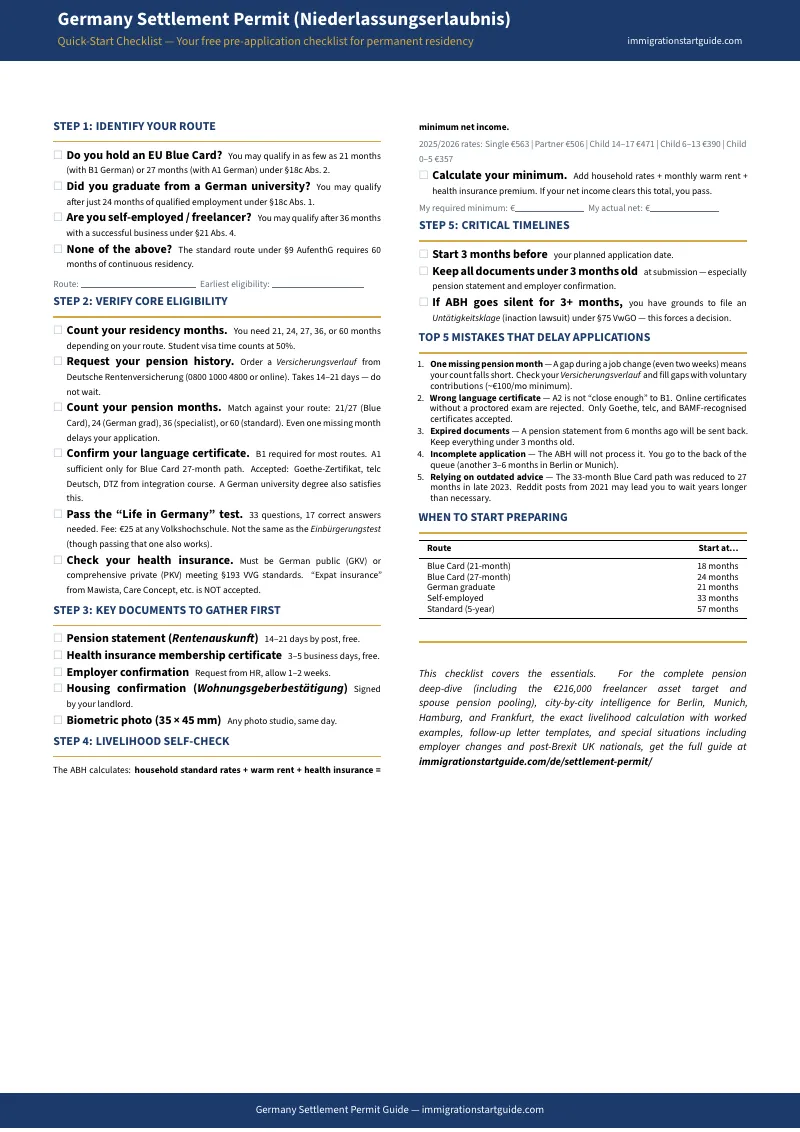
- Quick-Start Checklist — one-page action summary from requesting your pension statement through submitting your application
- Instant download — 9 files, start your preparation today
The Auslanderbehoerde application fee is EUR 113-147. A rejected or delayed application costs months of uncertainty, a lapsed Fiktionsbescheinigung, and potentially a restart from the back of the queue. An immigration lawyer charges EUR 500-2,000 for what this guide teaches you to do yourself. For , the guide pays for itself the moment it prevents one missing document from turning a 10-week process into a 10-month one.
100% Satisfaction Guarantee
If the guide doesn't give you a clearer, faster path to permanent residency in Germany than what you've pieced together from free resources, email us for a full refund. No questions, no hoops.