
The rules changed twice. Most people only know about the first change.
In June 2024, Germany passed the most significant reform to its nationality law in decades. Dual citizenship became legal for everyone. The residency requirement dropped from eight years to five. A fast-track path allowed naturalization in just three years for highly integrated residents. You probably heard about all of that.
Here's what you may not have heard: in October 2025, the government repealed the three-year fast-track for everyone except spouses of German citizens. If you've been counting down to your three-year mark based on the 2024 law, you are following rules that no longer exist.
This isn't a minor detail. Applying under the wrong assumption means a rejected application, a lost EUR 255 fee, and a return to the back of a processing queue that in Berlin already stretches past two years. The BAMF website has the current legal text, but it doesn't explain the transition rules for people who started their residency clock under the old law. Reddit threads mix Munich-specific experiences with Berlin-specific advice. Apps cover the Einbuergerungstest but nothing else. And the lawyers who can sort all of this out charge EUR 1,500 or more for what is, in 95% of cases, a document-gathering exercise.
The gap isn't in the law itself. It's in knowing how the law is actually applied — in your city, for your nationality, given your household situation — in 2026.
The Realignment Roadmap
The Germany Citizenship (Einbuergerung) Guide is built around the fact that the naturalization landscape has shifted twice in eighteen months. It doesn't rehash the 2024 headlines. It starts from the October 2025 reality: the five-year standard path is now the primary route for most residents, the three-year track is restricted to spouses, and the "secure livelihood" requirement is being enforced more strictly than at any point since the reform.
The guide is organized as a complete administrative project plan — from confirming your eligibility through collecting your documents, passing the test, submitting a bulletproof application, and protecting your citizenship for the next decade. Each module is tied to a specific failure point that causes applications to be rejected, delayed, or withdrawn.
What's Inside
2024/2025 Legal Landscape Decoder — A plain-language walkthrough of what actually changed, what was rolled back, and what still applies. Covers the June 2024 StARModG reform, the October 2025 fast-track repeal, the transition rules for pending applications, the "Vertrauensschutz" (protection of legitimate expectations) principle for those who started their clock under the old law, and the current residency thresholds: five years standard, three years for spouses of German citizens only. If you've read five conflicting articles about your eligibility, this module settles it.
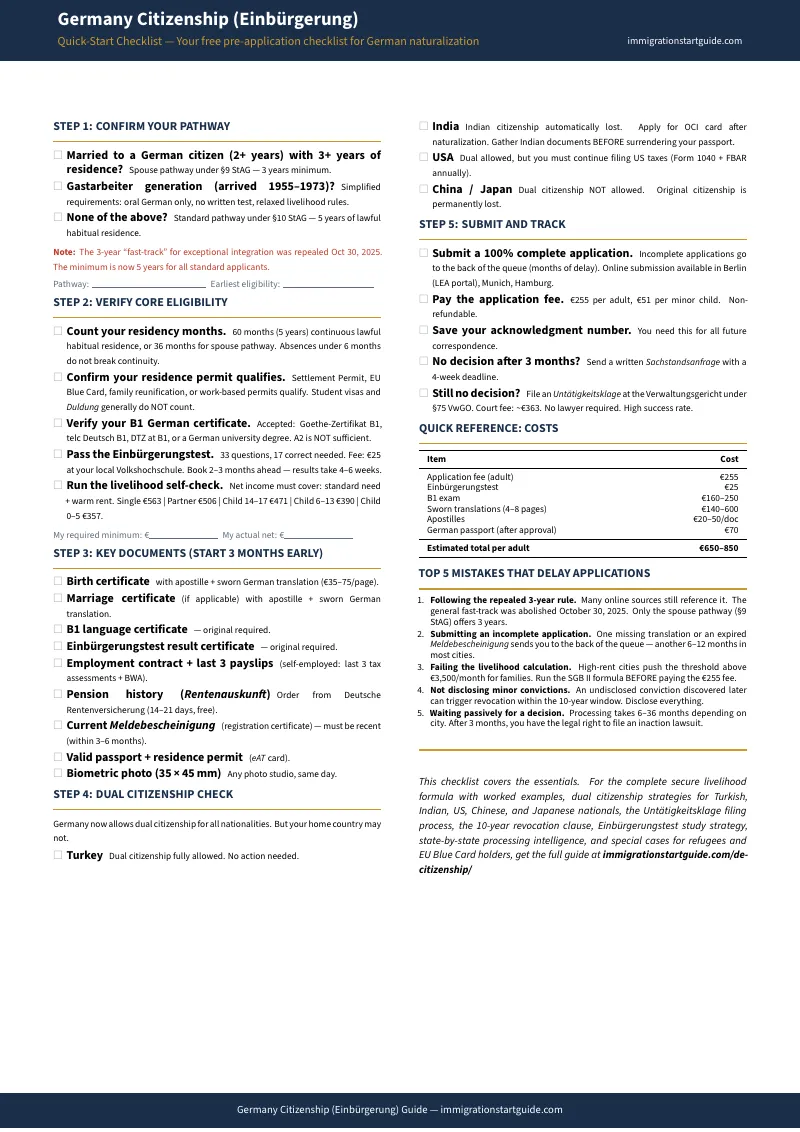
Secure Livelihood Calculator — The Auslaenderbehoerde doesn't just check that you have a job. It runs a prognosis based on the SGB II formula: your household's "Regelbedarf" (standard need) — EUR 563 for a single adult, EUR 506 per partner, EUR 357-471 per child — plus your warm rent, minus any public benefits. A family of four in Munich with EUR 1,800 in rent needs roughly EUR 3,700 net monthly income. The calculator walks you through the exact formula for your household size and city, including the critical 20-month full-time employment exemption that automatically satisfies the requirement for most employed applicants. Know your answer before you pay the EUR 255 fee.
Dual Citizenship Country Matrix — Germany now allows dual citizenship. But does your home country? Turkey permits it and offers a clear re-acquisition process for anyone who previously renounced. India requires renunciation and an Overseas Citizen of India (OCI) card — the guide covers the specific documentation chain, including the apostilled birth certificate and consular renunciation process at the Indian Embassy in Berlin. The United States allows it but requires continued global tax reporting via Form 1040 and FBAR. China and Japan generally prohibit it, meaning a German passport results in the loss of your original nationality. For each major origin country, the matrix explains what happens to your existing passport and what steps to take before, during, and after naturalization.
Einbuergerungstest "Study 40" Strategy — The test bank has 310 questions. The pass rate is over 90%, but most people waste weeks studying all of them equally. The guide categorizes every question into three tiers: "Free Points" (common-sense answers about democracy and daily life), "History Essentials" (the 40 high-frequency questions about dates, events, and constitutional principles that actually decide whether you pass or fail), and "State-Specific Traps" (the 10 state-level questions where your answers must match your Bundesland). A bilingual study approach for non-native German speakers, focusing on the questions that matter, reduces study time to two weeks of light preparation.
Complete Document Chain with Lead Times — Every document the Einbuergerungsbehoerde requires, listed in the order you should request them, with exact lead times. Your birth certificate needs an apostille — that takes 4-6 weeks from most countries. A Fuehrungszeugnis (police clearance) from Germany takes 1-2 weeks online but can take 3-4 months from your home country. The Einbuergerungszusicherung (naturalization assurance) for Indian nationals who must renounce before receiving German citizenship involves a specific consular sequence. The checklist includes the exact specification each document must meet — not "proof of income" but "last six consecutive payslips showing gross and net salary with the employer's Steuernummer" — and a three-month collection timeline so nothing expires before your submission.
City-by-City Processing Intelligence — Federal law sets the rules. Local offices decide the pace. Berlin's LEA has a backlog exceeding two years and does not respond to email inquiries — the guide covers the LEA digital portal submission process and realistic timelines. Munich processes in 9-14 months and conducts in-person interviews. Hamburg runs 6-10 months and is the fastest major city. Frankfurt releases appointment slots on specific mornings. For each city, you get the submission method, the actual wait time based on current reports, and the contact channel that produces results.
Untaetigkeitsklage (Inaction Lawsuit) Filing Guide — Under Section 75 VwGO, if the Einbuergerungsbehoerde has not decided on your complete application within three months, you have the legal right to file an inaction lawsuit. In the majority of cases, filing the lawsuit causes the office to prioritize your file and issue a decision within weeks — without ever going to court. The estimated court costs are approximately EUR 483. The guide provides the follow-up fax template, the timeline for when to escalate, and a step-by-step walkthrough so you can pressure a stalled application without hiring a lawyer.
10-Year Revocation Protection Checklist — The 2024 reform extended the period during which citizenship can be revoked for false statements from five years to ten. An inadvertent error in your application — an undisclosed minor conviction, an incorrect residency date, an incomplete employment history — can surface years later. The checklist walks through every field in the application form and flags the areas where caseworkers most frequently find discrepancies, so your application is airtight from day one.
Who This Is For
- Long-term residents at or approaching the five-year residency mark who want to naturalize under the reformed 2024/2025 law and need to know exactly which rules apply to them now
- EU Blue Card holders and skilled workers who accumulated residency through work visas and want to confirm whether their visa type, employment history, and pension contributions qualify them for the standard or an accelerated path
- Turkish nationals who can finally keep both passports and want the step-by-step process for dual citizenship — including how to re-acquire Turkish citizenship if they renounced it under the old German law
- Indian professionals who need to navigate India's renunciation requirement and OCI card application alongside the German naturalization process
- US, UK, and other expat nationals who were previously waiting for the eight-year mark and are now eligible three years earlier than they planned
- Applicants who have been waiting months or years for a decision and don't know how to force action from the Auslaenderbehoerde
- Anyone who has read five conflicting sources about the 2024 reform, the 2025 repeal, and the current eligibility rules — and needs one definitive answer
Why Not Free Resources?
The BAMF website explains the law. It does not explain the administrative practice. It will tell you that five years of lawful residence is required. It will not tell you that a two-month gap between residence permits can reset your clock in some cities, that the "secure livelihood" formula changes based on your warm rent and household composition, or that Berlin and Munich apply the same law with materially different timelines and documentation expectations.
"Make it in Germany" provides a solid English overview. It covers the requirements. It does not cover the October 2025 fast-track repeal, the transition rules for pending applications, the city-by-city differences in processing, or the SGB II calculation that determines whether your income qualifies as "secure."
Reddit and Facebook groups are full of experience reports. But a Turkish national's 2024 experience in Hamburg tells you nothing about an Indian professional's 2026 situation in Berlin. Anecdotal advice on a EUR 255 application is a gamble — and if the advice is wrong, you don't just lose the fee, you lose months in a queue you'll have to rejoin.
Test prep apps cover the Einbuergerungstest's 310 questions. They do not cover the livelihood calculation, the document chain, the inaction lawsuit, or the dual citizenship rules for your specific nationality. The test is one requirement among many — and it's not the one that causes most rejections.
An immigration lawyer charges EUR 1,500-2,000 for the same document gathering and application review. For the small minority of cases involving contested eligibility or complex legal situations, a lawyer is worth it. For the vast majority of applicants who meet the requirements and need to get the paperwork right, the guide delivers the same administrative intelligence at a fraction of the cost.
What You Get
- The complete guide covering the 2024/2025 legal landscape, the secure livelihood calculation, dual citizenship rules by nationality, the Einbuergerungstest study strategy, document requirements with lead times, city-by-city processing intelligence, the Untaetigkeitsklage filing process, and the 10-year revocation protection checklist
- Secure Livelihood Calculator — the exact 2026 SGB II formula with worked examples for single applicants, couples, and families, including the 20-month employment exemption
- Dual Citizenship Country Matrix — what happens to your existing passport for Turkey, India, USA, UK, China, Japan, and other major origin countries, with step-by-step processes for renunciation, OCI, and re-acquisition
- Complete Document Checklist — every document the Einbuergerungsbehoerde requires, with exact specifications, lead times, and a three-month collection timeline
- City-by-City Intelligence Reference — submission methods, realistic wait times, and working contact channels for Berlin, Munich, Hamburg, Frankfurt, and Stuttgart
- Follow-Up and Untaetigkeitsklage Templates — ready-to-use letters for stalled applications with fillable fields, citing the relevant legal provisions
- Einbuergerungstest Study Guide — the "Study 40" strategy categorizing all 310 questions into Free Points, History Essentials, and State-Specific Traps
- 10-Year Revocation Protection Checklist — field-by-field review of every section of the application to prevent errors that could trigger revocation under the extended 10-year window
- Quick-Start Checklist — one-page action summary from confirming eligibility through receiving your Einbuergerungsurkunde
- Instant download — start your preparation today
The application fee is EUR 255. A rejected application costs you that fee plus months of lost time in a queue that stretches past two years in Berlin. An immigration lawyer charges EUR 1,500 or more for what this guide teaches you to do yourself. For , the guide pays for itself the moment it prevents one missing document, one miscalculated livelihood threshold, or one wrong assumption about the 2025 changes from turning a straightforward application into a year-long ordeal.
100% Satisfaction Guarantee
If the guide doesn't give you a clearer, faster path to German citizenship than what you've pieced together from BAMF pages, Reddit threads, and outdated blog posts, email us for a full refund. No questions, no hoops.