
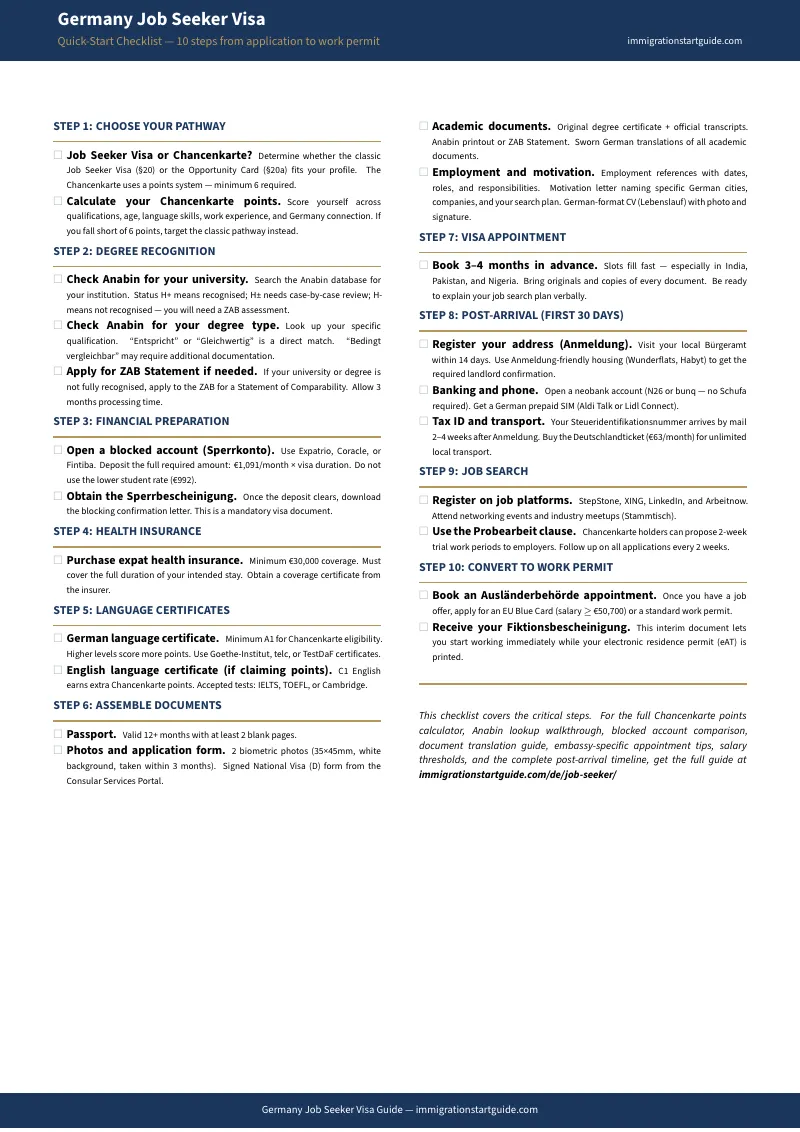
Germany's visa system is a maze designed by lawyers. This guide turns it into a 10-step checklist.
You've seen the headlines — Germany has over a million open jobs and two visa pathways that let you move there without a job offer. The Job Seeker Visa (§20) and the Opportunity Card (§20a / Chancenkarte) were built to attract professionals like you.
But between the all-German Anabin database, the €13,000+ blocked account, the motivation letter that consulates actually read word by word, and the three-month ZAB evaluation queue — one mistake means rejection. And since July 2025, Germany abolished the Remonstration appeal. Get rejected once, and you're starting from scratch.
Free portals list requirements in stiff bureaucratic English. Reddit threads contradict each other with pre-2024 advice. Immigration lawyers charge €2,000–€5,000. None of them give you what you actually need: the exact steps, in order, with the templates and comparisons that turn "overwhelmed" into "submitted."
The Bureaucratic Decoder System
The Germany Job Seeker Visa Guide is built around one principle: every bureaucratic requirement has a specific, repeatable way to meet it. Not theory. Not "consult a lawyer." Exact steps.
It starts with the Pathway Decision Matrix — a structured walkthrough that determines whether the §20 Job Seeker Visa or the §20a Chancenkarte gives you the fastest entry based on your degree status, experience, age, and language skills. Most applicants guess wrong because they don't understand the difference between full and partial degree recognition. The matrix eliminates the guesswork.
What's Inside
Anabin Database Walkthrough — Most applicants check their university on Anabin and stop. But you also need to verify your specific degree type — and that second check is where rejections hide. This guide walks you through both checks with the exact navigation path through the German-language interface.
Chancenkarte Points Calculator — The 6-point minimum sounds simple until you realize that partial degree recognition, work experience, language, and age all interact differently depending on your profile. The calculator shows common combinations for IT professionals, engineers, and healthcare workers so you know your score before you apply.
Blocked Account Comparison — Expatrio, Coracle, Fintiba, Deutsche Bank — compared on fees, speed, and embassy acceptance. Plus the critical detail that most guides miss: the mandatory rate is €1,091/month for job seekers, NOT the €992 student rate that appears in older guides. Using the wrong amount is a top rejection reason.
Motivation Letter Template — The #3 rejection reason is a vague motivation letter. Consulates in India, Pakistan, and Nigeria specifically look for named German cities, specific target employers, a financial calculation, and a contingency plan. The template structures all four so you don't have to guess what "sufficient motivation" means.
Consular Processing Intelligence — Appointment wait times for New Delhi (4–10 weeks), Mumbai (6–12 weeks), Islamabad (8–16 weeks), Lagos (several months), Istanbul (4–8 weeks), and São Paulo (immediate digital). Plus the 2026 CSP digital portal workflow that most applicants haven't encountered yet.
Post-Arrival Playbook — The Anmeldung-banking-insurance sequence that trips up every newcomer. Which temporary housing providers actually give you the Wohnungsgeberbestätigung form. Which neobanks open accounts without a Schufa score. How the Tax ID arrives and what to do if it doesn't. All in the order you need to complete them.
German Job Search Strategy — StepStone, XING, LinkedIn, Arbeitnow — which portals matter for which industries. How to access the "hidden job market" through Stammtisch networking. How to use the Probearbeit (trial work) clause on the Chancenkarte to get your foot in the door. German CV format and application conventions that differ from what you're used to.
Work Permit Conversion — EU Blue Card salary thresholds (€50,700 standard, €45,934.20 for shortage occupations in 2026). The IT Specialist Route that bypasses degree requirements entirely. What the Fiktionsbescheinigung is and why you need it. Ausländerbehörde appointment preparation.
Rejection Prevention — The top 5 causes of visa denial and the specific document, amount, or wording that triggers each one. With Remonstration abolished, prevention is no longer optional — it's the only strategy that works.
Budget Calculator — Full relocation budget breakdown from ZAB fees through apartment security deposit (approximately €17,674 total). Monthly cost-of-living estimates by city so you can plan how long your blocked account actually sustains you.
Who This Is For
- Skilled professionals applying from India, Pakistan, Nigeria, Turkey, Egypt, Brazil, or any non-EU country
- IT specialists, engineers, healthcare workers, and other professionals on Germany's shortage occupation list
- Professionals with partially recognized degrees who need the Chancenkarte points system
- Anyone confused by the §20 vs. §20a choice and the post-2024 rule changes
- Applicants who can't afford a €2,000+ immigration lawyer but can't afford a rejection either
Why Not Just Use Free Resources?
The "Make it in Germany" portal will tell you that a "Motivation Letter" is required. It will not tell you that consulates in Mumbai specifically look for named target employers, that consulates in Lagos flag letters without a financial contingency section, or that generic letters are the #3 rejection reason across all missions.
Reddit will tell you the Chancenkarte requires 6 points. It will not tell you that a user whose university is H+ on Anabin but whose degree type is "bedingt vergleichbar" qualifies for 4 points through partial recognition — a distinction that most commenters don't understand because they've never read the ZAB classification criteria.
YouTube will show you "how to fill in the visa form." It will not show you that the 2026 blocked account rate for job seekers is €1,091/month, that using the outdated €934 or €992 figure from older videos triggers automatic rejection, or that the Remonstration procedure your favorite vlogger mentioned no longer exists.
Free resources give you pieces. This guide gives you the assembled picture — verified against the 2026 legal framework, with every figure, threshold, and procedure updated for the current year.
What You Get
- The complete guide (13 chapters, 55-page printable PDF)
- The Quick-Start Checklist (1-page action summary)
- Chancenkarte Points Worksheet (fillable 2-page calculator)
- Detailed Document Checklist (2-page consular appointment prep sheet)
- Timeline Planner (2-page visual planner from 6 months out through arrival)
- Instant download — start your preparation today
The visa application fee alone is €75. The blocked account is €13,000+. A single rejection costs you that fee plus 3–6 months of your timeline. For , the guide pays for itself the moment it prevents one mistake.
100% Satisfaction Guarantee
If the guide doesn't give you a clearer path to Germany than what you've pieced together from free resources, email us for a full refund. No questions, no hoops.