
The $575 Application You Cannot Afford to Get Wrong
The Department of Home Affairs charges $575 to process your Australian citizenship application. That fee is non-refundable — if you miscalculate your absence days by one, if your identity documents have a name discrepancy you did not notice, if you fail the values questions on the citizenship test, you lose $575 and start over. Migration agents charge $1,000 to $2,000 to file this application for you. For a process that is fundamentally straightforward, that is a lot of money for paperwork.
The problem is not that the process is complicated. The problem is that the places where it goes wrong are invisible until it is too late. The ANAO audit found that 26% of applicants have identity verification problems. The citizenship test failure rate has climbed to 16%, driven almost entirely by the mandatory values questions — get one wrong out of five and you fail the entire test, regardless of your overall score. And if your home country is India, China, or the Philippines, the Department of Home Affairs will not tell you what happens to your original citizenship when you become Australian. They explicitly state they cannot advise on foreign laws.
This guide closes every one of those gaps — for , a fraction of a single agent consultation.
The First-Time-Right System
This is not a test prep app. It is not a blog post repackaged as a PDF. The Australia Citizenship Guide is a complete filing system — from the day you start counting your residency to the day you hold your Australian passport — built around the principle that a well-prepared application submitted once is worth more than a rushed application submitted twice.
What's Inside
Residency Calculation With Worked Examples
The four-year residency rule, the 365-day absence limit, and the 90-day final-year limit sound simple. They are not. The guide provides four worked examples covering the standard case, the applicant dangerously close to the 90-day limit, bridging visa periods that count toward residency but not toward the 12-month PR requirement, and the one-day unlawful gap that resets the entire four-year clock. You will know your exact eligibility date before you spend a dollar.
The Document Identity Audit
The ANAO found that 26% of applications had identity verification discrepancies — a maiden name on one document, a different transliteration on another, a middle name included on a birth certificate but omitted from a driver's licence. Any one of these can trigger a PIC 4020 investigation with a 10-year ban. The guide walks you through a systematic pre-submission audit across every document, and shows you how to prepare a statutory declaration that resolves discrepancies before the Department finds them.
The Citizenship Test — Values Questions Decoded
The test failure rate has climbed from 6% to 16%. The reason is the mandatory values section: five questions that require a perfect 5/5 or you fail automatically, even if you score 19/20 overall. The guide separates the 100+ pages of Our Common Bond into what is actually testable (Parts 1-4) and what is not (Part 5), identifies the high-frequency factual topics, and provides a three-week study strategy that prioritises the values content most applicants neglect.
Dual Citizenship Roadmaps — Country by Country
This is the biggest gap in every existing resource. The DHA explicitly refuses to advise on foreign nationality laws. The guide provides step-by-step roadmaps for seven nationalities: India (renunciation, passport surrender, and the $414 OCI application sequence), China (Article 9 automatic loss, hukou cancellation, and the consular protection limits that affect you if detained), Philippines (re-acquisition under RA 9225 for $90 to retain land and voting rights), Vietnam (the revolutionary 2025 Law 79 that allows dual nationality retention), UK (straightforward, no action required), South Africa (the prior permission trap), and Malaysia (Form K renunciation and property implications).
Post-Ceremony 30-Day Action Plan
Your citizenship does not fully activate at the ceremony. The guide maps every post-ceremony step: the 10-day wait before you can apply for a passport, compulsory electoral roll enrolment (with fines if you miss it), Medicare and ATO status updates, bank notifications, and the country-specific dual citizenship processes that have strict timelines — including the Indian OCI requirement to update your card within three months of every passport renewal.
The Complete Application Process
Form 1300t walkthrough, ImmiAccount setup, the $575 fee schedule, the common lodgement mistakes that add months to processing time (incomplete travel history is the most frequent), and realistic timelines: 14-17 months from lodgement to decision, 3-12 months from approval to ceremony, 3-4 weeks from ceremony to passport in hand.
Character Assessment — What Actually Matters
The good character test goes beyond criminal history. The guide explains why undisclosed traffic offences are viewed more harshly than the offences themselves, when overseas penal clearances are required (90+ days in any country since becoming a PR), ASIO security assessments that happen invisibly in the background, and the ART appeal process if your application is refused — including the 55-65% overturn rate for cases with detailed written submissions.
Special Situations
Children's citizenship (by conferral, by descent, and the 10-year automatic rule), the New Zealand 2023 direct pathway for SCV holders, reduced residency requirements for frequent travellers and defence personnel, and ministerial discretion for exceptional circumstances.
Who This Guide Is For
- The permanent resident who wants to file without an agent — your case is straightforward and you would rather put the $1,000-$2,000 agent fee toward your passport and settlement costs
- The careful planner who wants to verify everything before paying $575 — you want to confirm your residency count, audit your documents for inconsistencies, and pass the test on the first attempt
- The Indian, Chinese, Filipino, or Vietnamese PR navigating dual citizenship — you need the step-by-step process for your home country that the DHA will not provide and that no test prep app covers
- The person who has already been refused — you want to understand what went wrong, whether the ART appeal is worth pursuing, and how to reapply correctly
Why Not Just Use Free Resources?
The DHA website gives you the rules. It does not give you the worked examples that show you whether your 87-day final-year absence is calculated from departure date or arrival date. It does not audit your identity documents against the 26% error rate the ANAO found. It does not tell you what happens to your hukou when you become Australian, or that the Indian OCI process has a strict three-month update window tied to passport renewals.
Test prep apps charge $5-$12 and cover the 20-question test. They do not cover the residency calculation, the document preparation, the application process, the ceremony logistics, or anything that happens after the test. The test is not the hard part — the hard part is the eighteen months of process surrounding it.
Migration agents charge $1,000-$2,000 for what is, in straightforward cases, a four-page application form and a document checklist. If your case genuinely requires professional judgment — character issues, complex residency gaps, a potential PIC 4020 trigger — hire an agent. But if you are a permanent resident with a clean record who has counted their days and gathered their documents, this guide gives you the same systematic approach at a fraction of the cost.
Your Purchase Is Protected
If the guide does not deliver the clarity and confidence you need to file your application, email us at any time for a full refund. No questions asked.
10 Standalone Printable Worksheets
The full guide comes with 10 standalone PDFs you can print and use independently — no need to flip through the guide during your application:
- Absence Calculator Worksheet — fill in your trips and calculate your exact absence days against the 365-day and 90-day limits
- Document Identity Audit — systematic check across every document for name, DOB, and address consistency
- Application Lodgement Checklist — section-by-section Form 1300t completion guide
- Citizenship Test Study Planner — three-week study schedule with the testable vs non-testable breakdown
- Post-Ceremony 30-Day Action Plan — day-by-day roadmap from ceremony to passport in hand
- Dual Citizenship Reference Card — one-page country-by-country summary for India, China, Philippines, Vietnam, UK, South Africa, and Malaysia
- Character Self-Assessment — evaluate your good character eligibility before applying
- Cost & Timeline Reference — all fees, processing times, and key government websites on one page
- Form 1195 Declarant Guide — who qualifies to sign your identity declaration and what they must do
- Overseas Police Clearance Tracker — track which countries require clearances and monitor your applications
Get Your Citizenship Right the First Time
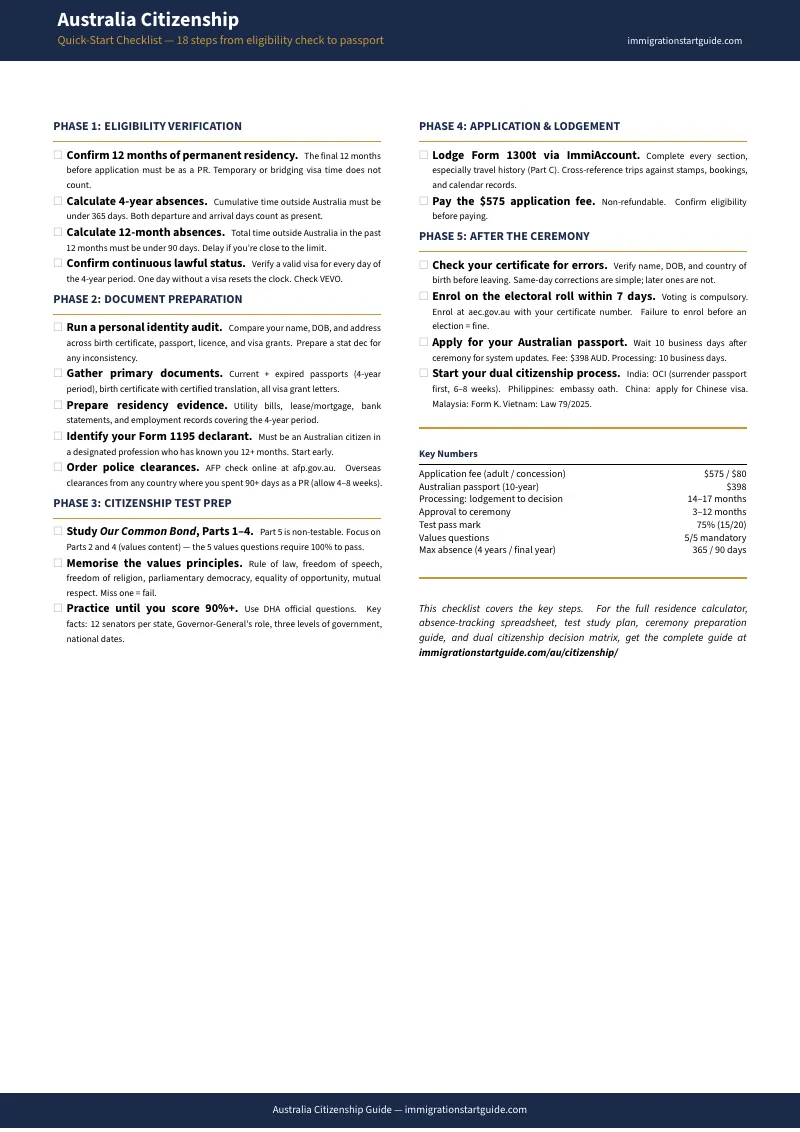
Download the free Quick-Start Checklist to verify your eligibility, count your absence days, and identify any document gaps today. When you are ready for the complete residency worked examples, dual citizenship roadmaps, test strategy, the 30-day post-ceremony action plan, and all 10 standalone worksheets, get the full Australia Citizenship Guide.