
The Migration Strategy System for a $100,000 Family Decision
Bringing a parent to Australia permanently is the most expensive, most confusing, and most emotionally charged migration pathway in the developed world. Government fees for the Contributory Parent Visa (Subclass 143) exceed $50,000 per parent. The non-contributory alternative has a 30-year queue. And migration agents charge $5,000 to $10,000 — on top of the government charges — for what is largely administrative work.
The Department of Home Affairs website tells you the rules. It does not tell you the strategy. It will not explain that applying for a 173 instead of a 143 could save your cash flow but cost you more in the long run. It will not warn you that your parent's controlled diabetes might trigger the $86,000 Significant Cost Threshold. It will not show you how to turn the 12–15 year queue into a savings window that makes the $43,600 second instalment manageable.
This is the guide that fills that gap — for the strategic decision framework that agents charge thousands for.
What's Inside
Every Visa Subclass Compared in One Decision Matrix
143, 103, 173, 804, 864, 870, 884 — each with different costs, wait times, bridging visa rights, and Medicare eligibility. The guide includes a pathway decision framework that maps your parent's age, your budget, and your timeline to the right subclass. No more guessing between a $50,000 contributory application and a 30-year non-contributory queue.
The Balance of Family Test — Worked Examples, Not Just Rules
The DHA website tells you the test exists. The guide shows you five worked examples with different family compositions — including step-children from former partners, children on temporary visas, and the edge case where a deceased child changes the calculation. You will know your result before you spend a dollar.
Assurance of Support Income Formulas You Can Actually Calculate
Services Australia publishes formulas based on JobSeeker Payment rates. The guide translates these into real 2026 numbers: approximately $58,000–$60,000 for a single sponsor, $85,000–$90,000 for a married sponsor with two children. It covers joint AoS arrangements with siblings, the two financial years tax rule that catches self-employed sponsors, and the exact bond amounts for Commonwealth Bank.
The $86,000 Health Threshold — A "Traffic Light" System for Common Conditions
No government resource tells you which conditions pass and which don't. The guide categorises common conditions into green (managed hypertension, controlled diabetes), amber (cancer in remission, stable heart disease), and red (dialysis, dementia, active TB). It explains the PIC 4007 health waiver that is available for parent visas but not skilled visas — and why private health insurance does not bypass the assessment.
The Complete Financial Roadmap and Savings Strategy
Total cost tables for every pathway, including the hidden costs agents don't mention upfront — health examinations, police clearances from every country lived in since age 16, document translations, and mandatory health insurance during the wait. Plus a savings strategy: lock in your queue position for approximately $5,000, then systematically accumulate the $43,600 second instalment over the 12–15 year processing period.
12-Step Application Process — From Eligibility Audit to Medicare Card
Every milestone, every form (47PA, Form 40), every document, every agency interaction — mapped in order with timing and dependencies. Covers the new April 2026 ImmiAccount online lodgment for Subclasses 143, 103, 864, and 804.
The Visitor Visa Bridge Strategy
How to use 3-year Subclass 600 visitor visas to keep your parents in Australia during the 12–15 year queue — without triggering a refusal for "lack of genuine temporary stay." When Condition 8503 applies, how to alternate parents on visitor visas, and when to consider the Subclass 870 temporary as an alternative.
Bridging Visa and Medicare Clarity
The single biggest source of confusion in parent visa forums. The guide explicitly maps which subclasses grant a Bridging Visa (804/864 onshore), which don't (143/103 offshore), and what this means for Medicare eligibility during the wait — correcting the misinformation that circulates on Reddit and Facebook groups.
Post-Grant Settlement Checklist
Medicare enrolment, Tax File Number, Seniors Card, My Aged Care registration, and the critical 10-year residency requirement for Age Pension. Your parents will not receive pension income for a decade after arrival — the guide ensures you plan for this.
International Comparison
Australia (143) vs Canada (PGP lottery + Super Visa) vs UK (Adult Dependent Relative — 4% success rate) vs New Zealand (income-based + $1M retirement visa). Context for the global parent migration landscape so you understand exactly what Australia's system offers and what it costs relative to alternatives.
Who This Guide Is For
- The sponsoring child who wants to file without an agent — your case is straightforward (clear Balance of Family, no criminal history, manageable health conditions) and you would rather put the $5,000–$10,000 agent fee toward your parents' settlement costs
- The informed client who plans to hire an agent — you want to understand every element of your case so you can evaluate your agent's advice and catch errors in a process where a single mistake costs $5,000 in non-refundable fees
- The planner in the early stages — you are comparing subclasses, calculating total costs, and trying to decide whether to start with the 143 or the 870 before committing real money
- The adult child managing guilt and logistics simultaneously — your parents gave you everything, and now you face a system that seems designed to make reunification as difficult as possible
Why Not Just Use Free Resources?
You can piece this together from the DHA website (rules without strategy), Services Australia pages (formulas without examples), and Reddit threads (experience without accuracy). Many families try. Most spend months on forums, accumulate contradictory advice, and still don't know which subclass to choose or whether their parent will pass the health test.
Migration agents charge $3,500 to $6,000 per application to answer these questions. For two parents, that is $7,000 to $12,000 — in a process where the government fees already exceed $100,000. This guide provides the same decision framework and strategic clarity at a fraction of the cost of a single agent consultation.
Your Purchase Is Protected
If the guide doesn't provide the strategic clarity you need, email us at any time for a full refund. No questions asked.
12 Printable Tools — Not Just a Guide
Your purchase includes the 74-page guide plus 10 standalone worksheets and reference cards you can print individually and use at every stage of the process:
- Visa Subclass Comparison — all seven parent visa subclasses on one page
- Pathway Decision Matrix — maps your age, budget, timeline, and location to the right subclass
- Balance of Family Worksheet — fillable form to count every child and calculate your result
- Cost Comparison Table — complete fee breakdowns for every pathway including hidden costs
- Health Traffic Light Reference — green, amber, and red conditions against the $86,000 threshold
- AoS Income Reference — bond amounts, income thresholds, and joint assurer rules
- Document Checklist — every document for both applicant and sponsor with checkboxes
- Timeline Planning Worksheet — 25-milestone tracker plus financial planning grid
- Post-Grant Settlement Checklist — Medicare, TFN, Seniors Card, My Aged Care, and the pension rule
- Contacts & Glossary Reference — every agency phone number and acronym on one page
Start Protecting Your Family's $100,000 Decision
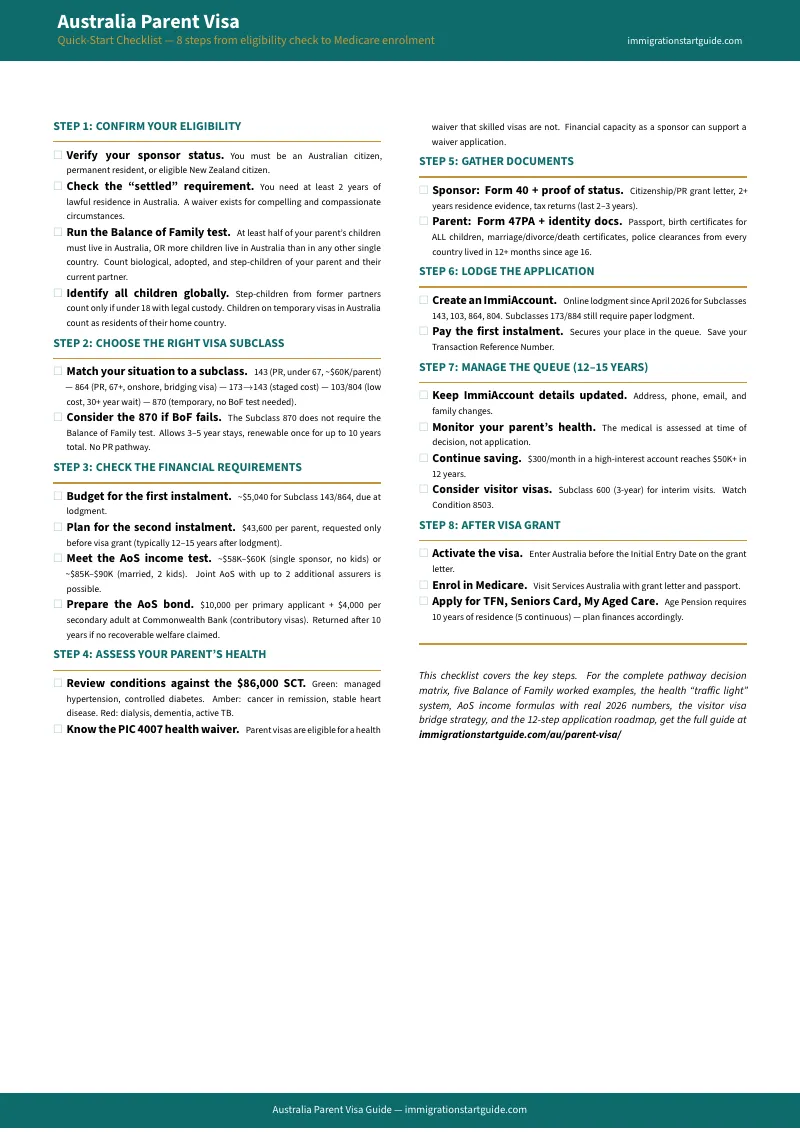
Download the free Quick-Start Checklist to confirm your eligibility and choose the right visa subclass today. When you are ready for the complete decision framework, financial roadmap, and step-by-step application process, get the full Australia Parent Visa Guide.