
The Evidence Engine for Australia's Most Elite Visa
You are in the top 5% of your field globally. You have the patents, the publications, the exits, or the executive track record. But when you sit down to write your Expression of Interest for the National Innovation Visa, you realize that being talented and proving you are talented to a government bureaucrat are completely different skills.
The Department of Home Affairs does not read your h-index the way your peers do. They do not understand why your Series B funding from Sequoia matters. They are processing thousands of EOIs against a planning allocation of just 4,300 places — and 93% of those EOIs are never invited.
Migration agents charge $6,000–$20,000 for the 858 visa. But an agent cannot invent your talent. They are dependent on the narrative you provide. Most 858 refusals are not legal errors — they are weak narrative framing. This guide gives you the system to frame your achievements in the language the Department actually responds to.
What Makes This Different: The Achievement Diagnostic System
Free government resources tell you that you need an "internationally recognized record of exceptional achievement." They cite Nobel Prize winners as examples. Then they leave you wondering whether your 15 patents and directorship at a Fortune 500 company qualify.
This guide replaces that ambiguity with sector-specific evidence benchmarks — the practical thresholds drawn from successful applications and community-reported outcomes. You will know exactly where you stand before you spend a dollar on fees or a minute on paperwork.
What's Inside
Sector-Specific Evidence Thresholds
Detailed breakdown of all 10 target sectors (DigiTech, Health, Energy, Renewables, Circular Economy, FinTech, Defence, Agri-food, Education, Infrastructure/Resources) with concrete examples of what "strong" looks like versus "borderline." For DigiTech: "CTO at a company with $20M+ ARR" clears the bar. "Mid-level developer at a large company" does not. Every sector gets this level of specificity.
The $183,100 Income Strategy
Three pathways to satisfy the Fair Work High Income Threshold — current earnings, Australian job offer, or "ability to attract." The PhD special pathway explained. Salary evidence package templates for professionals earning in INR, CNY, EUR, or GBP. What counts as income and what does not (spoiler: your stock options and performance bonus do not count).
Nominator Acquisition Framework
80% of successful offshore applicants had no personal connection to their nominator 12 months before applying. The ACS pathway for ICT professionals ($800 total). State government Registration of Interest programs. Cold outreach templates for LinkedIn. The "no-liability clause" — the one fact that turns a busy Australian executive from "no" to "sure, send me the form."
EOI Narrative Archetypes
Four proven narrative frameworks: The High-Value Entrepreneur, The Research Leader, The Technical Specialist, The Global Executive. Each archetype includes what evidence to lead with, how to structure the sovereign benefit argument, and common mistakes that trigger deprioritization. Before-and-after examples showing the difference between a CV dump (fail) and an impact dossier (success).
Priority Tier Intelligence
Ministerial Direction 112 creates a four-tier queue. Priority 1 gets invited in days. Priority 4 can wait 18 months. The guide explains exactly how the tiers work, where your profile likely sits, and specific strategies to move up — including state government ROI pathways that can elevate you from Priority 4 to Priority 2.
Processing Intelligence and Refusal Prevention
The 7 most common refusal patterns that account for the majority of unsuccessful applications. What S56 and S57 requests signal about your application. Realistic processing timelines by priority tier — not the government's published averages, but what the community actually reports.
Complete Document Checklist and Fee Breakdown
Every document for primary applicant, partner, and dependent children. Three cost scenarios: single applicant DIY ($6,000–$7,000), family of four DIY ($14,000–$17,000), family of four with agent ($20,000–$37,000). Health, character, and English language requirements mapped out step by step.
Standalone Planning Tools (Print-Ready PDFs)
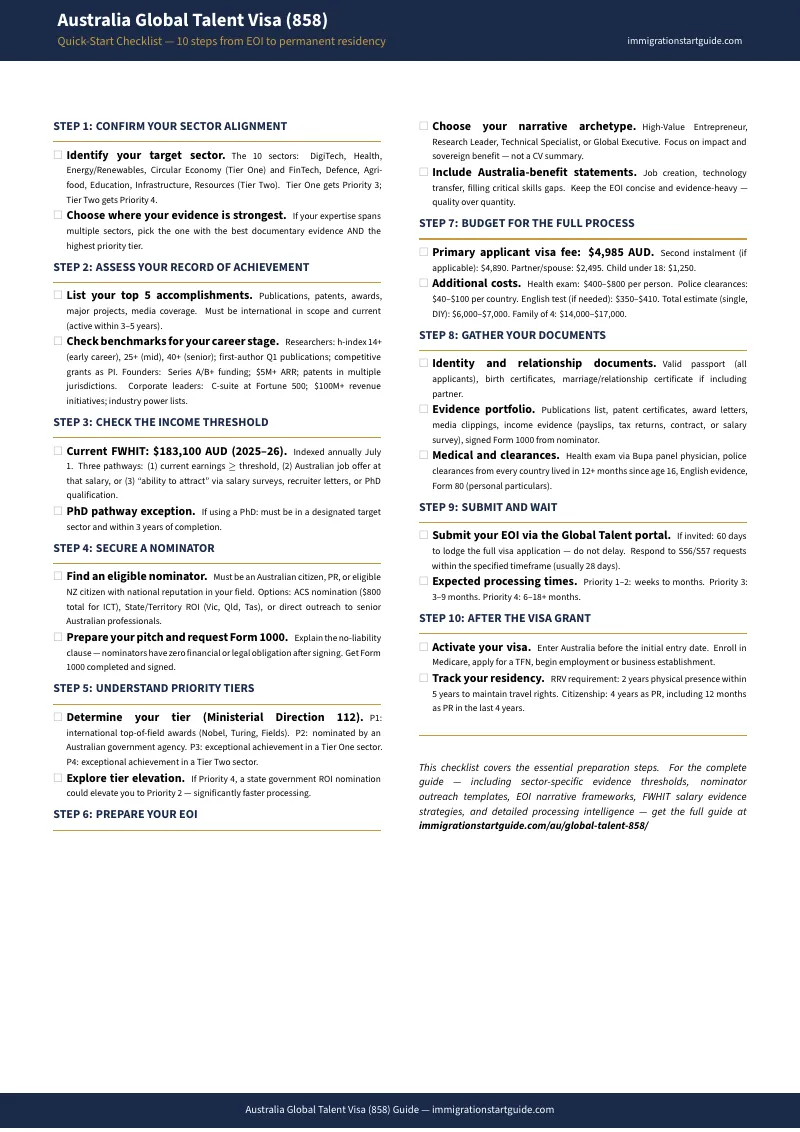
In addition to the 87-page guide and the Quick-Start Checklist, your download includes 5 standalone printable tools — designed to be printed, pinned to your wall, or carried to appointments:
- Evidence Audit Worksheet — Rate your evidence as Strong, Moderate, or Gap across 10 categories, with separate tables for academic researchers, tech founders, and corporate leaders
- Document Checklist — Every document needed for your visa application: identity, evidence portfolio, Form 1000, health, character, and family inclusion — with checkboxes and processing time estimates for police clearances by country
- Fee Breakdown Reference — All government fees, medical costs, ACS nomination fees, and three total cost scenarios on a single sheet
- Visa Comparison Card — Side-by-side comparison of the 858 vs 189 vs 190 vs 482 across 14 criteria, plus the priority tier breakdown with processing times
- Key Dates & Deadlines — Annual calendar of critical dates (FWHIT indexation, fee increases, state ROI rounds) plus application deadlines (60-day lodgement window, 28-day S56 response) with a fillable personal timeline tracker
Who This Guide Is For
- Senior tech professionals — engineers, architects, and AI researchers with 12+ years of experience evaluating whether DigiTech is the right sector claim
- Indian IT professionals — stuck in the 189/190 points-test backlog, looking for the direct PR pathway that does not depend on invitation rounds
- Funded startup founders — earning below the FWHIT because you reinvest in your company, needing the "ability to attract" strategy
- Academic researchers — strong publication records but salaries well below $183,100, navigating the PhD pathway and salary evidence requirements
- Healthcare specialists — navigating the intersection of professional registration, the Health Industries sector, and income evidence
- Corporate executives — "invisible experts" acclaimed in their niche but unsure how to frame executive leadership as "exceptional achievement" for a government assessor
Why Not Free Resources?
The Department of Home Affairs website gives you legal criteria. It does not give you strategy. It does not tell you that a single commercialized patent in Australia is worth more to an assessor than 50 academic citations in a vacuum. It does not explain why "senior software engineer" fails but "architect of a platform serving 2M users across 15 countries" succeeds — even when they describe the same person.
Reddit and forum threads give you lived experience. But most of that experience is from the 2020–2021 "Gold Rush" era, when 15,000 places were available and the bar was dramatically lower. Advice calibrated to 2021 standards will get your 2026 EOI ignored.
Migration agents give you legal compliance. This guide gives you the narrative strategy that makes the difference between being legally eligible and actually getting invited — two very different things when only 6.6% of EOIs result in an invitation.
The Guarantee
If the guide does not help you build a stronger application, email us and we will refund you. No time limit, no conditions. The cost of this guide is a rounding error compared to the $4,985 visa fee, the $6,000+ agent fee, or the opportunity cost of waiting 18 months in the wrong priority tier.
Start Building Your Evidence Strategy
Download the free Quick-Start Checklist to assess your readiness, or get the full guide and start building your evidence package today. The 2025-2026 program year has limited places — every month you delay is a month the bar potentially rises.