
Your Relationship Is Real. Your Evidence Portfolio Is What Gets Assessed.
You know your relationship is genuine. You live together. You share finances, holidays, and a future. But the Department of Home Affairs does not assess love — it assesses documentary evidence against a strict Four Pillars framework. And the gap between a genuine relationship and a bureaucratically compliant application is where partner visa refusals happen.
For most applicants, the base application charge is AUD $11,710. The Department generally does not refund it if your application is refused. Add health checks, police certificates, biometrics, NAATI translations, and other case-specific costs. Home Affairs stopped applying payment surcharges to card, PayPal, and UnionPay payments on 1 October 2026.
You have two options: pay a migration agent $3,000–$8,000 on top of the government fee, or navigate the process yourself using chaotic forum advice where one poster says 200 photos is enough and another says their joint bank account raised a red flag.
There is a third option.
The Four Pillars Evidence Architecture
This guide gives you the structural layer that sits between dangerous forum advice and a migration agent's compliance retainer — the evidence architecture that transforms your genuine relationship into the clinical, DHA-compliant narrative case officers actually assess.
Most DIY applicants fail not because their relationship is fake, but because they do not understand what the Department is looking for. They submit 200 selfies when the case officer wants 15 captioned photographs with third parties. They open a joint bank account two weeks before lodging when the Department wants 12 months of active, shared living expenses. They write emotional relationship statements when the DHA needs objective, structured evidence across four specific dimensions.
The Four Pillars Evidence Architecture is the translation layer — converting your lived reality into the language the Department of Home Affairs speaks.
What You Get
The Four Pillars Framework Decoded
Financial interdependence is not about having a joint bank account — an empty one opened before lodgement is a red flag, not a strength. The guide maps the evidence hierarchy for each pillar: what case officers weight heavily, what they dismiss, and what actively harms your application. You learn how to demonstrate a unified economic life through annotated bank statements, shared liabilities, and cross-transfer patterns — even with completely separate finances.
Form 888 Witness Coaching
The two required witness statements are one of the most common failure points. Form 888 is a supporting statement, not a statutory declaration. Witnesses write "They are very much in love" when the DHA needs "I attended their housewarming at 42 Smith Street in March 2024 and observed them jointly managing household expenses." The guide provides the exact briefing protocol: what witnesses should write, what they must avoid, and how to structure observations across all four pillars.
The Schedule 3 Trap
If you apply for an onshore 820 without holding a substantive visa, Schedule 3 criteria 3001, 3003, and 3004 generally apply unless the Minister is satisfied there are compelling reasons not to apply them. If you do not meet the applicable criteria and no exception applies, your application can be refused. The guide maps visa transition scenarios and identifies when Schedule 3 may apply to you.
Stage 2 (801) Maintenance Strategy
Most applicants stop collecting evidence after lodging the 820. Once two years have passed since you applied, you can submit updated relationship evidence for the permanent 801 assessment. The guide provides a month-by-month evidence collection protocol — no scrambling to reconstruct two years of proof at that point.
Cultural Workarounds for Cross-Cultural Couples
Filipino-Australian couples where financial commitment shows through remittances rather than joint savings. Indian-Australian couples where cultural norms preclude cohabitation before marriage. UK and US partners whose complacency leads to thin evidence despite genuine relationships. Latin American couples navigating the gap between "dating" and "de facto to the exclusion of all others." Each context receives specific evidence strategies that address the DHA's Western-centric framework.
The Complete Cost Architecture
The AUD $11,710 base charge for most applicants is the starting point. Bupa medical exams, AFP clearances, international police certificates, NAATI translations, dependent charges, and the contingency budget for a potential ART review are other cost considerations. Home Affairs no longer applies payment surcharges to card, PayPal, or UnionPay payments. You get the full financial planning framework so there are no surprises after you have already committed your savings.
Who This Guide Is For
- Couples whose temporary visa is expiring — if you apply while holding a substantive visa, you are generally granted a Bridging Visa A that comes into effect when that visa ends; work rights depend on the conditions attached to your bridging visa, and you cannot afford a weak application that triggers an RFI
- DIY applicants drowning in conflicting forum advice — you need a single authoritative framework that tells you what actually matters, not 47 Reddit opinions that contradict each other
- Cross-cultural couples whose evidence does not fit the standard template — you communicate across multiple platforms, your financial arrangements reflect cultural norms, or you live with extended family
- Couples who cannot justify $3,000–$8,000 for a migration agent — on top of the $11,710 base application charge for most applicants, you want to understand the Four Pillars well enough to manage the process yourself or hire an agent as an informed client
- Applicants approaching Stage 2 (801) eligibility — you stopped collecting evidence after lodgement and need a structured plan to prepare updated relationship evidence
- Form 888 witnesses — you have been asked to provide a supporting statement and have no idea what case officers actually look for
Why Free Resources Are Not Enough
The DHA website tells you to provide evidence of "financial aspects of the relationship." It does not tell you that an empty joint account is worse than no joint account. Reddit says 200 photos worked for one person — it does not mention that the same approach triggered an RFI for someone else because the photos were uncaptioned selfies with no third-party social proof.
Free forum advice gives you fragments. Etsy checklists tell you what documents to gather but not how to structure them into a persuasive narrative. Migration agents at $5,000+ provide compliance and lodgement — but even with an agent, you still gather every piece of evidence yourself.
This guide provides the strategic layer: the evidence architecture that tells you what to include, what to leave out, how to sequence the narrative, and how to address the specific evidentiary gaps in your situation — whether that is separate finances, no joint lease, cultural communication patterns across multiple platforms, or a long-distance period you need to account for.
The Guarantee
The Department generally does not refund the visa application charge if your application is refused. If your refusal notice gives you review rights, the ART fee for most migration reviews is AUD $3,727, with a 50% reduction available for financial hardship. For partner reviews finalised from 1 April to 30 September 2026, 50% of cases were finalised within 3 years and 1 month. For a fraction of a single consultation with a migration agent, you get the complete Four Pillars evidence framework — the structural blueprint that 65% of ART appellants wish they had before their first lodgement.
If the guide does not give you a clear, actionable evidence strategy for your specific situation, email us for a full refund, no time limit. No questions, no conditions.
Standalone Printable Tools
In addition to the 12-chapter guide, your download includes four standalone PDFs designed to be printed and used independently:
- Form 888 Witness Guide — Print this and hand it to each of your Form 888 witnesses before they start writing. Covers the Four Pillars framework, example phrases for each pillar, and a clear list of what to write and what to avoid.
- Relationship Statement Template — The section-by-section structure both applicant and sponsor follow when writing their personal statements. Keep it beside you while drafting.
- Complete Document Checklist — Every document required for the 820/801 application, organised by Four Pillars category. Print it, check off each item as you gather it.
- Evidence Maintenance Schedule — Post this on your fridge. Monthly, quarterly, and six-monthly actions that keep your evidence portfolio decision-ready during the two-year period before Stage 2 eligibility.
Two Ways to Start
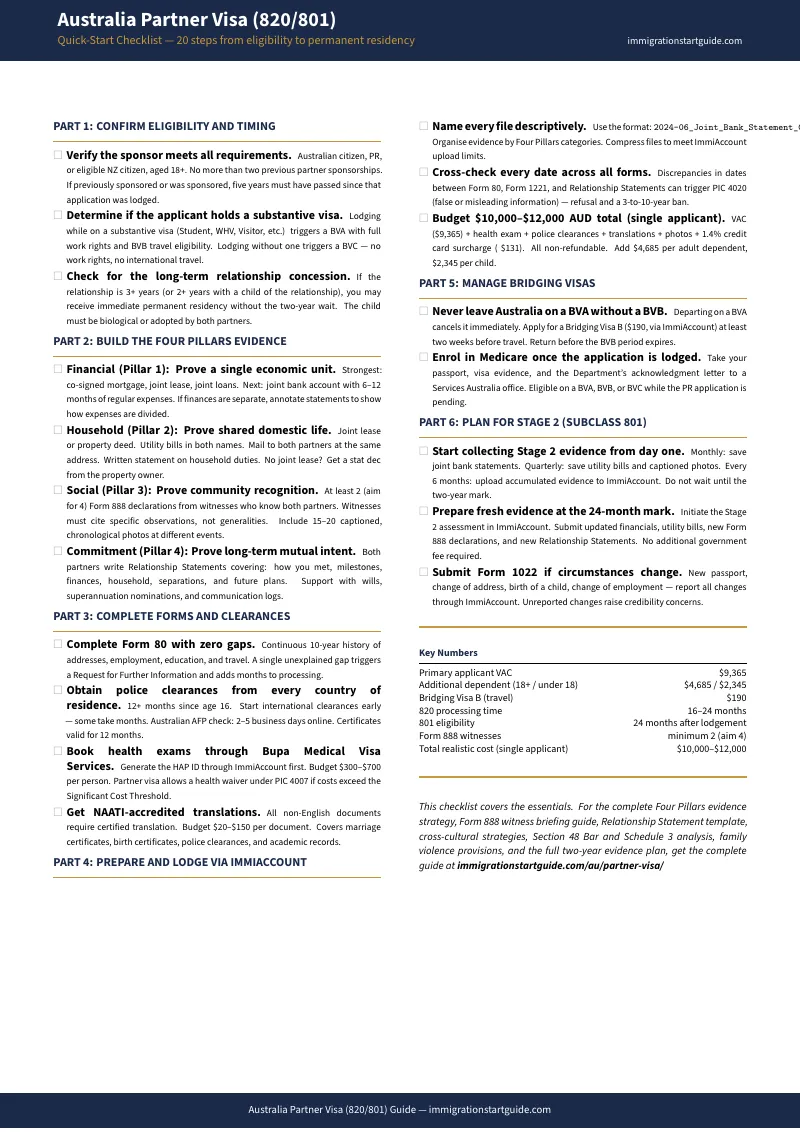
Download the free Quick-Start Checklist — the 20-point action plan covering eligibility verification, Four Pillars evidence essentials, ImmiAccount lodgement steps, and Stage 2 preparation. It gives you the structure to begin organising your application immediately.
Or get the full Australia Partner Visa (820/801) Guide — 12 chapters covering the complete Four Pillars evidence architecture, Form 888 witness coaching, Schedule 3 analysis, bridging visa management, cultural workarounds, the Stage 2 maintenance strategy, and relationship statement templates, plus 4 standalone printable tools (Form 888 Witness Guide, Relationship Statement Template, Complete Document Checklist, Evidence Maintenance Schedule). Everything you need to file with confidence instead of anxiety — for , about 1.1% of the AUD $11,710 base charge at the Australian price.
Frequently Asked Questions
What if the rules change after I buy?
We update the guide when the rules change. Email us any time, even years later, and we'll send you the current edition free.