
You Are About to Spend $80,000 on a Degree That Gets 40% of Applicants Refused Before They Arrive. This Guide Makes Sure You Are in the Other 60%.
You have been researching Australian universities for months. You have compared tuition fees, checked city rankings, read every Reddit thread on r/AusVisa about the Genuine Student test, and watched YouTube videos titled "Best Courses for PR in Australia 2026" from creators who get paid by the institutions they recommend. Your education agent sent you a shortlist of programs at three partner universities. You are ready to pay the deposit and lodge your student visa application.
But here is the question nobody around you can answer with certainty: when you sit down at your ImmiAccount portal and type your four Genuine Student responses — each capped at exactly 150 words — will your answers survive the most aggressive visa assessment regime Australia has deployed in two decades? Because between January and March 2026, 40-42% of Indian student visa applicants were refused. Nepal hit 73% refusals in March alone. Bangladesh sat at 45-51%. And the visa application fee — AUD $1,600 to $2,000 — is non-refundable whether you are approved or not.
This is not a temporary crackdown. The Department of Home Affairs reclassified India, Nepal, Bangladesh, and Bhutan to Evidence Level 3 — the highest risk category — under the Simplified Student Visa Framework. The old Genuine Temporary Entrant statement is gone, replaced by a four-question Genuine Student test where case officers cross-reference every sentence you write against your uploaded financial documents, your prior visa history, and whether your chosen course is available domestically at a fraction of the cost. Meanwhile, the Subclass 485 Temporary Graduate visa fee doubled overnight to AUD $4,600 as of March 2026. The age cap dropped from 50 to 35. The English threshold rose to IELTS 6.5. And the COVID-era post-study work extensions are permanently abolished.
Your education agent cannot navigate this for you. They are paid commission by the universities they enrol you at — their incentive is filling seats at partner institutions, not verifying whether your degree maps to a CSOL-listed ANZSCO code that enables state nomination. A Registered Migration Agent charges AUD $2,000 to $5,000 for end-to-end lodgement. A generic YouTube video from 2024 tells you about post-study work extensions that no longer exist.
The Australia Student Visa (500) + Post-Study Work Guide is built around one principle: every course choice is a permanent residency decision. It maps the full pipeline — from GS test response architecture through CSOL-aligned course selection, 485 stream eligibility, regional extension strategy, skills assessment timelines, and the complete points test breakdown — so that the $80,000+ you invest in an Australian degree actually terminates in permanent residence, not in a flight home with family debt and nothing to show for it.
What's Inside
The complete 13-chapter guide, a 20-item quick-start checklist, and 6 standalone printable tools — covering every stage from choosing the right course through securing permanent residence:
The Genuine Student Test Architecture
How to write all four 150-word GS responses using the Claim-Evidence-Outcome framework without triggering AI detection flags or sounding like a copy-paste template. The guide covers each question individually — current circumstances, course and provider choice, course benefits, and other relevant information — with specific structural guidance for applicants from Evidence Level 3 countries. Case officers are cross-referencing your narrative against your financial documents in real time. If your GS response claims family business wealth but your bank statements show a newly opened account with an unexplained deposit, the refusal is automatic. This chapter teaches you how to make every sentence defensible.
The CSOL-Aligned Course Selection Matrix
Instead of choosing a course and hoping it leads somewhere, you start from the end: which ANZSCO code do you want a positive skills assessment for? The guide maps the 2026 Core Skills Occupation List — 456 occupations across three priority pillars (healthcare, construction/trades, digital technology) — against actual degree programs, so you can trace a line from your first day of class to your permanent residence application. A Bachelor of Nursing maps to ANZSCO 254499 and consistently receives PR invitations at 75-80 points. A generic business management diploma maps to nothing and is increasingly treated as a red flag during the GS assessment. This framework prevents the single most expensive mistake in Australian immigration — spending $80,000 on a degree that blocks your PR pathway.
The Subclass 485 Survival Guide
The March 2026 fee doubling, the age 35 cut-off, the IELTS 6.5 requirement with a 12-month validity window, the two renamed streams (Post-Vocational Education Work and Post-Higher Education Work), the six-month application deadline that runs from your completion letter — not your graduation ceremony — and the Australian Study Requirement trap where falling one week short of 92 CRICOS weeks makes you permanently ineligible. The guide covers every eligibility criterion with specific deadlines and fee amounts, because a single miscalculation on the AUD $4,600 application means forfeiting the fee with no recourse.
The AI-ECTA Advantage for Indian Graduates
Under the Australia-India Economic Cooperation and Trade Agreement, Indian passport holders receive extended post-study work durations: 3 years for a Bachelor's with First Class Honours in STEM, 3 years for any Master's degree, and 4 years for a PhD — one full year more than graduates from other countries in the same streams. The guide details the exact eligibility criteria and how to leverage this extra runway to complete skills assessments, accumulate Australian work experience points, and target state nomination before your visa expires.
Regional Strategy and the Second 485 Visa
How studying in a Category 2 postcode (Perth, Adelaide, Hobart, Canberra, Gold Coast) adds one year to your 485 duration and +5 bonus PR points, while Category 3 postcodes add two years. How maintaining continuous regional residence qualifies you for a second 485 visa — buying one to two extra years of work rights that metro graduates never get. And how regional state nomination through the Subclass 491 injects +15 bonus points into your profile, neutralising the 90-95 point barriers that make the Subclass 189 functionally inaccessible for most graduates.
The Full Financial Architecture
Every fee from student visa application (AUD $1,600-$2,000) through OSHC, living costs (AUD $29,710 minimum for a single student), skills assessment fees ($335-$1,136 depending on the assessing body), 485 application ($4,600), and PR application — totalling significantly more than tuition alone. Plus the financial evidence strategy: why six to twelve months of consistent savings history matters, why lump-sum deposits trigger refusals, and how to document sponsor funds so that case officers see stability rather than fabrication.
Skills Assessments and the Points Test
Which assessing body covers your occupation (ACS for IT, Engineers Australia for engineering, ANMAC for nursing, VETASSESS for trades and generalist roles), their exact fees, realistic processing times (8-20 weeks), and what to prepare during your studies rather than scrambling after graduation. The points test chapter maps realistic invitation thresholds by occupation — 75-80 for nursing, 85-90 for engineering, 90-95+ for IT and accounting — and explains why state nomination (Subclass 190: +5 points) and regional nomination (Subclass 491: +15 points) are the practical paths for most graduates, not the hyper-competitive Subclass 189.
When Things Go Wrong: Refusal Recovery
Common refusal triggers under Clause 500.212 — the home-country study clause, the predictive ROI assessment, financial evidence inconsistencies, and PIC 4020 for false or misleading information (which carries a three-year ban from all Australian visas). The guide covers what to do after a refusal: how to request your assessment notes, what can be addressed through reapplication, and when you need a migration lawyer for Administrative Appeals Tribunal review.
Who This Guide Is For
- International students choosing an Australian program for 2026 or 2027 intake — you need to verify your course maps to a CSOL-listed occupation before paying the tuition deposit, not after you have spent three years and $80,000 on a degree that leads nowhere
- Students from India, Nepal, Bangladesh, Pakistan, Sri Lanka, or the Philippines facing 35-73% refusal rates — you need the GS test response architecture and financial evidence strategy that addresses the specific refusal grounds case officers use for Evidence Level 3 countries, not a generic template
- Families investing $40,000-$120,000 in a child's Australian education — you need to understand whether the program your agent recommended actually maps to CSOL, leads to a positive skills assessment, and has a realistic shot at state nomination, or whether it is a seat the agent earns commission on
- Students already in Australia preparing for the 485 application and the PR transition — you need the skills assessment timeline, the points test targeting strategy, and the state nomination breakdown to convert your graduate visa into permanent residence before it expires
- Anyone who has already been refused a student visa or 485 application — you need the refusal recovery framework, the Clause 500.212 analysis, and the reapplication strategy to identify exactly what went wrong and fix it
Why Not Free Resources?
- Your education agent is paid commission by the universities they enrol you at. They recommend programs at partner institutions that pay the highest commissions, not programs whose ANZSCO codes have the lowest PR point thresholds. The guide has no institutional partnerships. Every recommendation traces directly to the 2026 CSOL and actual state nomination data.
- Registered Migration Agents and lawyers provide legally sound, individualised advice for AUD $2,000 to $5,000 per application. They are essential for complex cases involving prior refusals, PIC 4020 exposure, or AAT review. But for the strategic planning layer — which course to choose, which city to study in, how to time your skills assessment and target state nomination — most consultants assume you have already made the right academic choice. This guide covers the strategic foundation that comes before the lawyer's involvement, at a fraction of the cost.
- YouTube creators and influencers build audiences by sharing their personal "Journey to PR" stories. Their content is emotionally compelling but algorithmically fragmented — you cannot synthesise a multi-year strategic pipeline from 60-second shorts and 10-minute vlogs. And a viral video from 2024 recommending 485 extensions that no longer exist will actively harm your application if you follow it in 2026.
- WhatsApp and Telegram groups spread panic faster than they spread accuracy. Every refusal story gets amplified. Every policy change spawns contradictory interpretations. The guide gives you the actual regulatory framework so you can evaluate what you read in these groups rather than reacting to it.
— Less Than One Day's Tuition
A single year of Australian university tuition costs AUD $20,000 to $50,000. A Subclass 500 visa application costs AUD $1,600 to $2,000 and is non-refundable. A Subclass 485 application costs AUD $4,600 and is non-refundable. A Registered Migration Agent charges AUD $2,000 to $5,000 for end-to-end lodgement. And if the wrong course choice means three years of tuition with no PR pathway at the end, the total loss is $80,000 to $120,000 — plus the family debt that does not care whether you passed the Genuine Student test.
This guide does not replace a migration lawyer for complex legal situations, PIC 4020 exposure, or AAT review proceedings. But it provides the strategic planning system — the GS test frameworks, the CSOL course mapping, the 485 eligibility verification, the regional strategy, the points test targeting — that prevents the upstream mistakes which make downstream legal intervention necessary in the first place.
If it saves you from enrolling in one CSOL-misaligned program, from one GS response that triggers an AI-detection flag, or from one missed deadline on the AUD $4,600 graduate visa, it pays for itself before you finish Chapter 2.
Money-back guarantee, no time limit. If the guide does not make your Australian immigration pathway clearer, you pay nothing.
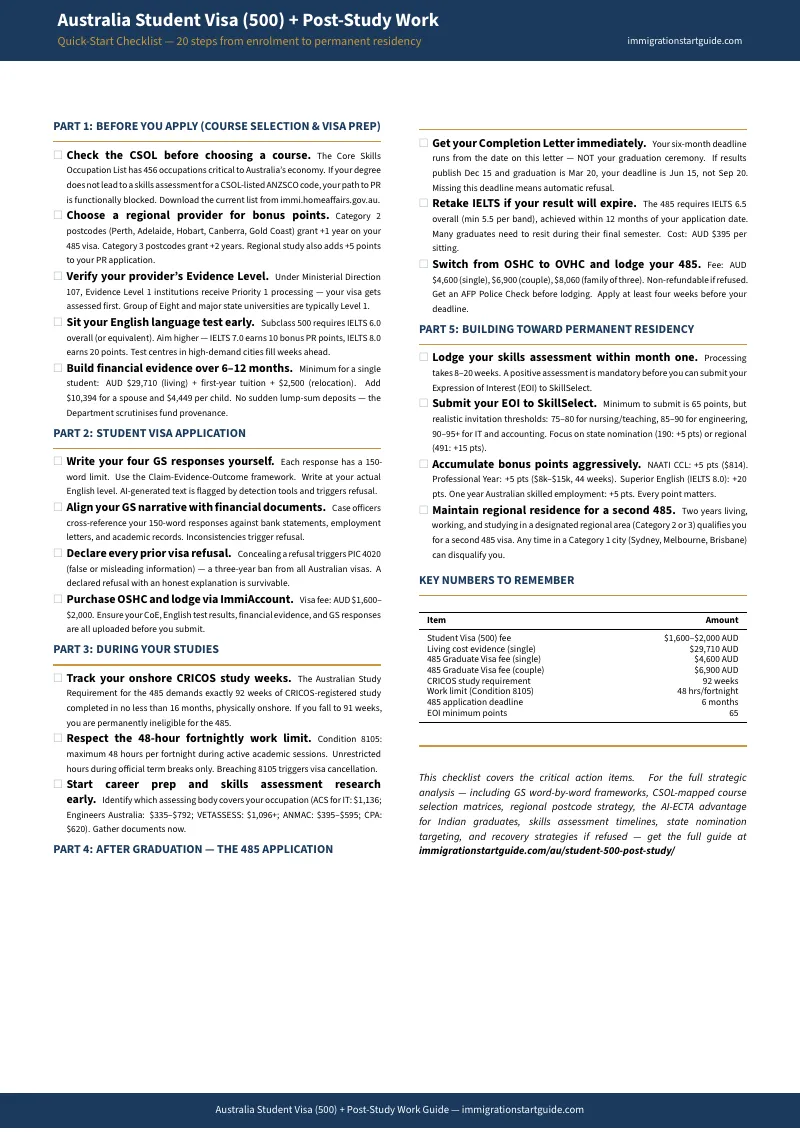
Download the free Quick-Start Checklist to see the 20 highest-stakes action items across five phases — from CSOL verification through Expression of Interest submission. When you are ready for the complete strategic planning system, the GS test architecture, the CSOL course matrix, and the full study-to-PR timeline, the guide is here.
Australia is still granting student visas and permanent residence. It is just no longer granting them to people who guess. This guide makes sure you do not have to.