
You Scored 70 Points. The System Needs You at 85. The 491 Closes That Gap in One Move.
You ran the points calculator. You came up with 70 — maybe 75 if you push your English score. Then you checked the SkillSelect invitation rounds: the Subclass 189 invited software engineers at 95 points. Your occupation sits on the Short-term Skilled Occupation List, which means the 189 is not even available to you. The 190's 5-point boost brings you to 75 — still invisible in NSW or Victoria.
You are not underqualified. You are applying for the wrong subclass.
The Subclass 491 adds 15 points through state or territory nomination — the largest single injection in the entire points system. Your 70-point profile becomes 85. Your 65-point profile becomes 80. You go from mathematically excluded to actively competitive, in a single move. And the "regional" designation that makes this possible? It includes Perth (population 2.1 million), Adelaide, the Gold Coast, Canberra, and Hobart. Not farms. Cities.
The Regional Pathway Navigator
This is not a generic "Australian PR checklist" that bundles the 189, 190, and 491 into one document and hopes you figure out which applies. Those products dedicate pages to pathways that are statistically impossible for candidates in the 65-75 point range.
The Australia Skilled Work Regional Visa (491) Guide is built exclusively around the regional pathway — the one that actually works for your points profile. It maps the complete journey from identifying your strongest state to transitioning into unconditional permanent residency via the Subclass 191, covering every strategic decision, compliance requirement, and myth that the government portals leave unanswered.
What's Inside
- The 15-point mathematics decoded — why the 491's state nomination bonus transforms candidates that the 189 and 190 ignore, and the precise comparison showing when the 491 is your only viable pathway versus when you should target the 190 instead
- All eight state nomination programs broken down for the 491 stream — Western Australia's 2,200-place allocation with 65-point minimum invitations and offshore pathways, South Australia's exclusive ICT-to-491 funnel (42/42 ICT invitations in March 2026 went to the 491, zero to the 190), Queensland's $100K small business owner route to the Gold Coast, Tasmania's priority pass system, and five more jurisdictions analysed by occupation, points, and onshore/offshore eligibility
- The family-sponsored stream as an alternative — eligible relatives, federal invitation rounds, and the decision framework for choosing between state nomination and family sponsorship
- The SkillSelect EOI strategy that most applicants get wrong — the multiple-EOI approach for targeting several states simultaneously, why selecting "Any" as your preferred state disqualifies you in some jurisdictions, Date of Effect rules, and how EOI updates reset your queue position
- Skills assessment navigation by assessing authority — the ACS experience deduction trap that strips 2-6 years from ICT applicants, Engineers Australia CDR requirements, VETASSEV specificity mandates, and the validity-gap timing that causes nominations to expire before lodgement
- The 60-day application sprint — from invitation to lodgement, the front-loading protocol for evidence assembly: NAATI translations, DHA medicals, police clearances from every country of residence, employment evidence, and the Section 56 pre-emption strategy that avoids the most common delays
- Regional living realities for professionals — cost of living comparisons (Perth and Adelaide apartments cost 30-40% less than Sydney with comparable salaries), school fee exemptions for 491 dependents in five states, Medicare eligibility from day one of visa grant, and the career markets in ICT, engineering, healthcare, construction, and hospitality
- Visa Condition 8579 — what it actually restricts — geography only. You can change employers, switch industries, work part-time, or launch a business. The condition mandates where you live, not what you do for a living
- The 3-year transition to the permanent Subclass 191 — the abolished income threshold (the dollar amount on your ATO Notice of Assessment is irrelevant), the geographic compliance evidence protocol, the three-year holding period calculation, and the systematic tracking approach from day one
- Relationship breakdown protections — if your partnership ends during the provisional period, both the primary and secondary applicant retain independent eligibility for the permanent 191 visa
- The complete cost envelope — visa application charges ($4,910 primary), state nomination fees by jurisdiction, skills assessment fees by authority, English testing, medical exams, police clearances, NAATI translations, and realistic total budgets for singles ($6,500-$8,000) and couples ($10,000-$13,000)
- Contingency pathways — what to do if your 491 application stalls, including pivoting to the 190, employer sponsorship under the 482/494 framework, and reapplication strategies
Who This Is For
- IT professionals, engineers, and managers scoring 65-75 points — the 189 requires 90+. The 190's 5-point boost is not enough. The 491's 15-point injection is the only pathway that makes your profile competitive
- Applicants whose occupation is on the STSOL or Regional Occupation List — the 189 is unavailable to you. The 491 accesses the broader Combined List, and specific states are actively nominating your occupation
- Onshore graduates on a 485 visa approaching expiration — the 491 provides the fastest route to a viable permanent residency pathway through broader occupation access and higher state allocations
- Offshore applicants in Singapore, the Philippines, India, or the Middle East — Western Australia and South Australia maintain specific offshore pathways for the 491, with WA frequently waiving employment contract requirements for critical occupations
- Anyone who dismissed the 491 because "regional" sounded rural — Perth, Adelaide, and the Gold Coast are regional for migration purposes. The guide provides the salary data, housing costs, and city profiles that reframe the 491 as a lifestyle upgrade
Why Not Just Use Free Resources?
The Department of Home Affairs publishes the rules. Reddit threads debate them. Migration agent blogs summarise them. But none of these sources deliver the strategic layer.
The DHA website tells you that eight states nominate for the 491. It does not tell you that South Australia is exclusively funnelling ICT professionals into the 491 stream, or that Western Australia issues invitations at 65 points for offshore trades applicants, or that Queensland's small business owner pathway lets you bypass the occupation list entirely with a $100K investment on the Gold Coast.
Generic Australian PR checklists bundle the 189, 190, and 491 together, dedicating pages to the 189 — a pathway that is statistically impossible for candidates with 65-75 points. They sell strategy for a visa you will never receive.
Migration agents charge $4,000-$6,000 AUD for application management. They are essential for complex cases — character concerns, health waivers, prior refusals. But they are not structured to deliver the comparative analysis of which state gives your specific occupation, points, and circumstances the highest probability of 491 nomination. That strategic layer is what determines whether you spend six months waiting for an invitation or eighteen.
This guide gives you that strategic layer. Either use it to manage the process yourself, or walk into your agent's office as a client who already knows which state to target and why.
The Income Threshold Is Gone. The Path to PR Has Never Been Clearer.
The Department of Home Affairs abolished the minimum income requirement for the Subclass 191 permanent visa transition. Previously, 491 holders lived in constant anxiety that a redundancy, a career change, or a slow business year could permanently derail their permanent residency application.
That fear is gone. You provide three ATO Notices of Assessment across three financial years to prove economic participation. The dollar amount on those assessments is irrelevant to the visa outcome. You can earn $30,000 or $130,000. You can work part-time while studying. You can launch a startup that does not turn a profit in year one. Your pathway to permanent residency is secured by geographic compliance and tax lodgement — not by maintaining a salary you cannot control.
The guide maps this transition step by step, including the evidence protocol, the compliance tracking system, and the timeline calculations that let you plan your permanent residency application from the moment your 491 visa is granted.
— Less Than a Single Hour With a Migration Agent
A one-hour initial consultation with a registered migration agent costs $150-$300 AUD. The full application management fee runs $4,000-$6,000 AUD. Government visa charges alone exceed $4,910 for the primary applicant.
This guide gives you the complete strategic framework — which state to target, how to structure your EOI, what evidence to front-load, how the regional commitment works, and exactly what the 191 transition requires — so you can invest those thousands wisely, whether that means self-managing or hiring an agent who executes what you have already decided.
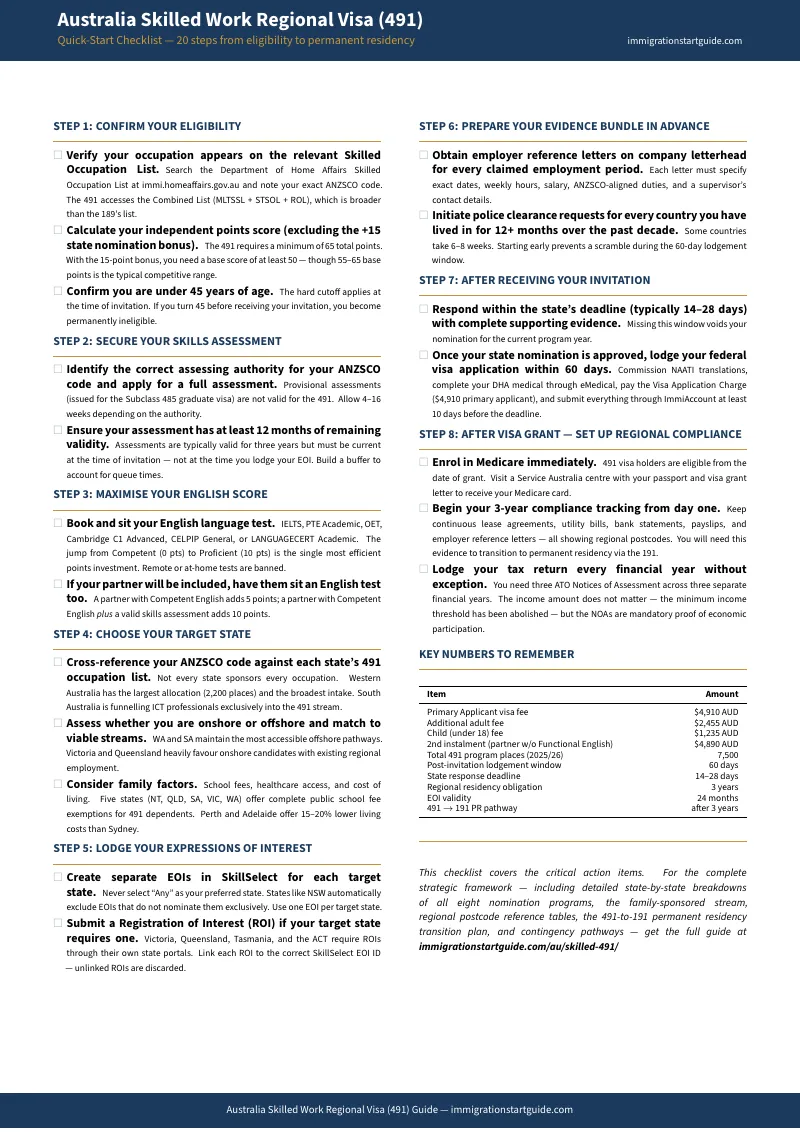
Includes 8 standalone printable tools alongside the guide: a points calculator worksheet, state nomination comparison matrix, state decision worksheet, 60-day application sprint checklist, document preparation checklist, fee calculator, regional postcode reference card, and a 3-year compliance tracker for the 491-to-191 permanent visa transition. Plus a free Quick-Start Checklist — the 20 critical action items distilled into a single reference sheet.
Satisfaction guarantee, no time limit. If the guide does not deliver the strategic clarity you need for your 491 pathway, email [email protected] for a full refund. No questions.