
You Scored 75 Points. The Pass Mark Is 65. You Are Not Even Close to an Invitation. This Guide Shows You Exactly How the Algorithm Works — and How to Beat It.
You ran the Department of Home Affairs points calculator. You scored 75 — ten points above the legislative minimum of 65. You assumed you were competitive. Then you checked the SkillSelect invitation round data.
Software Engineers: invited at 95 points. Accountants: 100. ICT Business Analysts: 95. Your 75-point Expression of Interest is not borderline. It is invisible. And the quarterly invitation calendar means you now wait three months to discover whether your score has become even less competitive as higher-scoring applicants pile into the queue above you.
You go to r/AusVisa. Someone says the Australian Computer Society deducted four years of their work experience — wiping out 10 points they thought they had. Another poster claims their Date of Effect reset when they updated their English score, sending them behind candidates who scored lower but submitted earlier. A third person says their occupation ceiling was exhausted in the first quarterly round and no more invitations were issued for the entire program year. Everyone has a theory. The Department publishes the rules but not the strategy.
You consider a MARA-registered migration agent. They quote $3,300 to $7,950 AUD. But agents handle compliance — filling forms, certifying documents, lodging the application. They are not in the business of telling you that the four-tier multiplier means a Tier 1 nurse at 65 points is prioritised over a Tier 4 software engineer at 90, or that the FOI-disclosed ceiling formula gives your niche engineering role the same 500-invitation cap as a cohort ten times your size, or that submitting your EOI two weeks early at 90 points instead of waiting for a 95-point NAATI result would have locked in a Date of Effect that actually got you invited.
The Australia Skilled Independent Visa (189) Guide is a Points Optimization System — the strategic architecture that sits between the Department's impenetrable data and a migration agent's $4,000+ compliance retainer. It transforms scattered government rules, FOI disclosures, occupation ceiling formulas, and community anecdotes into a mathematically precise campaign to maximise your points, optimise your timing, and secure an invitation.
What's Inside the Points Optimization System
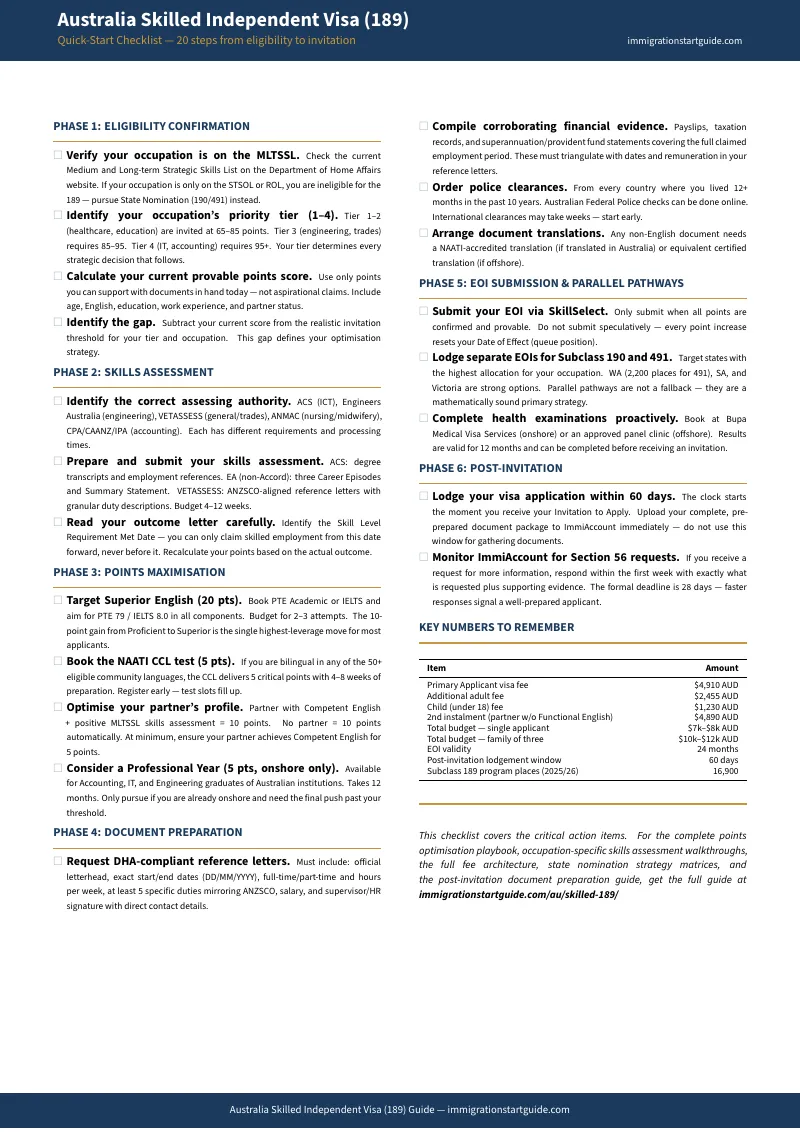
The complete kit includes the 12-chapter guide, the 20-step quick-start checklist, and 5 standalone printable tools — a points calculator worksheet, a four-tier reference card, a document preparation checklist, a state nomination reference card, and a fee calculator worksheet. Everything you need to plan, optimise, and execute your Subclass 189 application.
The Four-Tier Invitation Decoder — the 2025/2026 program year replaced pure points-based ranking with a four-tier occupation prioritization model. The guide maps every ANZSCO code to its priority tier, explains the multiplier formula disclosed through FOI request FA 26/01/00545, and shows you the realistic invitation threshold for your specific occupation — not the theoretical pass mark the Department publishes. Tier 1 healthcare professionals receive invitations at 65 points. Tier 4 IT professionals need 95+. If you are planning your entire strategy around a 65-point pass mark, you are planning around the wrong number. The standalone Tier Reference Card puts this data at your fingertips in a single printable page.
The Points Matrix Optimizer — every lever, every interaction effect, every edge case. Moving from Proficient English (IELTS 7.0 / PTE 65) to Superior English (IELTS 8.0 / PTE 79+) delivers a 10-point swing — the single highest-leverage move for most applicants. The NAATI CCL test yields 5 critical points without additional study or work experience. Partner points can add 10 — but only if the partner's assessment, English score, and age all satisfy specific thresholds that most applicants misconfigure. The guide maps every point category with the exact combination logic that the DHA points calculator does not reveal. The fillable Points Calculator Worksheet lets you calculate your actual score, identify your gap, and prioritise the optimization moves that close it fastest.
The Skills Assessment Navigator — authority-by-authority execution guides for the five major assessing bodies, each with different frameworks, evidentiary standards, and fatal error modes:
- ACS (ICT) — the deduction trap that systematically removes 2 to 6 years of your work experience, and the critical rule that claiming those deducted years on your EOI triggers visa refusal under PIC 4020. The guide shows you exactly which years are legally claimable and how to calculate your real points after the outcome letter arrives
- Engineers Australia — the Competency Demonstration Report structure that defeats plagiarism detection, the fatal "we did this" narrative error, the 16-competency Summary Statement mapping, and the $250 Fast Track option that compresses processing from 15 weeks to 20 business days
- VETASSESS / TRA — the specificity mandates for reference letters that mirror ANZSCO dictionary duties, statutory declaration templates for when corporate HR refuses custom letters, and the documentary precision that separates approvals from rejections
- ANMAC — nursing and midwifery pathway requirements, English test alternatives, and the modified skills assessment process for registered nurses and midwives
- CPA / CAANZ / IPA — accounting assessment pathways, the membership requirement, and the Professional Year interaction for onshore graduates
The SkillSelect Timing Engine — Date of Effect mechanics decoded. When two Software Engineers both score 95 points, the one who reached 95 first receives the invitation. But every point increase resets your Date of Effect, sending you to the back of the queue for the new bracket. The guide provides the analytical framework for the most consequential decision in the 189 process: submit now at a lower score with an earlier Date of Effect, or wait for additional points and risk losing months of queue time. The answer depends on your occupation's ceiling depth, the tier multiplier, and the quarterly round calendar — and the guide gives you the data to calculate it.
The Dual-Pathway Hedge — relying solely on the 189 is strategically negligent for Tier 3 and Tier 4 applicants. The guide structures concurrent Subclass 190 (state nomination, +5 points) and Subclass 491 (regional, +15 points) EOIs as parallel campaigns. Western Australia allocated 2,200 regional places versus Victoria's 700. South Australia targets healthcare and engineering. NSW operates opaque cut-offs for IT and finance. The guide maps the state-by-state allocation trends, explains how to manage separate EOIs without one undermining another, and covers the 491-to-191 permanent transition pathway. The State Nomination Reference Card puts the pathway comparison and state allocation data on a single printable page.
The Section 56 Defence Protocol — securing an invitation is the transition from strategy to legal scrutiny. An S56 request is not a refusal — it is a warning that your application is structurally deficient. The guide covers the front-loading protocol that pre-assembles every document before the invitation arrives, the strict 28-day S56 response deadline, the evidence standards for partner points claims that trigger the most intense scrutiny, and the specific documentary gaps (missing police checks, incomplete health exams, uncertified translations) that most commonly trigger S56 requests. The printable Document Checklist covers every document category across eight sections — so you can tick off each item as you gather it and lodge a complete application the moment your invitation arrives.
DHA-Compliant Employment Evidence Architecture — the evidence triangulation framework that combines reference letters, payslips, tax records, and superannuation statements into a portfolio that withstands case officer scrutiny. Includes templates for statutory declarations when corporate HR refuses custom reference letters, and the specific format requirements (DD/MM/YYYY dates, hours per week, ANZSCO-aligned duties) that prevent overclaiming allegations.
The Complete Fee Architecture — every cost for singles and families, broken down with no surprises. The $4,640 primary applicant visa charge. $2,320 per adult dependent. $1,160 per child. Skills assessment fees by authority ($550–$1,000+). English test costs ($350–$415 per attempt). Health examination fees ($400–$700). Police clearances across jurisdictions. The second instalment charge of $5,890 per adult dependent without functional English. The fillable Fee Calculator Worksheet lets you enter your specific situation — family size, number of test attempts, jurisdictions — and calculate your total investment before you commit a dollar.
Who This Guide Is For
- You scored 70–80 points and assumed you were competitive. Then you discovered your Tier 4 occupation requires 95+. You need a systematic plan to close a 15-to-25 point gap using every available lever — Superior English, NAATI CCL, partner points, Professional Year — in the right sequence, before the next quarterly round.
- The ACS deducted 4 years of your work experience. Your points calculation is now fundamentally different from what you expected. You need to understand exactly which years you can legally claim on your EOI — and the alternative point levers that compensate for the lost years without triggering a PIC 4020 fraud finding.
- You are preparing a CDR for Engineers Australia. You have heard that plagiarism detection is aggressive and template-based Career Episodes cause rejections, but you do not know what a compliant CDR looks like — or whether the $250 Fast Track option is worth the cost given your timeline to the next quarterly round.
- You submitted your EOI months ago and have not been invited. You are considering adding NAATI CCL points or updating your English score, but every change resets your Date of Effect. You need to know when a reset helps your position and when it destroys it.
- Your 485 or 482 visa is expiring. You need the fastest realistic route to permanent residency. You cannot afford to spend six months pursuing the 189 when your occupation tier makes a 190 or 491 the superior primary strategy.
- You are weighing $3,300–$7,950 for a migration agent. You want to understand exactly what an agent does and does not do — so you can either self-manage the process or hire an agent as an informed client who knows what outcome to demand.
This guide does not replace a migration agent for cases involving character concerns, health waivers, or prior visa refusals. It gives you the strategic architecture that the Department does not provide and agents are not incentivised to deliver.
Why Not Free Resources?
- The Department of Home Affairs publishes every rule. The points table is public. The occupation lists are available. The invitation round data is released quarterly. But the points table does not tell you that the four-tier multiplier means a Tier 1 nurse at 65 points beats a Tier 4 software engineer at 90. The EOI instructions do not warn you that adding 5 NAATI points resets your Date of Effect. The ACS assessment letter does not explain that claiming deducted years on your EOI triggers visa refusal. The system is designed to be navigated, not understood.
- Reddit and forums (r/AusVisa, ExpatForum, Pomsinoz) host thousands of anecdotes from applicants who filed under different occupation ceilings, different tier allocations, and different quarterly round conditions. Survivorship bias is structural — the people who post "189 GRANTED" do not mention the three failed strategies they tried first. The applicant who overclaimed ACS-deducted years and was refused does not post about it.
- YouTube channels (VisaEnvoy, AMEC) publish excellent reaction videos to each invitation round. They do not provide the personalised calculation for your specific occupation, tier, and points profile. They explain what happened — not what you should do next.
- Migration agents quote $3,300 to $7,950 AUD for application management. They handle compliance. They rarely deliver the strategic layer — whether your points are viable for the 189 given the current tier dynamics, whether you should submit at 85 or wait for 90, or whether your time is better spent targeting a 190 from Western Australia than chasing a 189 invitation that your occupation ceiling makes statistically improbable.
This guide fills the strategy gap — the space between "I technically qualify" and "I am mathematically positioned to receive an invitation in the next quarterly round."
— Less Than One Migration Agent Consultation
A single consultation with a MARA-registered migration agent costs $150 to $400 AUD. Full-service 189 application management runs $3,300 to $7,950 AUD. And the applicant still does the actual work — passing the English test, completing the skills assessment, gathering employment evidence, coordinating police clearances, and calculating the points.
Your total Subclass 189 visa costs will exceed $8,000 AUD for a single applicant. For a family with two adults and a child, mandatory government fees alone exceed $15,000 AUD. This guide represents a fraction of that commitment — and it is the piece that determines whether the rest of your investment produces a visa grant or an expired EOI that sat in SkillSelect for 18 months because you were ten points short of an invitation that never came.
Money-back guarantee, no time limit. If the Points Optimization System does not sharpen your strategy, you pay nothing.
Download the free Quick-Start Checklist to see the 20-step action plan and calculate your real points gap tonight. When you are ready for the complete Points Optimization System — the 12-chapter guide, 5 standalone printable tools, and the 20-step checklist — the full kit is here.
The Department made the system opaque. This guide makes it strategic.