
12,850 Places. Eight States. Each With Different Rules. You Have One Shot at Picking the Right One. This Guide Decodes All Eight Nomination Programs So You Target the State Where Your Occupation, Points, and Profile Actually Get Selected.
You ran the Department of Home Affairs points calculator. You scored somewhere between 65 and 80. The Subclass 189 invitation data crushed you — Software Engineers invited at 95, Accountants at 100, ICT Business Analysts at 95. Your score is valid. It is not competitive. The Skilled Independent pathway is closed to you.
So you turned to the Subclass 190 — state nomination, +5 points, permanent residency. And you discovered that "state nomination" is not one program. It is eight entirely separate programs run by eight different governments, each with its own occupation list, its own selection mechanism, its own hidden requirements, and its own annual quota. Victoria uses a Registration of Interest system and prioritises healthcare. NSW enforces six-month residency requirements and operates invitation thresholds above 90 for IT. Queensland just received a 208% quota increase but demands strict ongoing employment. The ACT ignores federal points entirely and runs its own Canberra Matrix. Tasmania uses a colour-coded Gold Pass system. South Australia publishes 460+ occupations with occupation-specific caveats. Western Australia requires six-month employment contracts. The Northern Territory has a boutique $515,000 investment pathway sitting alongside its standard streams.
You go to r/AusVisa. Someone says they lodged an ROI with Victoria six months ago and heard nothing. Another poster says their occupation was removed from the NSW Skills List mid-cycle. A third person relocated their family from Sydney to Adelaide to access South Australia's offshore stream — only to discover the occupation caveat requires three years of post-graduate experience they do not have. Everyone has a theory about which state is "easiest." Nobody has comparative data.
You consider a MARA-registered migration agent. They quote $3,000 to $6,000 AUD for the state nomination coordination and visa lodgement. But agents handle compliance — filling forms, certifying documents, submitting applications. They are not in the business of telling you that Queensland's 208% allocation surge makes it the prime strategic target for 2025-26, or that Victoria's ROI system systematically deprioritises general IT roles in favour of medical research and manufacturing, or that the ACT's Canberra Matrix rewards six months of local employment so heavily that a 65-point applicant living in Canberra can outrank an 80-point applicant from Sydney.
The Australia Skilled Nominated Visa (190) Guide is a State Selection System — the strategic intelligence layer that sits between the Department's siloed government portals and a migration agent's $4,000+ compliance retainer. It transforms eight fragmented state programs into a single comparative framework that maps your occupation code, points total, and personal circumstances against every jurisdiction's competitive reality.
What's Inside the State Selection System
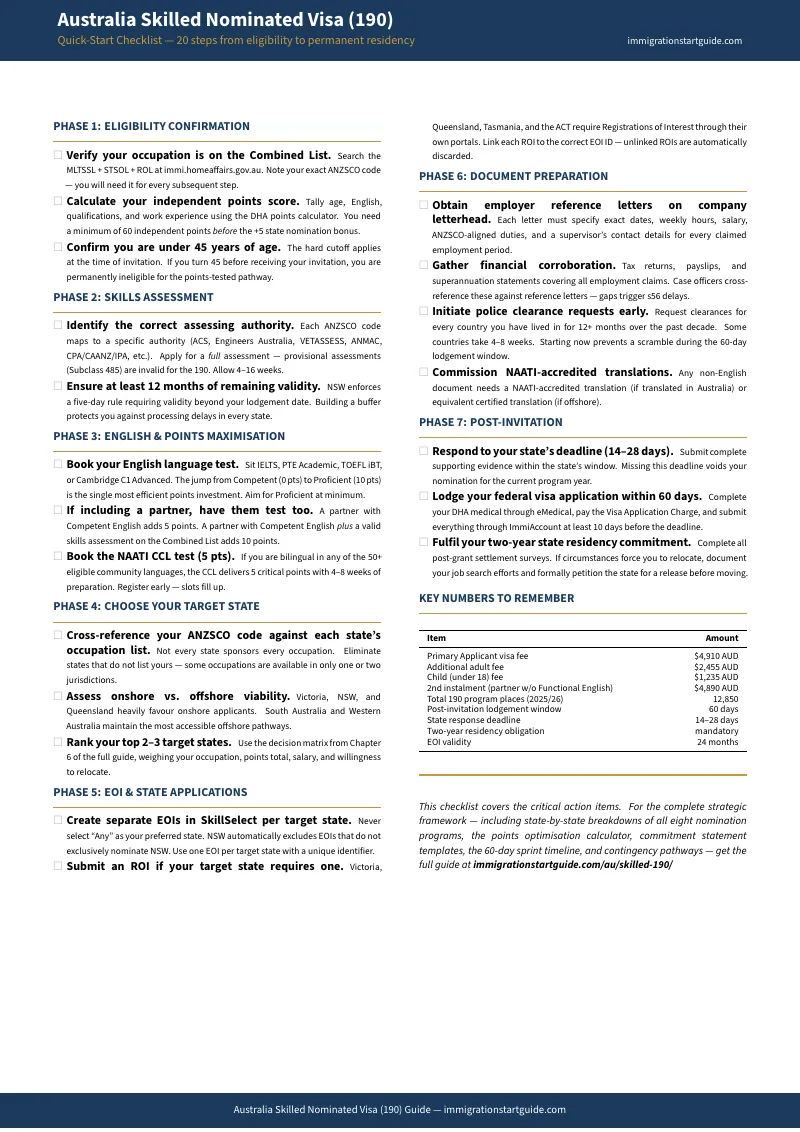
The complete kit includes the 13-chapter guide, the 20-step quick-start checklist, and 5 standalone printable tools — worksheets and reference cards you can print separately and use at your desk while working through the process.
The Eight-State Comparison Framework — the core strategic engine. Every jurisdiction analysed on the same axes: 2025-26 quotas, selection mechanisms, occupation lists, residency mandates, employment requirements, processing timelines, and hidden barriers. Not eight separate summaries stitched together — a genuine comparative matrix that shows you which states actually nominate your ANZSCO code, which ones favour your profile type, and which ones will waste your time. Victoria received 2,700 places but operates an invitation-only ROI system that systematically filters for healthcare and advanced manufacturing. Queensland received 1,850 places — a 208% increase — but enforces ongoing local employment. South Australia cut to 1,350 places but publishes 460+ occupations with dedicated offshore pathways. The guide shows you the real competitive landscape behind the headline numbers.
The State Decision Matrix — a structured analytical tool in Chapter 6. You feed in your occupation code, your independent points total, your onshore/offshore status, your work experience, and your willingness to relocate. The matrix ranks your viable states by probability of nomination and maps the tradeoffs between quota availability, selection competitiveness, and lifestyle commitment. Stop guessing. Start calculating.
The Points Test Breakdown — the federal points test decoded in full. Age brackets, English proficiency tiers, Australian versus overseas qualifications, work experience calculations, and the supplementary points levers (NAATI CCL, Professional Year, regional study, partner skills). The +5 state nomination bonus is automatic upon selection — but you need a minimum of 60 independent points to be eligible. The guide shows you every lever and its interaction effects so you submit your EOI at maximum strength.
The Skills Assessment Navigator — your assessment is the foundation. The wrong authority, a provisional assessment, or an expired validity date can disqualify you before your EOI reaches any state's inbox. The guide covers all five major assessing bodies:
- ACS (ICT) — the work experience deduction trap, claimable years versus total years, and the critical difference between a provisional 485 assessment and a full 190-eligible assessment
- Engineers Australia — CDR structure, the Summary Statement mapping, plagiarism detection, and the Fast Track processing option
- VETASSESS — reference letter specificity mandates, statutory declaration alternatives, and the qualification relevance assessment
- ANMAC — nursing and midwifery pathways, the modified assessment process, and the English test alternatives
- CPA / CAANZ / IPA — accounting assessment, the membership requirement, and how Professional Year interacts with onshore graduate streams
The SkillSelect & ROI Playbook — how EOIs and ROIs interact with state nomination systems. The multiple-EOI strategy for targeting several states simultaneously. The fatal "Any state" mistake that automatically excludes you from NSW. How Victoria, Queensland, Tasmania, and the ACT require separate ROIs through their own portals — and the linking error that gets your ROI discarded. Date of Effect mechanics and when updating your EOI helps versus when it destroys your queue position.
The 60-Day Federal Sprint — once your state nominates you, the Department issues an automatic invitation. You have exactly 60 days to lodge a complete federal visa application. The guide provides the front-loading protocol: commissioning NAATI translations, scheduling eMedical health exams, requesting international police clearances, assembling the employment evidence triangulation (reference letters + payslips + tax returns + superannuation), and submitting everything through ImmiAccount with a 10-day buffer.
The Section 56 Defence Protocol — processing times run 6 to 14 months after lodgement. The Department regularly requests additional information via s56 notices, targeting re-medicals (health clearances expire after 12 months), lapsed police certificates, and rigorous employment verification. The guide shows you how to front-load your evidence portfolio so the s56 never arrives — and exactly how to respond if it does.
The Two-Year Commitment Decoder — the most anxiety-inducing topic on every migration forum. What the two-year state residency obligation actually means legally, when states enforce it, what happens if you lose your job and need to relocate, how to formally petition for a release, and the real consequences of non-compliance. The short version: permanent residency cannot be cancelled for interstate movement under current constitutional law, but acting in bad faith can jeopardise citizenship. The guide gives you the nuanced reality, not the forum panic.
The Complete Fee Architecture — every cost mapped with no surprises. The $4,910 primary applicant visa charge. $2,455 per adult dependent. State nomination fees ($300-$330). Skills assessment fees ($500-$1,500). English test costs ($350-$415). Health exams ($300-$500). Police clearances. NAATI translations. The second instalment charge for dependents without functional English. Budget your total investment before you commit a dollar.
Standalone Printable Tools — five ready-to-print worksheets and reference cards extracted from the guide, designed to sit next to your laptop while you work through the process:
- Federal Points Test — Quick Reference — every points table on one page: age brackets, English proficiency (IELTS and PTE), overseas and Australian work experience, qualifications, and additional points levers. Pin it to your wall and calculate your score in two minutes.
- Eight-State Comparison Matrix — all eight nomination programs decoded side-by-side on two landscape pages: 2025-26 allocations, selection mechanisms, onshore/offshore priority, key requirements, and a quick decision guide matching your profile type to optimal states.
- State Decision Worksheet — fillable two-page worksheet where you map your occupation code, points, and circumstances against each state. Includes the eligibility check table, viable state ranking, multi-state EOI strategy planner, and a final decision box.
- 60-Day Federal Application Sprint — the post-nomination action checklist broken into six timed phases (Days 1-50 plus a 10-day buffer). Every task — translations, police clearances, medical exams, employment evidence, ImmiAccount upload — in printable checkbox format with your deadline date filled in.
- 190 Visa Fee Calculator — fillable budget planner covering every cost: government fees, skills assessments, English tests, medical exams, police clearances, translations, and optional agent fees. Subtotals per category and a grand total at the bottom.
Who This Guide Is For
- You scored 65-80 points and discovered the 189 is closed to you. Your occupation is Tier 3 or Tier 4 for the Skilled Independent pathway, and the 190's +5 point bonus plus a state willing to nominate your ANZSCO code is the only realistic route to permanent residency. You need to know which state gives you the highest probability of nomination — not the highest headline quota.
- You are on a 485 or 482 temporary visa and it is expiring. You have built a life in Australia — employment, community, maybe a partner. The clock is running. You need to identify the fastest viable state nomination pathway and submit before your visa expires. Relocating interstate is on the table if the numbers justify it.
- You are offshore and cannot tell which states sponsor overseas applicants. Most states heavily favour onshore candidates. South Australia and Western Australia maintain the most accessible offshore streams. The guide identifies which states actively invite overseas workers and what the specific employment and experience caveats are for your occupation.
- Your occupation was dropped from the 189 pathway. The shift from ANZSCO to OSCA and the introduction of the Core Skills Occupation List has reshuffled eligibility. Your profession may still be available on individual state lists under the STSOL. The guide maps occupation eligibility across all eight jurisdictions.
- You are paralysed by eight different state programs. Victoria's ROI. ACT's Canberra Matrix. Tasmania's Gold Pass. NSW's opaque cutoffs. You have read dozens of Reddit threads and every one gives different advice. You need a structured, comparative analysis — not anecdotes from people who applied under last year's rules.
- You are weighing $3,000-$6,000 for a migration agent. You want to understand exactly what the state nomination process involves — so you can either self-manage the application or hire an agent as an informed client who knows which state to target and what outcome to demand.
This guide does not replace a migration agent for cases involving character concerns, health waivers, or prior visa refusals. It gives you the strategic state-selection intelligence that the Department does not consolidate and agents are not incentivised to deliver.
Why Not Free Resources?
- The Department of Home Affairs publishes every rule — but on eight different government websites. The Live in Melbourne portal explains Victoria's ROI perfectly. It says nothing about how Victoria compares to Queensland's 208% quota increase or South Australia's 460 offshore occupations. The system is siloed by design. No government entity publishes the comparative analysis that actually determines your optimal state.
- Reddit and forums (r/AusVisa, ExpatForum) provide emotional support and anecdotal processing timelines. They also spread outdated advice from previous program years, survivorship bias from applicants who succeeded under different quota conditions, and panic-inducing speculation about invitation rounds. The poster who says "just apply to Tasmania, it's the easiest" applied under a 2,100-place allocation that has since been cut to 1,200.
- YouTube channels (VisaEnvoy, AMEC, KBA Global) publish excellent visa update videos. They explain what changed — not which state to target given your specific occupation, points, and personal circumstances. They describe the landscape. They do not provide the decision framework.
- Migration agents quote $3,000 to $6,000 AUD for nomination coordination and visa lodgement. They handle compliance. They rarely deliver the comparative strategic layer — whether Queensland's quota surge makes it a better target than Victoria despite its stricter employment caveats, or whether the ACT's Canberra Matrix rewards your profile more highly than Western Australia's General Stream, or whether South Australia's offshore pathway is viable for your specific ANZSCO code.
This guide fills the strategy gap — the space between "I qualify for state nomination" and "I know exactly which state to target and why."
— Less Than One Migration Agent Consultation
A single consultation with a MARA-registered migration agent costs $150 to $400 AUD. Full-service 190 application management runs $3,000 to $6,000 AUD. And the applicant still does the actual work — passing the English test, completing the skills assessment, gathering employment evidence, coordinating police clearances, and the hardest part: choosing which state to commit to.
Your total Subclass 190 visa costs will exceed $8,000 AUD for a single applicant. For a couple, mandatory government fees alone surpass $12,000 AUD. This guide represents a fraction of that commitment — and it is the piece that determines whether you target the right state on your first attempt or waste months pursuing a nomination that your profile was never competitive for.
Money-back guarantee, no time limit. If the State Selection System does not sharpen your strategy, you pay nothing.
Download the free Quick-Start Checklist to see the 20-step action plan and identify your top target states tonight. When you are ready for the complete State Selection System — the 13-chapter guide and the 20-step checklist — the full kit is here.
The Department publishes the rules. The states guard the strategy. This guide gives it to you.