
Your Employer Said They'd "Handle the Sponsorship." You Have No Idea What That Means.
Your boss agreed to sponsor you three weeks ago. HR sent you a form to fill out. That's the last you heard. Nobody told you the company needs to run job advertisements for 28 consecutive days on two national platforms before they can even lodge the nomination. Nobody mentioned that if they post the ad for 27 days instead of 28, the nomination is refused and the $1,200-$1,800 SAF levy your employer paid is gone — non-refundable. Nobody explained that the salary they offered you needs to clear both the Core Skills Income Threshold ($76,515) and the Annual Market Salary Rate for your occupation in your location — and that if the market rate is lower than the threshold, the position is effectively ineligible for sponsorship.
You won't discover any of this until you get the refusal letter. By then your current visa has six weeks left, the employer has lost thousands in fees, and the HR manager who was "handling it" is Googling "482 visa refused what now" for the first time.
Or maybe you're the employer. You've never sponsored before. You found someone brilliant, they need a visa, and the Department of Home Affairs portal is a labyrinth of 40+ sub-pages, legislative instruments, and links to other government agencies. You know the Skilling Australians Fund levy exists but not whether you pay $1,200 or $1,800 per year. You know Labour Market Testing is required but not that the ad must include your company name, a salary range, and specific duty descriptions — or that using Gumtree instead of SEEK gets the whole thing thrown out. You know it's illegal to recover certain costs from the worker, but not which costs — and the penalty for getting it wrong is up to $396,000.
The Australia TSS 482 Visa Guide is a Compliance Bridge System. It covers both sides of the sponsorship equation — worker and employer — in a single document, with the LMT compliance calendars, AMSR calculation methodology, skills assessment logic, and fee recovery rules that no free resource, forum thread, or $15 Amazon ebook provides. It replaces the $5,000-$8,000 migration agent with a verified, step-by-step framework that prevents the specific technical errors causing 482 refusals.
What's Inside the Compliance Bridge System
15 chapters plus printable compliance tools covering every stage from employer sponsorship approval through permanent residency transition, plus a free quick-start checklist:
Labour Market Testing Compliance Calendar (Chapter 7)
LMT is the "administrative guillotine" of the 482 visa — a single day's error in the 28-day window or the omission of your company name from an ad leads to an unappealable refusal. This chapter provides the complete compliance framework: which platforms qualify (SEEK, Indeed, LinkedIn — not Gumtree, not Facebook), mandatory wording requirements, salary disclosure rules for roles under $96,400, and the 4-month lookback window that determines when your ads expire. Print the calendar, pin it to the wall, and track every deadline. Because the SAF levy you lose on a failed nomination — $4,800 to $7,200 for a 4-year visa — doesn't come back.
AMSR Calculation Methodology (Chapter 8)
The Annual Market Salary Rate is the most common reason for salary-related nomination refusals. You must pay the higher of the CSIT ($76,515) or the market rate for the same role in the same location. But what if you have no Australian employees in that role? No free resource explains how an SME with no comparables proves the AMSR using Hays Salary Guides, Glassdoor data, or union advice in a format the Department will accept. This chapter does — with the exact evidence structure, source requirements, and worked examples that prevent refusals for salary "not genuine" or "inflated to meet the visa rule."
Skills Assessment Logic by Occupation (Chapter 6)
For IT professionals, the ACS "deduction" system is the golden ticket — and the most misunderstood step. ACS deducts 2 to 6 years of experience depending on the relevance of your degree, and your "Date Deemed Skilled" determines when your claimable experience begins. Claim 10 years when ACS recognizes only 6, and your visa is refused for overclaiming. For tradespeople, TRA requires reference letters written in ANZSCO-specific language — generic duty descriptions fail. This chapter maps the deduction logic for ACS, VETASSESS, Engineers Australia, TRA, and ANMAC, with reference letter templates that mirror the exact keywords assessing bodies look for.
Three-Stream Selection Framework (Chapter 2)
The Skills in Demand visa operates three streams — Specialist Skills (salary above $141,210, 7-day processing), Core Skills (CSOL-listed occupations, $76,515 floor), and Essential Skills (Labour Agreement pathways for aged care, disability, meat processing). Choosing the wrong stream wastes months. This chapter maps your occupation and salary to the correct stream, explains the CSOL and occupation caveats (turnover requirements, business size minimums, regional restrictions) that cause refusals for otherwise qualified applicants, and shows which streams lead to permanent residency and under what conditions.
Occupation Caveats and Hidden Restrictions (Chapter 3)
Over 50 occupations on the CSOL carry caveats — restrictions that are not visible on the main DHA landing page. A restaurant manager needs an employer with $1M+ turnover. A project administrator needs a mandatory skills assessment regardless of nationality. A chef can only be sponsored in certain regions. These caveats cause immediate nomination refusal when the business profile doesn't match. The appendix provides the complete caveat lookup with strategic workarounds for each restriction type.
Fee Recovery Rules and Employer Obligations (Chapter 9)
Australian migration law prohibits employers from recovering the SAF levy, nomination fee, or Standard Business Sponsorship fee from the worker. Forum data shows many employers attempt to "deduct" these costs from salary anyway. The penalty: up to $396,000 per breach, cancellation of the business's sponsorship licence, and potential "modern slavery" investigations. This chapter maps exactly which costs the employer must bear ($420 SBS + $330 nomination + SAF levy), which costs the worker can pay (the $3,210 visa application charge), and the documentation that protects both parties from compliance breaches.
Permanent Residency Roadmap — 186 TRT Pathway (Chapter 11)
The 2024-2026 reforms reduced the PR qualifying period from three years to two and made all streams eligible — the most significant change in a decade. But the clock only counts work performed while your employer held a valid Standard Business Sponsorship. Change employers and your experience is portable — but only within the same nominated occupation and only if both sponsors were approved. This chapter covers the two-year timeline, the age-45 cutoff and its exemptions, the higher English requirement for PR (IELTS 6.0 per band), and the exact sequence from 482 to 186 TRT to permanent resident.
English Language Standards and Exemption Matrix (Chapter 3)
Competent English for the 482 visa (IELTS 5.0) is lower than many expect, but the exemptions are where applicants waste money on unnecessary tests. Citizens of the UK, US, Canada, NZ, and Ireland are exempt. Five years of English-medium education qualifies. Specialist Skills stream applicants earning above $141,210 have additional exemptions. And if your partner cannot demonstrate Functional English (IELTS 4.5), you owe a $4,890 second instalment charge before the visa can be granted. This chapter maps every exemption and every trap.
LMT Exemptions Under Trade Agreements (Chapter 7)
Citizens of CPTPP countries (Canada, Chile, Japan, Malaysia, Mexico, Peru, Singapore, Vietnam), AANZFTA/ASEAN nations, UK (under AUKFTA), China (ChAFTA), and South Korea (KAFTA) may be exempt from Labour Market Testing entirely — saving the employer four weeks of advertising and removing the most common refusal risk. Most applicants do not know these exemptions exist. This appendix provides the complete country-by-agreement mapping and the conditions that must be met to invoke each exemption.
Complete 2026 Fee Architecture (Chapter 9 appendix)
Every government fee mapped: SBS application ($420), nomination ($330), SAF levy ($1,200-$1,800/year), primary applicant VAC ($3,210), adult dependent VAC ($3,210), child dependent VAC ($805), onshore surcharge ($700), skills assessment ($300-$1,260 depending on authority), health examinations, police clearances, and the $4,890 second instalment for dependants without Functional English. Total project cost for a family of three: $18,575-$20,575. Know exactly what you're committing to before you start.
Regional Migration Pathways — DAMA and Subclass 494 (Chapter 14)
If your occupation is not on the CSOL or your salary falls below the CSIT, Designated Area Migration Agreements may offer an alternative pathway. Active 2026 DAMA regions — Northern Territory, Western Australia, South Australia, Far North Queensland — allow concessions to age limits (up to 50-55 for PR), English scores, and salary floors (up to 10% below CSIT). This chapter covers DAMA eligibility, the two-tier agreement structure, and the Subclass 494 regional pathway that leads to permanent residency after three years.
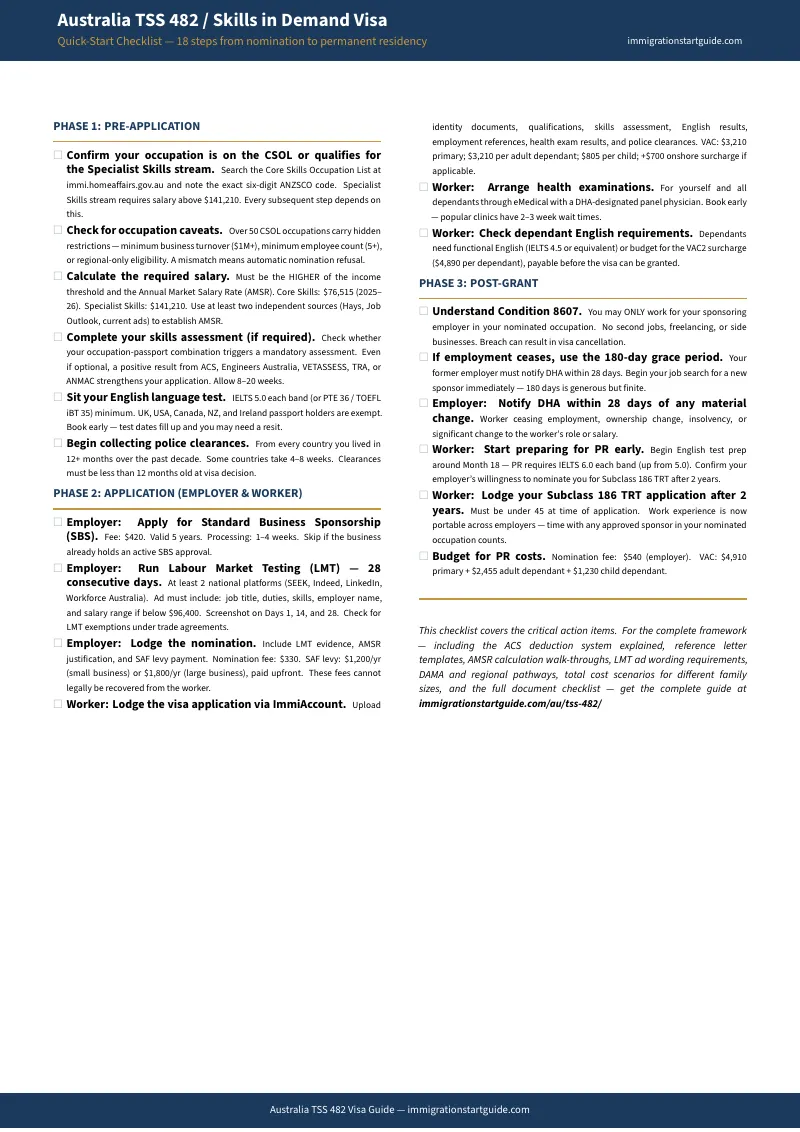
Quick-Start Checklist (free download)
The critical decision points distilled into a single action sheet: confirm your occupation is on the CSOL, determine your stream, verify salary against both CSIT and AMSR, check for occupation caveats, and confirm your employer's SBS status. Enough to take your first strategic step tonight.
Standalone Printable Tools
Print-ready reference cards and checklists for HR meetings, agent consultations, and filing sessions: LMT Compliance Calendar (28-day tracker with platform and wording requirements), AMSR Evidence Worksheet (salary benchmarking template with source documentation), Employer Sponsorship Cost Calculator (all fees mapped by business size and visa duration), Worker Document Checklist (identity, qualifications, English, health, character), and Occupation Caveat Quick Reference (restriction types and workarounds). Each is a standalone one-page PDF — no need to flip through the full guide when you're sitting across from your HR manager.
Who This Guide Is For
This guide is for skilled workers being sponsored by Australian employers and SME employers navigating sponsorship for the first time:
- You've secured a job offer from an Australian employer who agreed to sponsor you, but neither of you has done this before — the guide gives both sides the exact compliance framework to avoid the errors that cause refusals and cost thousands in non-refundable fees
- You're an Indian IT professional whose ACS skills assessment deducted 4 years of experience and you need to understand what "Date Deemed Skilled" means for your visa application, your PR timeline, and your EOI points
- You're an HR manager who has never sponsored a 482 visa and your CEO just told you to "sort it out" — you need a step-by-step framework, not 40 pages of legislative instruments
- You're an onshore graduate on a 485 visa with months left before it expires, and you need to understand the exact sequence from employer offer to nomination lodgement to visa grant before the clock runs out
- You're a tradesperson from the UK or EU who needs a TRA skills assessment and doesn't know which reference letter format will pass or which ANZSCO keywords to use in your duty descriptions
- You want to know your pathway to permanent residency — how the two-year qualifying period works, whether changing employers resets the clock, and what English score you need for the 186 TRT transition
Why Not Free Resources?
Free information on the 482 visa is abundant. Here's what it actually delivers:
- The Department of Home Affairs portal provides the statutory requirements across 40+ sub-pages — dense, bureaucratic, and deliberately silent on strategy. You'll learn that Labour Market Testing is required. You won't learn which platforms are accepted, what wording the ads must contain, or what happens when your 28-day window is one day short.
- Migration agent blogs (Edvise Hub, Work Visa Lawyers, Migration Dreamz) publish detailed analyses of the SID reforms — because their business model is to demonstrate overwhelming complexity and then offer a $5,000 retainer to resolve it. They explain why AMSR calculation matters. They never provide the evidence templates that prove your salary to the Department.
- Reddit and OzBargain forums are repositories of anecdotal data from anonymous users whose occupation, nationality, salary, and individual case facts you don't know. A strategy that worked for a UK tradesperson in the Northern Territory DAMA is irrelevant for an Indian IT professional applying for Core Skills in Sydney. You're building a career-defining application on survivorship bias from strangers.
- ACS and VETASSESS guides are 50+ page PDFs using terms like "Major ICT content" and "closely related field" without explaining how those classifications affect how many years of experience get deducted from your record — the single factor that determines whether you meet the work experience requirement.
This guide fills the compliance gap. It doesn't compete with free information — it translates 40+ pages of legislative instruments into an actionable playbook that both the worker and the employer can execute. It provides the LMT calendars, AMSR worksheets, and skills assessment logic that migration agents charge $5,000-$8,000 to apply, at a fraction of the cost.
— Less Than One Hour of Migration Agent Billable Time
A registered migration agent charges $3,000 to $8,000 for end-to-end 482 representation. DIY checking services start at $1,000. A single failed nomination costs $1,500+ in non-refundable government fees — the SAF levy alone is $4,800-$7,200 for a four-year visa. The total project cost for sponsoring a family of three approaches $20,000.
The guide doesn't replace an agent for complex legal appeals or tribunal matters. But it gives you the compliance frameworks and evidence templates that prevent the LMT errors, salary miscalculations, and occupation caveat mismatches that cause refusals — the ones that cost thousands in lost fees and months of restarting the process. If you're DIY-ing, it's your complete blueprint. If you're hiring an agent, it transforms you from a confused client into a prepared partner who cuts billable hours and catches mistakes before they become refusals.
Money-back guarantee, no time limit. If the compliance frameworks don't make your application stronger, you pay nothing.
Download the free Quick-Start Checklist to see the critical decision points. When you're ready for the LMT compliance calendar, AMSR calculation methodology, and the complete Compliance Bridge System, the full guide is here.
One LMT error costs more than the guide. Get it right the first time.